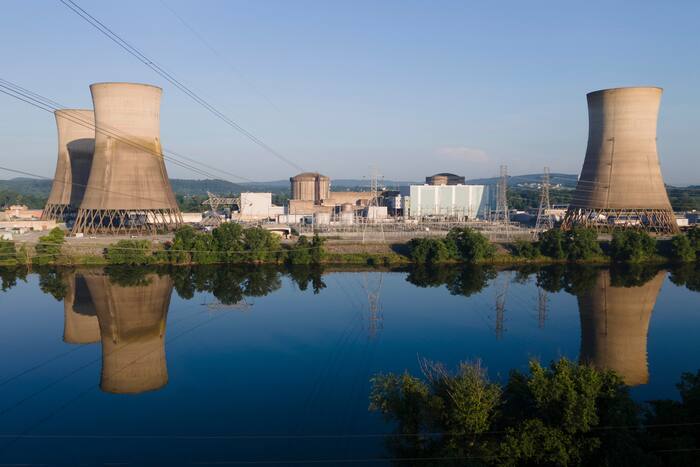


The United States is undertaking an unprecedented effort to bring three shuttered nuclear power plants back online as electricity demand surges, driven in part by the rapid expansion of large-scale data centers.
No commercial nuclear reactor is known to have resumed electricity generation after entering the formal decommissioning process, which removes a plant from service. However, some reactors have returned to operation following lengthy shutdowns.
The Department of Energy is providing up to $4.4 billion in loans to restart Michigan’s Palisades Power Plant, Pennsylvania’s Crane Clean Energy Center at Three Mile Island and Iowa’s Duane Arnold Energy Center. Together, the facilities could restore 2.25 gigawatts of generating capacity—enough electricity to power about 2 million homes and businesses. All three plants closed before their operating licenses expired, largely because their electricity was considered too costly.
That calculation has changed. Two of the plants have signed agreements with major technology companies willing to pay a premium for large supplies of carbon-free power for data centers. The Trump administration is also aggressively promoting nuclear energy to support artificial intelligence and manufacturing, while directing billions of dollars toward upgrades at existing nuclear plants to increase their output.
Restarting an existing reactor can deliver substantial electricity relatively quickly and at a lower cost than building a new large reactor, said Todd Allen, a nuclear engineering expert.
“There’s a demand in the country for more power,” Allen said. “You have these assets that were previously hooked up. They were previously operable, and you can relatively quickly get them generating electricity again, compared to your other possibilities. For anyone who wants zero carbon, nuclear provides that. For the Trump administration, which really wants nuclear, this fits that story also.”
Restarting a reactor is similar to restoring a car
Allen likened the effort to restarting a car that has sat unused for several years. The driver still needs a valid license, and every component must be checked to ensure it works properly.
“That’s what they’re trying to do with these nuclear plants, but it’s a much bigger, complicated system,” said Allen, associate dean for research at the University of Michigan’s College of Engineering.
For a nuclear facility, that means bringing back workers and confirming that their training is current, testing equipment, completing overdue maintenance, securing an adequate fuel supply and asking regulators to reinstate the plant’s operating license, Allen said.
It is a long list of requirements, he said, but one that is relatively straightforward to manage.
Expert warns that reactor restarts carry risks
Edwin Lyman of the Union of Concerned Scientists said taxpayer funds should be used to address potential safety problems. Most U.S. nuclear plants were built between 1970 and 1990 and designed to withstand the natural disasters understood at that time, said Lyman, director of nuclear power safety at UCS. Climate change, however, is increasing the frequency and intensity of extreme weather events.
“It’s possible, if they set the right level of safety and spend the necessary funds to meet that, they could restore these plants to operable condition,” he said. “That’s not happening at this point.”
Iowa’s only nuclear plant, Duane Arnold, began operating in 1975 and was scheduled to close permanently in October 2020. Replacing it with lower-cost energy sources, including wind power, was expected to save Iowa customers $300 million in energy costs. Instead, the plant shut down early, in August 2020, after sustaining damage from a powerful storm known as a derecho.
NextEra Energy owns Duane Arnold. After assessing the facility’s condition, CEO John Ketchum said company officials “felt really good about the ability to bring it back.”
Palisades is the furthest along in the restart effort
Palisades operated from 1971 until 2022, when its owner, Entergy, exited the nuclear power business. The plant’s operating license was set to remain valid through 2031.
Holtec International purchased the facility and began dismantling it, although none of the work had reached an irreversible stage. Michigan officials, seeking to preserve nuclear industry jobs and electricity generation, urged Holtec to pursue a restart and provided state funding. In 2024, the Biden administration approved a $1.5 billion loan for the project, and the Trump administration continued making payments.
In August, Holtec began loading nuclear fuel, one of the final major steps before a reactor can return to service. The company paused the work after a fuel assembly tilted from its upright position and officials determined they needed to identify the cause. Under its power purchase agreements, Palisades must be operating by March 2027.
Holtec says its efforts will restore baseload power, strengthen energy security and demonstrate the role of nuclear energy in meeting the nation’s growing electricity demands.
Big Tech will purchase power for data centers
NextEra Energy and Google are collaborating to restart Duane Arnold by early 2029.
“This is a perfect example of data centers paying their own way,” Ketchum said in an interview. “We’re able to sign a long-term contract with a hyperscaler for that project. So none of the costs are being paid by residential customers in Iowa.”
Microsoft has a contract with the Crane Clean Energy Center on Three Mile Island just outside Harrisburg. The plant was the site of the nation’s worst commercial nuclear power accident in 1979. The accident destroyed one reactor, leaving the plant with one functioning. In 2019, Constellation Energy’s then-parent company Exelon shut down the functioning reactor, saying it was losing money and that Pennsylvania lawmakers had refused to subsidize it.
Constellation Energy announced in 2024 that it would spend $1.6 billion to restart the reactor under a 20-year agreement with Microsoft. It hopes to bring the plant back online in 2027. The Energy Department provided a $1 billion loan, and Deputy Energy Secretary James Danly took a tour last week.
Jack Spencer at The Heritage Foundation said he can’t think of a worse use of taxpayer money than using it to restart reactors. These are low-risk projects where there is a massive demand for the energy, so there is no reason to funnel federal dollars to these companies, said Spencer, director of the foundation’s Center for Energy, Climate and Environment.
Conversely, Jennifer Gordon at the Atlantic Council said she thinks it’s a terrific way of leveraging federal financing to get needed electricity. Gordon directs the council’s Nuclear Energy Policy Initiative.
Industry group says reactors shouldn’t close early
The World Nuclear Association said restarting nuclear reactors should be celebrated, but preventing them from closing prematurely would be the best option.
Palisades is expected to be the first nuclear plant in the world to resume generating power after beginning the decommissioning process, but other countries have restarted or refurbished reactors after long-term shutdowns, the association said. That includes Canada, Armenia, Belgium, Japan, India and South Korea. Others are considering or in the process of restarting reactors.
___
Associated Press writer Sarah Rankin in Richmond, Virginia, contributed to this report.
___
The Associated Press’ climate and environmental coverage receives financial support from multiple private foundations. AP is solely responsible for all content. Find AP’s standards for working with philanthropies, a list of supporters and funded coverage areas at AP.org.


