

Paramount
RATING : 4 / 10
It was hardly unexpected that the new “Street Fighter” movie would borrow from the template established by the rival game adaptation “Mortal Kombat” in 2021. What is surprising is that it makes the same mistake of postponing the tournament audiences came to watch. “Mortal Kombat” withheld its major combat showcase until the stronger sequel released earlier this year. “Street Fighter,” meanwhile, reveals almost immediately that the World Warrior tournament is a setup designed to lure the world’s finest fighters into the orbit of dictator M. Bison (David Dastmalchian), who plans to siphon away their abilities. There is no champion and no satisfying conclusion. Instead, the film simply promises that the real showdown will arrive in a sequel—one that may never be made.
Zach Cregger’s excellent “Resident Evil” film, along with a run of successful television adaptations, has helped create the sense that video game movies may finally be entering a golden age. The best examples understand how to translate a game’s distinctive storytelling language to the screen. Against that backdrop, “Street Fighter” feels conspicuously dated—and not only because its version of 1993 leaves almost everyone dressed as though the mid-1980s never ended.
Rather than recreate the direct, character-driven rush of the original games, director Kitao Sakurai and screenwriter T.J. Fixman attempt to build an elaborate narrative around a property that was never especially plot-heavy. The added mythology and world-building do little more than obstruct the straightforward action the source material handled so effectively.
The worst kind of live-action cartoon
Paramount
The PG-13 rating further weakens the combat, leaving the film’s violence almost entirely blood-free. Sakurai tries to compensate with the broad physicality of a live-action cartoon, an understandable idea that proves painful in practice. A few visual gags work, but most collapse under clumsy staging and martial-arts sequences that lack either impact or momentum.
Callina Liang stars as Chun-Li, an undercover Interpol agent seeking revenge for the death of her father at Bison’s hands. She begins assembling fighters from around the world for the dictator’s tournament in Metrolao City, among them the estranged adopted brothers Ryu (Andrew Koji) and Ken Masters (Noah Centineo). Ryu has retired from fighting and travels to stop Ken from entering the competition, but Ken refuses to walk away from his chance to escape his brother’s shadow. Before long, he discovers the darker purpose behind the event—and the extent of Bison’s control.
The film’s world-building is as thin as expected from an adaptation based more on groundbreaking gameplay than storytelling. Beyond the tournament, Bison’s dystopian regime is barely defined. His cartoonishly authoritarian uniform seems designed to fill in the blanks the screenplay leaves untouched, making the resistance against his grand plan feel almost consequence-free. Even the supposedly realistic characters are broad caricatures. By insisting so relentlessly that nothing should be taken seriously, Fixman and Sakurai eventually make it difficult to care about anything at all.
There has been speculation that Skydance CEO David Ellison has pursued more right-leaning projects in an effort to reach a particular audience. Although “Street Fighter” was produced and filmed under Legendary, Ellison had no direct connection to this production. Still, the movie’s attempts to court a stereotypically male crowd are difficult to miss: jokes about Asian food feel stale, gay-panic punchlines repeatedly undercut its overt homoeroticism, and a steady stream of sexual gags mistakes vulgarity for wit.
At least the film is willing to sexualize its male characters as aggressively as its women, a mildly refreshing choice for a blockbuster aimed at that demographic. Even the hand-drawn animated passages linger on sculpted pectorals. But those moments feel less like genuine inclusivity than a diversion from the film’s broader habit of treating queerness—and sexuality outside conventional norms—as a punchline.
Lost in the ’90s
Paramount
The film does occasionally turn its joke toward straight male audiences. In one Michael Bay-style sequence, Chun-Li enters a shower as steam clouds the camera, only for the image to transition to a sumo wrestler relaxing in a sauna. Yet the gag depends on presumed fatphobia and heterosexual discomfort, making it feel like a relic from a less thoughtful era, long before body positivity became part of the mainstream conversation. That assumption also exposes how hollow the movie’s other gestures toward homoeroticism really are.
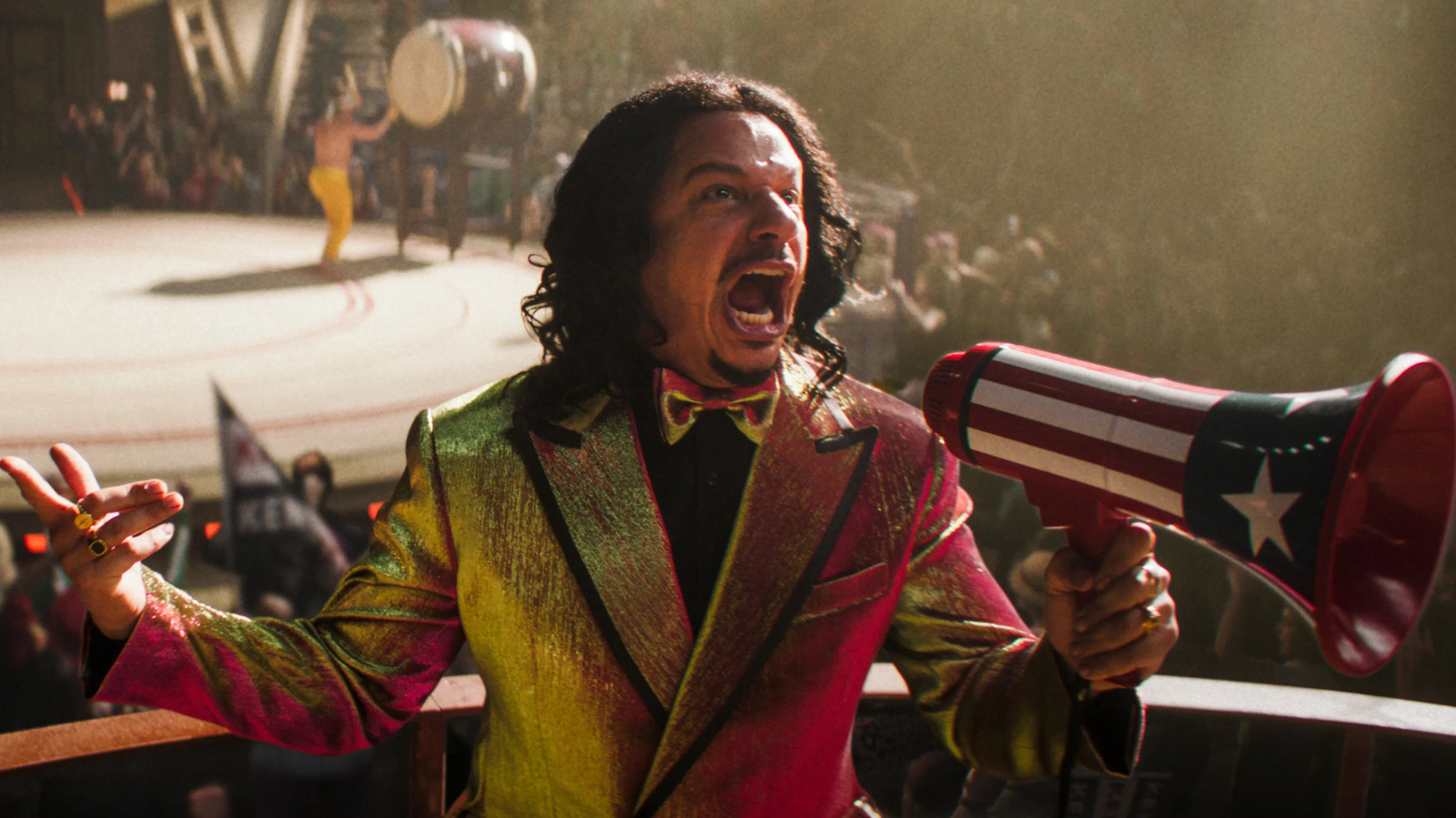
The consistently cartoonish tone may soften some of those shortcomings, but the cast rarely supplies the energy it demands. Even Eric Andre, usually a dependable agent of chaos, seems disengaged as tournament host Don Sauvage, whose introduction involves licking a boot. The editing ultimately shares that lack of conviction. Fights that already have little at stake are chopped apart by arbitrary cuts between locations, destroying any sense of rhythm. A sharper pace might have made the bloodless action easier to accept; instead, the movie’s wandering slapstick repeatedly misses its mark.
Ultimately, “Street Fighter” seems determined to court viewers who grew up with the franchise, yet it offers almost nothing capable of reviving their affection for the game. It is an odd strategy for a PG-13 blockbuster aimed at older millennials, particularly after the success of “Backrooms” and “Buddy” demonstrated Gen Z’s fascination with the final years before the internet reshaped daily life. The 21-year-old director of the latter even delivered a more convincing portrait of the 1990s despite being born in 2005.
The movie’s emotional throughline rests on Ryu’s affection for 4 Non-Blondes’ “What’s Up,” which he listens to before the 1987 tournament—even though the song was not released until 1993. That mistake captures the film’s larger problem: it pursues nostalgia through references that have no meaningful connection to the story. “Street Fighter” wants audiences to remember the cultural moment surrounding the franchise, but it never gives them a compelling reason to care about that world in the present.


