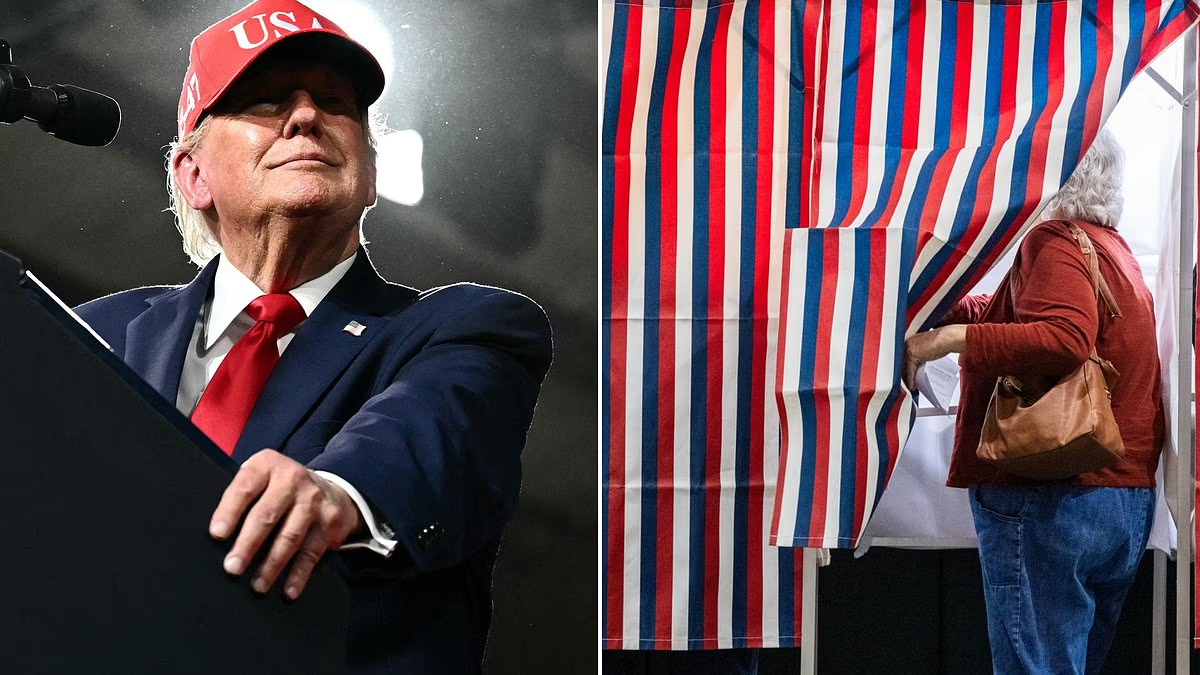

President Donald Trump traveled to Greenville, North Carolina, on Tuesday evening as he worked to energize Republican voters in the closing days of the November midterm campaign.
The North Carolina rally was one stop on a broader, multi-state push by Trump to help Republicans in the final stretch of the elections. His schedule has also included visits to South Carolina, Iowa, Florida, Georgia, Michigan and Texas.
Trump has delivered a familiar message at each appearance, asking supporters to vote as though his own name were on the ballot. He returned to that theme during Tuesday’s event in Greenville.
“Because when I’m on the ballot, we do unbelievably,” Trump told the crowd.
“Please pretend I’m on a ballot,” he added. “And in a way, I am on the ballot.”
Trump said he expected Republicans to perform strongly, adding, “I just feel it.”
The appearance marked Trump’s second visit to North Carolina in four weeks. He is campaigning to strengthen support for Republican Senate candidate Michael Whatley, the former chair of the Republican National Committee.
Two protesters were escorted out of the rally soon after Trump began speaking. Authorities did not immediately clarify what the demonstrators had said.
Trump also highlighted his electoral record in North Carolina, a state that has backed him in three presidential elections. “When I ran, it was great because we got 50 percent—almost 50 or some more votes—and we won everything,” he told supporters.
“We won the Senate,” Trump said while discussing the 2024 election. He added that, when he was not personally on the ballot, he had largely left campaigning to others, saying, “I figured that’s it. What did I know?”

President Donald Trump appears at a campaign rally at Pitt-Greenville Airport in Greenville, North Carolina

Michael Whatley, the former Republican National Committee chair and GOP candidate for the US Senate in North Carolina

Trump supporters await his remarks at a midterm campaign rally at Pitt-Greenville Airport in Greenville, North Carolina
Whatley is trailing Democratic nominee and former North Carolina Governor Roy Cooper in the contest to succeed outgoing Republican Senator Thom Tillis. Cooper’s stronger-than-anticipated lead has already led the top Republican super PAC and other GOP fundraising organizations to stop spending on advertising in the race.
Even so, Trump is betting that his high-profile visit can help Whatley as voters turn out at polling locations across the country.
North Carolina turnout is running 37 percent higher than it was at the same point during the 2022 midterms, while participation has also surpassed comparable levels from 2018.
Cooper has maintained a substantial advantage for much of the campaign. Recent polling has placed him more than 10 percentage points ahead of Whatley.
The Cooper campaign has also raised nearly three times as much money as Whatley’s operation, adding to the Democrat’s edge in a Senate race viewed as essential to Democratic hopes of reclaiming control of the chamber this fall.
A Cooper victory would carry added significance for Democrats, who have not captured a US Senate seat in North Carolina since 2008.
Trump has continued to use his political influence on Whatley’s behalf, building on the close working relationship the two developed during Trump’s 2024 reelection campaign.
Trump also said Tuesday night he was going to travel to the state a third time before Election Day to stump for Republicans – news that was met with audible cheers from his supporters.
‘We have like 15 days, and I’m doing about 18 rallies,’ Trump said of his multi-state campaign swing.
‘That’s work. But it’s not work in front of North Carolina,’ he told the crowd.


