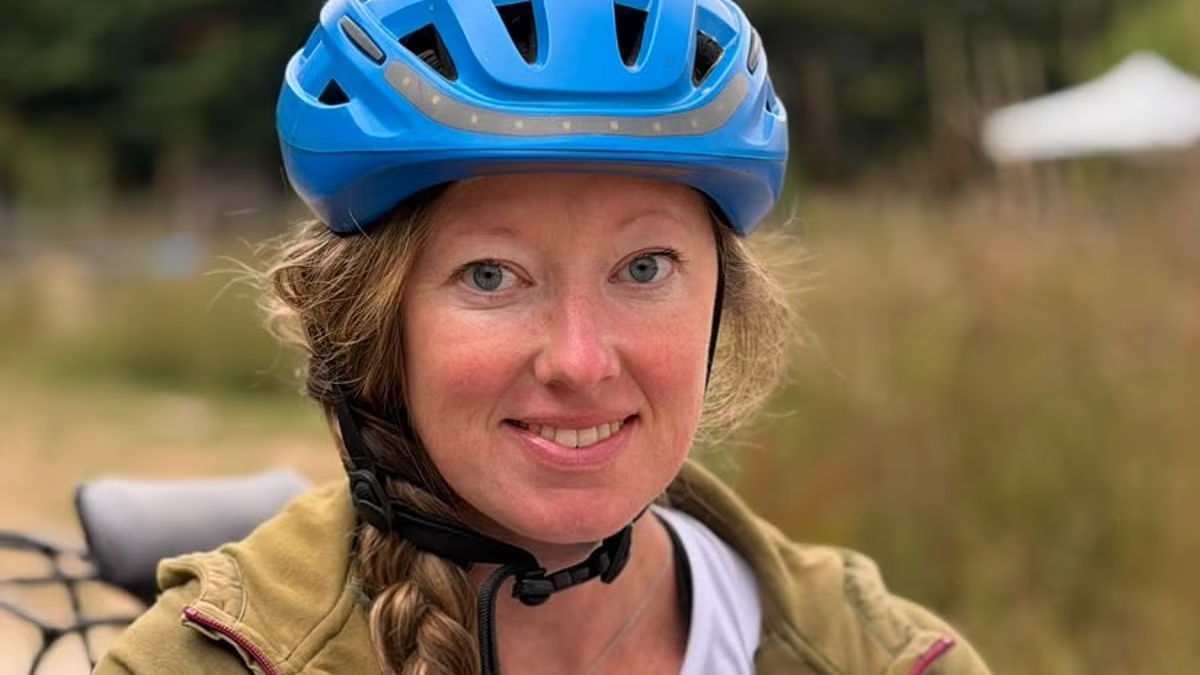

Emma Karembo Cornthwaite first discovered the diagnosis that would change her life through a letter pushed through her door on her 37th birthday.
An adventurous outdoor enthusiast, Emma had spent years leading expedition groups and travelling around the world before launching a camping business in Lincolnshire with her husband, Dave.
She was accustomed to carrying heavy bags and equipment, often over long distances.
That is why it was so unsettling when, six years earlier, her grip suddenly failed while she was leading a group of teenagers on a camping trip. The jerrycans in her hands tumbled noisily to the ground.
‘It was really scary,’ Emma says. ‘I had no control over my hand. I just watched it happen.’
Tired after the trip, Emma initially blamed the incident on exhaustion. Soon, however, she began dropping things and losing her grip with increasing frequency.
‘I was always a bit clumsy, but this was different – it was always my right hand, which was usually my more dominant one,’ she says.
Strange sensations also began interfering with her work as a massage therapist. During one appointment, as she pressed down on a client, she felt a tremor resembling an electric current travel from her hand up through her arm.
‘I was worried the client had felt it, but they hadn’t, and my arm didn’t move at all,’ she says.

Outdoorsy and adventurous, Emma Karembo Cornthwaite was used to long hikes and camping trips. So she was shocked when her grip suddenly slipped on the jerrycan she was carrying
‘At this point I knew something wasn’t right. But I still thought it may just be fatigue – or early menopause.’
Friends and family urged Emma to seek medical advice, and she eventually shared her concerns with her GP. After roughly two years of tests, she received the diagnosis: early-onset Parkinson’s disease.
‘It was devastating,’ she says – ‘particularly because I found out through a letter from my neurologist meant for my GP, which was delivered on my birthday. When my GP rang two days later asking me to sit down, I told her I already knew.’
‘I had no family history of it and didn’t even know anyone got it under the age of 60 – let alone under 40. It was a huge shock.’
More than 166,000 people in the UK live with Parkinson’s disease, a progressive neurological condition that most commonly develops between the ages of 50 and 65.
For about 11,000 people in Britain, symptoms begin earlier, between the ages of 25 and 49. This is known as young-onset Parkinson’s.
The condition appears to be becoming increasingly common among younger people. Research indicates that Parkinson’s rates in younger patients doubled between 1990 and 2021.
Experts have not established what is driving the rise in young-onset cases. Possible explanations include improved detection, stronger genetic links among younger patients and greater exposure to environmental toxins, including pesticides.

It took Emma more than two years to receive a Parkinson’s diagnosis, during which time her symptoms worsened
Parkinson’s develops when a misfolded protein builds up in the brain and destroys cells that produce dopamine. This chemical messenger helps control movement and plays a role in the brain’s reward and motivation systems.
Without adequate dopamine, movement can become slow and jerky and mood and energy fall too.
The best-known symptom of the condition is stiffness and tremor – a rhythmic shaking of the hand, arm or foot that occurs when the limb is relaxed or at rest.
But experts say there are more than 40 different warning signs of Parkinson’s – including apathy, anxiety and depression, sleep problems, falls, dizziness, constipation and loss of sense of smell.
Younger patients are more likely to develop a different – and lesser-known – set of symptoms than older ones, says Dr Alastair Noyce, consultant neurologist at Barts Health NHS Trust and professor of neurology at Queen Mary University London.
‘Early-onset patients tend to see more motor symptoms – things like clumsiness in one hand, dragging one leg or slowing down – than older patients,’ he says.
‘This can begin subtly, such as difficulty doing up buttons, shoelaces or zips, or trouble when preparing food, and become worse over time.
‘They’re also much more likely to develop a symptom called dystonia – a twisting or cramping sensation in the affected side, often appearing as pain in the foot.’

Symptoms of Parkinson’s include uncontrollable tremors, slow movements and muscle stiffness
More than 60 per cent of young-onset Parkinson’s patients experience dystonia, studies have found – roughly double that of the general Parkinson’s population.
It’s also often the very first sign of the condition – appearing years before classic symptoms such as tremor or rigidity, the medical term for sudden stiffness and locking of the muscles – and can appear as innocuous as the toes involuntarily curling during exercise, or in the morning, say experts.
In general, symptoms also develop more slowly in younger patients than older ones, research shows – taking much longer to become visible.
As a result, says Professor Noyce, young-onset patients tend to wait much longer for a diagnosis than older ones, as doctors don’t often think about Parkinson’s when someone presents with symptoms.
This was certainly the case for Emma.
While her grip weakness and occasional muscle spasms began years before, it wasn’t until during the pandemic that other, more visible symptoms began to develop.
When Emma and her husband began socialising again after lockdown, her friends and family were shocked and concerned by the change in her gait. Emma had also begun to have trouble finding the right words when she was tired – and occasionally misplaced the milk in the cupboard, or put used teabags in the fridge.
‘My friends encouraged me to go to my GP, who at first told me I had functional neurological disorder (FND) – a condition where the brain struggles to send and receive signals properly,’ she says.

Emma is cycling from Lincolnshire to the south of France to raise money for Parkinson’s UK
‘It wasn’t until I was on the phone with a specialist, however, that they told me I didn’t have FND, and sent me back to my GP.’
Thus began a two-year journey of endless fruitless tests and scans. Finally, three years ago, Emma was evaluated for Parkinson’s by a neurologist – the last test, she says, because doctors assumed it was the least likely outcome.
The diagnosis, she explains, was both upsetting and, in some ways, a relief.
‘I finally knew what was happening to me, and how to tackle it,’ she says.
Today, after starting treatment for Parkinson’s, many of Emma’s symptoms have vastly improved.
‘There was a time when I struggled to even write my name – now I can write, and paint, again,’ she says.
Emma was started on levodopa – a synthetic dopamine replacement therapy and one of the two main drug treatments for Parkinson’s.
The medication isn’t a cure, but it can significantly reduce symptoms, research shows, by replacing dopamine stores in the affected areas of the brain.
Younger patients are also sometimes prescribed a different class of drugs called dopamine agonists, such as pramipexole, ropinirole and rotigotine, which are taken once daily and longer acting.
But a new line of promising Parkinson’s treatments may hold particular hope for young-onset patients, says Becky Jones, research communications lead at Parkinson’s UK.
‘Because early-onset Parkinson’s patients take drugs for a much longer time period, they’re more likely to experience side effects from the medications – such as problems with their muscles, nausea and fatigue,’ she says.
‘But exciting news over the last couple of weeks has been the development of dopamine replacement drugs that work in slightly different ways from currently-available treatments – avoiding many of the current side effects.
‘Parkinson’s UK will be campaigning hard to make sure these are available to patients in the UK as soon as possible.’
In the meantime, Emma is doing as much as she can, while she still can.
To raise money for Parkinson’s UK, which provided essential support after her diagnosis, she’s currently cycling on a recumbent tricycle from her home in Lincolnshire to her father’s house in the south of France – a journey of roughly 1,200 miles.
Her advice for others worried about or facing a potential Parkinson’s diagnosis?
‘Just keep pushing. You know your body and if something’s not right, don’t give up trying to find out what that is,’ she says.
To follow more of Emma’s journey, visit her Instagram here or donate to her Parkinson’s UK fundraiser here.


