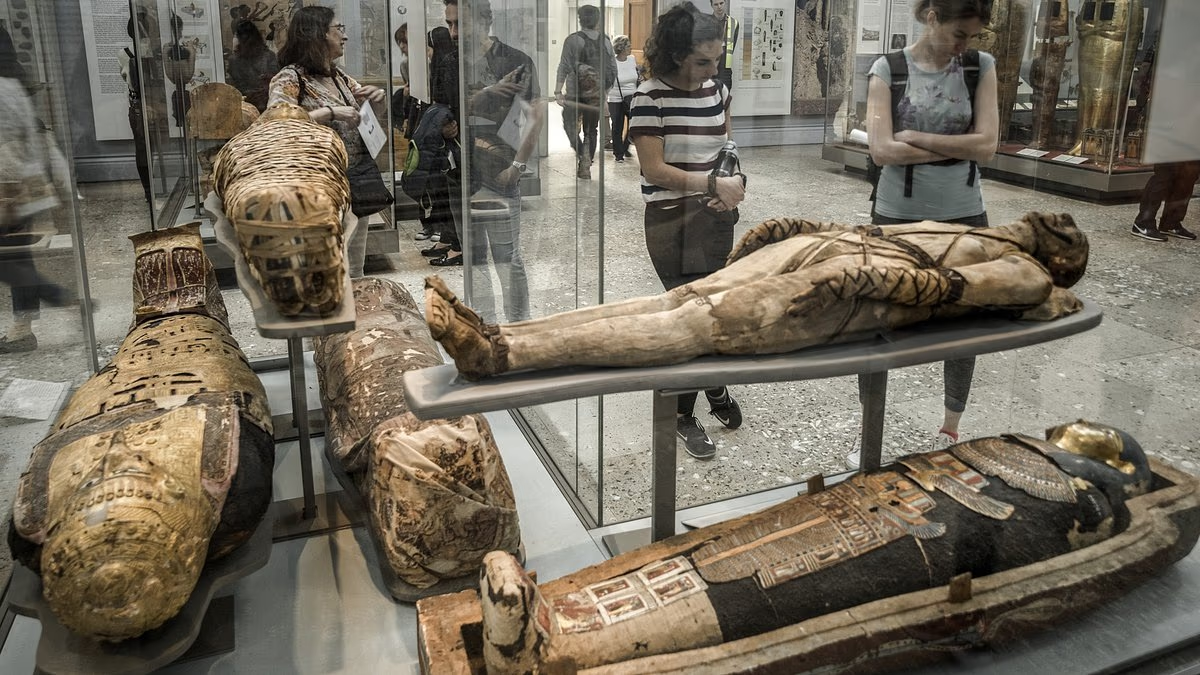

The British Museum has confirmed that its mummies will remain on public display, setting its policy apart from Glasgow’s Kelvingrove Art Gallery and Museum, where human remains have been withdrawn amid a debate over consent and respect.
Experts at the London institution say Egyptian mummies have significant educational, historical and scientific importance, and that visitors will continue to be able to view them.
That position differs sharply from Kelvingrove’s approach. The Glasgow museum removed its mummies from display, describing the decision as a “mark of respect” for the deceased.
The Mail reported this week that Egyptian remains were taken out of the exhibition after museum officials said they had no evidence that the “deceased individual” had consented to being displayed.
Chris McGovern, a former adviser to the Downing Street Policy Unit under Baroness Thatcher and Sir John Major, praised the British Museum as the “greatest museum in the world”.
He said: “As a long-standing member of the British Museum, and a former government adviser on history, I am deeply concerned about the direction in which our museums are heading.
“These institutions belong to the public, not to those in positions of power.
“Museums across the UK now seem increasingly focused on censoring the past and presenting history through filters designed to satisfy the demands of woke campaigners.”

Part of the Egyptian collection at the British Museum in London

Kelvingrove Art Gallery in Glasgow has faced criticism after removing mummies from display over concerns about consent
“They are attempting to shut away parts of the history we all share.
“If this approach continues, even the Bayeux Tapestry could come under scrutiny because it depicts extensive violence, numerous deaths and human remains.”
The British Museum’s policy says human remains are valuable to researchers studying subjects including archaeology, disease, human biology and genetics. It also states that they can provide essential context for other items in its collections.
According to the policy, human remains must be handled with “respect, care and dignity”. Rather than automatically preventing an exhibition, the museum says appropriate explanations and historical context should accompany displays.
The policy also says trustees, chaired by former Chancellor George Osborne, begin with the presumption that human remains should stay in the collection because of the benefits they can provide to the public.
ALSO READ: Volvo Cars Shares Plunge 24% on China, U.S. Slump and Job Cuts
The trustees’ broader position is that the collection should “remain intact”. They identify research, education and greater understanding of how societies have viewed death and treated the remains of the dead as key public benefits.
The British Museum, home to one of the world’s most important collections of Egyptian antiquities, told the Mail that it has “no plans to remove mummies from display”.
Its stance contrasts with that of Kelvingrove. The Hunterian Museum at the University of Glasgow has also taken an Egyptian mummy out of public view after deciding that she “deserves privacy in death”.
Staff at the Hunterian covered the remains, known as Lady Shep-En-Hor, with a conservation-grade textile material, preventing visitors from seeing the ancient wrappings beneath it.

The gallery is one of Scotland’s best-loved visitor attractions
Glasgow Life, the arm’s-length charitable organisation funded by Glasgow City Council, said a mummified head was among the items removed at Kelvingrove.
The changes came to light after a visitor posted an image on social media platform X of a sign stating: ‘We have removed human remains from this display as a mark of respect.’
The items removed include a painted coffin containing the remains of the priest Nekht, a mummified male head, a mummified right hand recovered from the Valley of the Kings in Luxor, Egypt and a mummified foot.
Glasgow Life said: ‘Once we have completed work at Kelvingrove Museum, work will begin to remove a coffin and mummified human remains on display in St Mungo Museum.’
St Mungo Museum is the only museum dedicated to religion and art in the British Isles.
Kelvingrove, which opened in 1901 and attracts more than 1.3 million visitors a year, has long featured Egyptian mummies and other remains among the star attractions of its Ancient Egypt galleries.
Glasgow Life argued that the removal of human remains from display at Glasgow Life museums ‘reflects contemporary museum practice’.
A spokesman said: ‘Glasgow Life Museums’ draft Human Remains Policy proposes that human remains should only be displayed where there is documented and informed consent from the deceased individual or, in appropriate circumstances, their descendants.
‘In the absence of such consent, we believe removing ancient Egyptian human remains from display is more respectful to the deceased individuals.’


