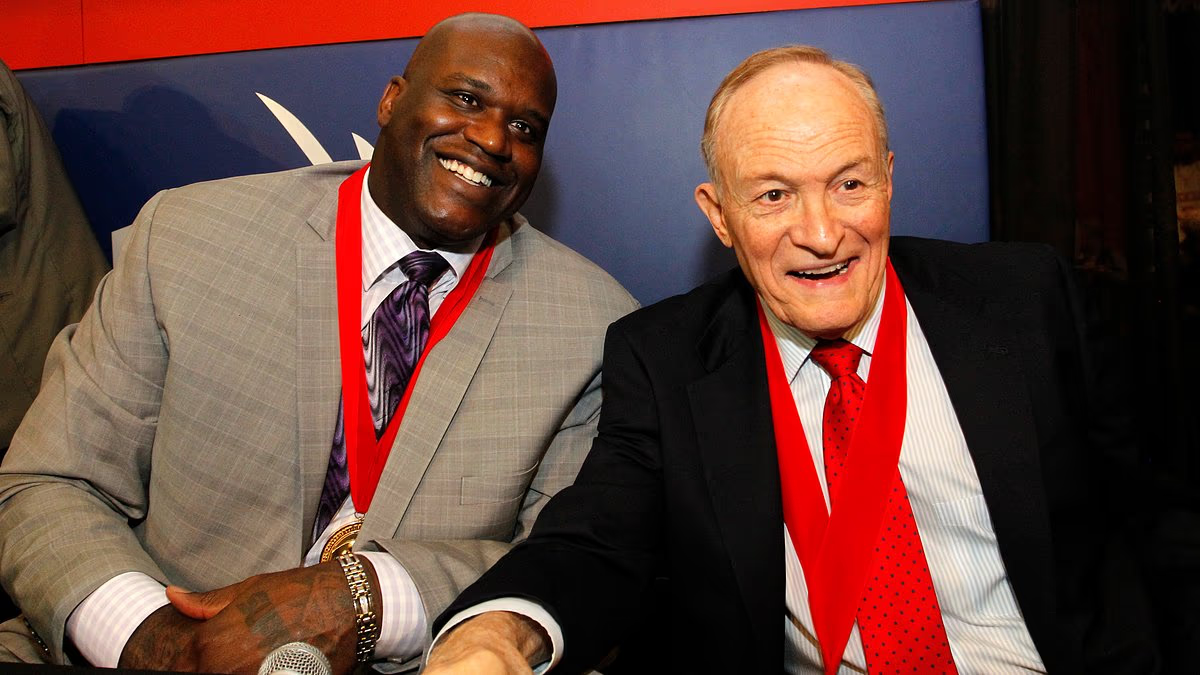

Dale Brown, the longtime LSU basketball coach celebrated for discovering a 13-year-old Shaquille O’Neal, has died just seven days before his 91st birthday.
Only days before his death, Brown was announced as the recipient of the 2027 John R. Wooden Legends of Coaching award.
“We have lost the most loving and most loved man any of us has ever known,” Brown’s family said in a statement. “Dale Brown always put others first. He always led with the heart. He was always a great humanitarian before anything else. Dale long ago fell in love with Louisiana. And the people of Louisiana loved him right back. We are forever grateful for that.”
Brown was named Associated Press Coach of the Year in 1981 and earned SEC Coach of the Year honors four times. He remains the winningest coach in LSU basketball history. His teams played with flair and won at a prolific rate, turning the Tigers’ dome-shaped Pete Maravich Assembly Center into one of college basketball’s most intimidating venues. The building became known as the “Deaf Dome” because of its famously deafening crowds.
Over 25 seasons at LSU, Brown guided the Tigers to two Final Four appearances, with his 1981 and 1986 teams reaching college basketball’s national semifinals.
Brown coached O’Neal for three seasons, beginning with the 1989-90 campaign. The 7ft 1in center later entered the 1992 NBA draft and was selected No. 1 overall by the Orlando Magic. LSU reached the NCAA Tournament in each of O’Neal’s three seasons. His first year also featured fellow All-American Mahmoud Abdul-Rauf, then known as Chris Jackson, although the Tigers did not progress beyond the second round in any of those tournament appearances.

LSU basketball coach Dale Brown shouts instructions to his team during the 1986 Final Four

Shaquille O’Neal admitted he was a poor player when he first met Dale Brown (right) in the mid-1980s

Dale Brown poses with the Louisiana State University basketball team in Baton Rouge
O’Neal recently recalled meeting Brown for the first time in a tribute video honoring his former coach.
O’Neal was raised at the US Army base in Wildflecken, West Germany, where his stepfather was stationed. At 13, he approached Brown during a basketball clinic at a local gym. O’Neal was already 6ft 6in, leading Brown to assume he was a soldier or a college player.
“After I told him I was only 13, the way he hugged and grabbed me, it was like he found the biggest piece of gold nugget in a mountain you could find,” O’Neal said.
Brown offered O’Neal advice on building strength in his lower body. Even as the young player continued to struggle, Brown recognized his potential and eventually offered him a scholarship to LSU.
“I wasn’t very good in basketball at the time,” O’Neal said. “After I did all the workouts, I still didn’t make the team. And I sent coach Brown a tearful letter. Then coach Brown responded by sending me a scholarship to LSU. ‘You come and sit next to me. You can be whatever you want to be. I just want you to go to college.’”
“I decided to follow that man and go to LSU,” O’Neal added. “And he made me one of the best basketball players ever.”
The closing chapter of Brown’s coaching career was overshadowed by an NCAA investigation into recruiting practices that would be permitted under today’s rules.
During the 1996-97 season, the NCAA determined that a booster had given about $5,000 to Lester Earl, one of Brown’s former players, while Earl was playing for the Tigers.
Brown retired in 1997, and LSU was placed on probation the following year.
Despite the controversy, Brown remained deeply popular across Louisiana. His energetic, outgoing and highly expressive personality had made him a favorite among LSU supporters. Many fans also embraced a narrative, promoted in significant part by Brown himself, that the NCAA had unfairly targeted and persecuted him.
Brown was later inducted into the Louisiana Sports Hall of Fame. In 2022, LSU named its home basketball court in his honor; the court was subsequently also named for late women’s coach Sue Gunter in 2024.
When Brown’s name was unveiled on the court during a halftime ceremony, Brown credited his former players and assistant coaches, many of whom were in attendance that night.
‘The best potential of me is we,’ Brown said. ‘This is an example.’

Brown coaches LSU against the Georgia Bulldogs during a 1997 game in Memphis
The late former Temple coach John Chaney called Brown ‘one of the true statesmen of college basketball,’ according to a profile of Brown on LSU’s website.
That same profile also quoted Hall of Fame UCLA coach John Wooden saying he will ‘always remember Dale for his enthusiasm.’
When he was hired by LSU in 1972, few Tigers fans had previously heard of him. His name recognition and popularity began surging after LSU knocked off then-third-ranked Memphis State in the home opener of Brown’s first season.
Brown went on to coach an LSU squad forecast to finish last in the SEC to a 9-9 league record, resulting in his first SEC Coach of the Year honor.
Brown went on to post a career 448-301 record at LSU. Following his retirement, Brown became a motivational speaker, a basketball analyst for television broadcasts and started the charitable Dale Brown Foundation, which aims to promote educational opportunities for students who have physical disabilities or come from families who’ve struggled financially.


