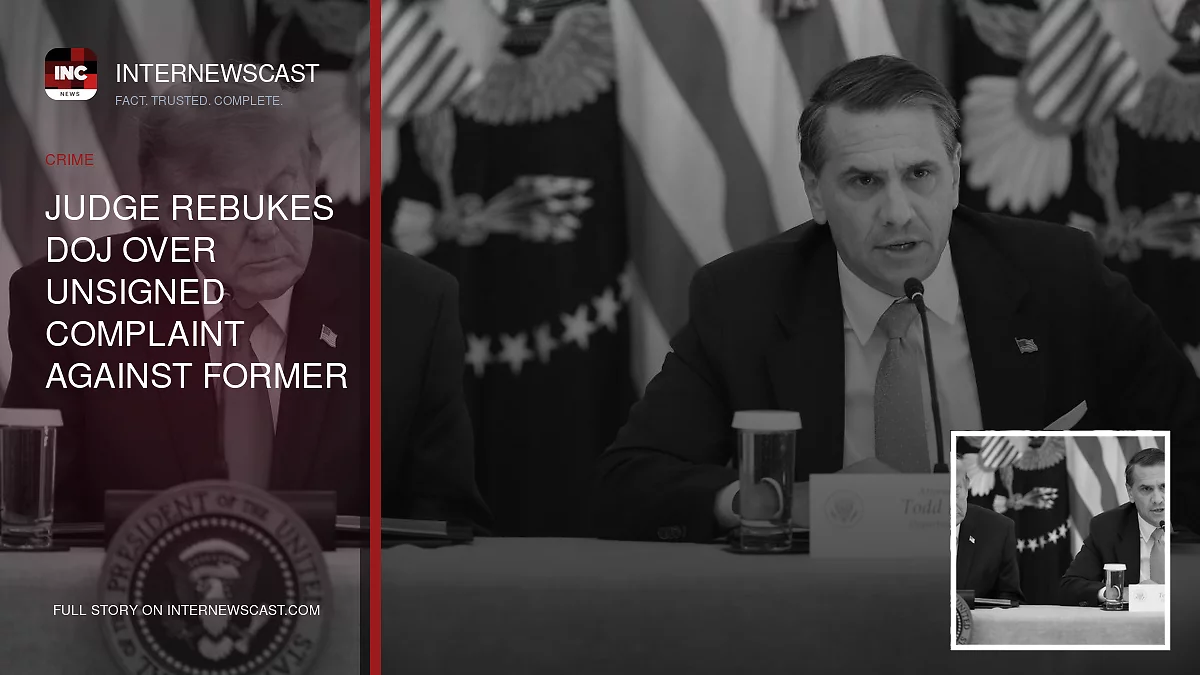

President Donald Trump listens to Attorney General Todd Blanche during a roundtable in the White House East Room on Wednesday, Oct. 21, 2026, in Washington. (AP Photo/Alex Brandon).
Questions about the U.S. Department of Justice’s handling of the case dominated a hearing involving two former FBI agents accused of misleading Congress during its investigation into Hunter Biden.
The Trump administration claims Nikki Floris and Bradley Benavides knowingly delivered “materially false statements” to the House Judiciary Committee during testimony in the summer and fall of 2023.
A sealed criminal complaint filed last week accused the pair of making false statements to Congress. But prosecutors later submitted a “superseding criminal complaint” that added felony allegations of obstruction and attempted obstruction, according to the new filing.
Defense attorneys immediately challenged the government’s move in an early Tuesday filing.
The defense argued that the unsigned and unsworn document appeared designed to repair weaknesses in the original complaint, replace the officer who attested to its allegations and introduce another charge. Because the new felony accusation carries constitutional requirements, attorneys said it must be approved through a grand jury indictment.
In a four-page motion to strike, Floris’ lawyers dismissed the second filing as only “purported” and accused prosecutors of attempting to manipulate the criminal process.
The attorneys said the government’s filing, submitted just before a previously scheduled preliminary hearing, was not only procedurally flawed but also represented an abuse of the charging process. They alleged that prosecutors were attempting to bypass judicial safeguards, avoid scrutiny and prevent the defense from testing the accusations in open court.
The dispute over the alleged superseding complaint consumed the preliminary hearing that had been set for late Tuesday morning.
The magistrate judge overseeing the case expressed strong disapproval of the Justice Department’s approach.
“I am not going to bless it as a superseding complaint,” Magistrate Judge Zia Faruqui told prosecutors at the U.S. District Court in Washington, D.C., according to CNBC’s courtroom report.
Faruqui’s comments appeared to echo the defense’s criticism of the government’s charging document.
The defense motion argued that no procedural rule allowed the document to be placed on the public docket. Lawyers described it as legally ineffective and said its filing violated Floris’ rights by presenting unapproved allegations as though they were valid criminal charges.
The filing further stated:
SEE ALSO: Cuban Official Accused of Shoving US Diplomat to Be Expelled
Defense attorneys argued that publicly posting the document was especially serious because the docket should not be used to circulate unapproved accusations, promote the government’s preferred account of events or generate publicity through the authority of a federal case. In their view, prosecutors had introduced new allegations dating to 2023 without meeting the legal standards required for a formal charging instrument, leaving what they characterized as an untested accusation—or political narrative—before the public.
Faruqui suggested that the Justice Department’s filing may have departed from the court’s ordinary procedures for initiating criminal charges.
“It is not our court’s practice … that unsigned complaints are filed in the docket,” the judge reportedly said.
The court also criticized the DOJ for what it viewed as an attempt to create an entirely new method of bringing charges, according to Lawfare senior editor Anna Bower’s courtroom report.
“I’m concerned with your view as to what the law is,” Faruqui said, questioning why the federal government had chosen this case to depart from the procedures it had followed historically.
The judge called the DOJ’s conduct “very concerning” and said prosecutors were effectively intensifying the defendants’ argument that the case had been handled in an unusual manner.
“Why would you not just want a magistrate judge to make a probable cause finding as you would in every other case?” Faruqui asked.
The government leaned into that idea without directly addressing the court’s question about the apparent sea change in charging practice.
“To be clear, we’re ready for a probable cause finding,” a DOJ attorney told the judge.
After some back and forth, the judge told the government lawyer he was “reluctant” to move forward with a probable cause hearing “given what you’ve said your view is of what my signing that complaint would mean … the idea that the magistrate judge just rubber stamps it without a probable cause determination.”
The judge eventually determined the hearing would continue on the basis of the first complaint.
Notably, just before the hearing started, the DOJ filed a notice that the disputed charging document and associated “[f]ilings were entered in error, as this filing is an Amended Complaint not a Superseding and needs to be processed by the Clerk’s Office and sworn by the judge before being filed on the docket.”
The post ‘Throwing gasoline’: Judge ridicules DOJ lawyers for filing unsigned complaint in case against former FBI agents, refuses to sign off on new charging document first appeared on Law & Crime.