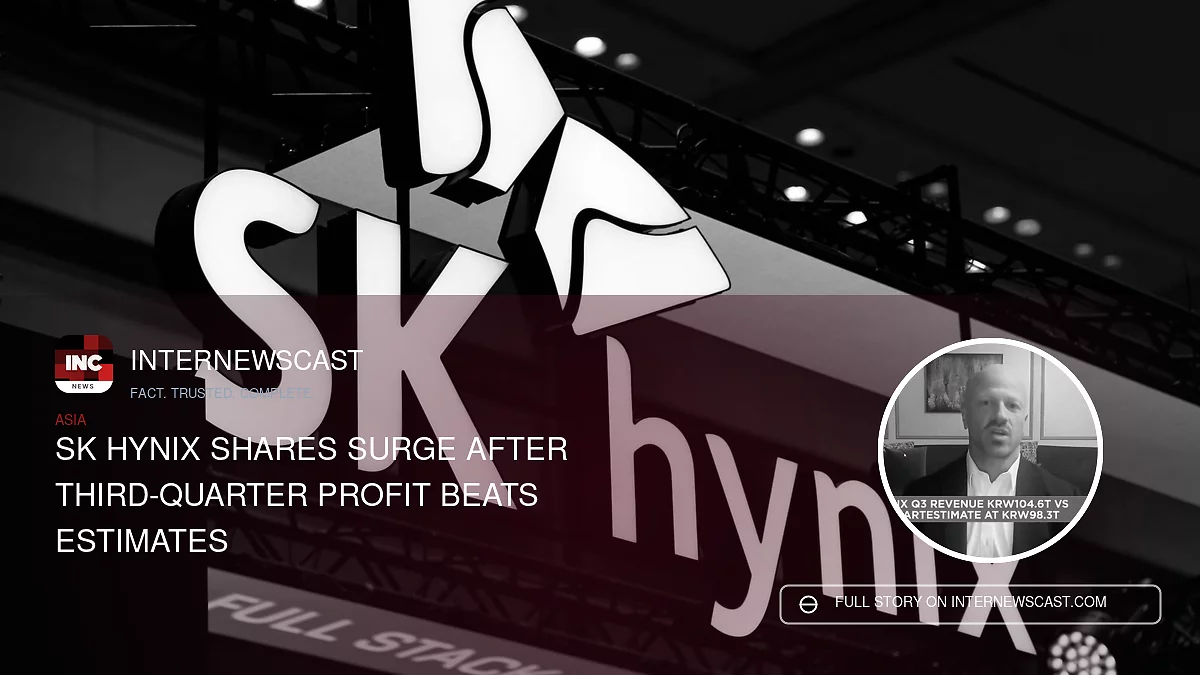


Shares of South Korean chipmaker SK Hynix surged 10.89% in Asia on Wednesday after the company reported a record quarterly profit that exceeded expectations and unveiled plans for more than $25 billion in dividends and share buybacks.
Here is how SK Hynix’s third-quarter performance compared with LSEG SmartEstimates, which place greater weight on projections from analysts with stronger forecasting records:
- Revenue: 104.62 trillion won ($78.86 billion) versus 98.34 trillion won expected
- Operating profit: 83.33 trillion won versus 76.72 trillion won expected
Revenue jumped 327.9% from a year earlier, while operating profit soared 632.1% year over year.
On a quarterly basis, revenue increased 31.9% and operating profit advanced 37.6%.
SK Hynix outperformed the benchmark Kospi, which finished 6.63% higher. Its U.S.-listed shares also gained more than 11% on Wednesday.
The company recorded its strongest quarterly revenue and operating profit on record, with sales surpassing 100 trillion won for the first time. It also said it plans to return about 100 trillion won to shareholders, including at least 30 trillion won in cash dividends and 60 trillion won through share repurchases and cancellations.
During an earnings call, SK Hynix CEO Kwak Noh-Jung said volatility in financial markets and a pullback in semiconductor stocks had prompted the company to suspend its review of potential pre-IPO fundraising and listing options for its U.S. subsidiary, Solidigm.
SK Hynix had previously said it would continue reviewing the timing, scale and financing methods for investment in Solidigm, with the goal of supporting the subsidiary’s expansion and increasing shareholder value.
Kwak also said SK Hynix plans to distribute gains from its investment in Japanese chipmaker Kioxia. “We intend to return the gains realized from our investment in Kioxia this year to our shareholders through a special dividend,” he said.
The chipmaker approved a third-quarter dividend of 14 trillion won, including a special dividend financed by proceeds from its Kioxia investment.
SK Hynix will additionally repurchase 20 trillion won of its own shares, with half set to be cancelled this year. That follows the completion last week of a previously announced 40 trillion won buyback, which will also be cancelled shortly, according to the earnings call.
The company plans to lift its shareholder-return target to more than 50% of cumulative free cash flow generated from 2025 through 2027. It expects strong AI investment to continue as AI services become more widely adopted and the investor base broadens.
SK Hynix also said the memory market’s structural supply-demand imbalance is likely to persist for now, with demand continuing to exceed available supply.

Mehdi Hosseini, a senior equity research analyst at Susquehanna International Group, maintained a neutral rating on SK Hynix after its third-quarter results. He said he favored Micron and Samsung Electronics instead.
Hosseini pointed to Micron’s more diversified memory portfolio and Samsung’s foundry business as providing a more attractive risk-reward balance.
He also said SK Hynix shares appeared undervalued and that he preferred the company’s U.S.-traded American depositary receipts, or ADRs, to its South Korean-listed stock because the U.S. market offers a larger pool of potential investors.
“I would prefer the ADR in U.S.,” he told CNBC’s “Squawk Box Asia,” adding that he was uncertain whether the Korean market had enough additional buyers.
Memory production boost
SK Hynix expects HBM4 to overtake HBM3E in both shipments and revenue during the fourth quarter as production ramps up at its M15X facility in Cheongju, South Korea.
HBM, or high-bandwidth memory, is an advanced form of memory used with AI processors to handle large volumes of data. HBM4 is the technology’s sixth generation and entered mass production and shipment during the third quarter.
Average selling prices for DRAM increased by a high-20s percentage compared with the previous quarter, supported by higher prices for conventional DRAM and a larger contribution from more expensive HBM4 products.
Server DDR5 memory shipments, meanwhile, rose by more than 40% quarter over quarter, according to the earnings call. These chips are used in data center servers.
The company has signed long-term agreements with 14 major customers covering more than 50% of its production capacity for 2027 and 2028. It expects memory demand to remain ahead of supply through 2030 and plans to significantly raise investment next year.


