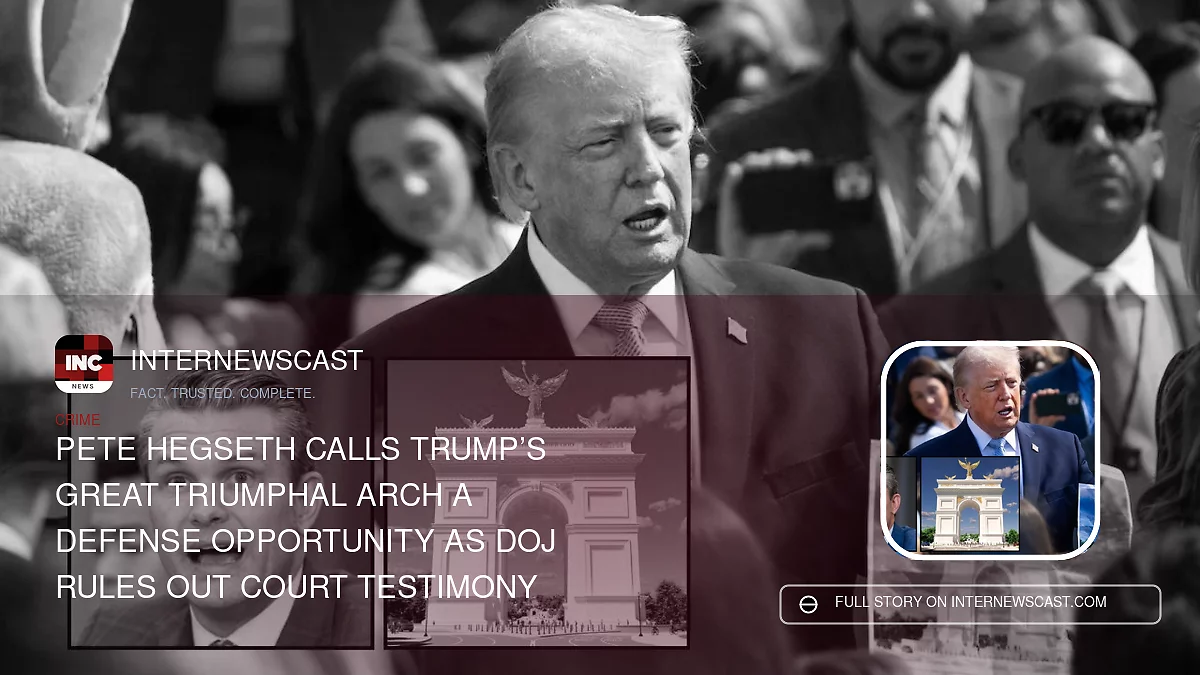

Left inset: Defense Secretary Pete Hegseth answers a reporter’s question before a meeting with Australian Deputy Prime Minister and Defense Minister Richard Marles at the Pentagon on Friday, Feb. 7, 2025, in Washington. (AP Photo/Manuel Balce Ceneta). Right inset: An artistic rendering of the arch to be shared by Interior Secretary Doug Burgum. Background: President Donald Trump displays an image of the proposed Triumphal Arch on the South Lawn during the White House Easter Egg Roll on Monday, April 6, 2026. (Tom Williams/CQ Roll Call via AP Images).
Defense Secretary Pete Hegseth says President Donald Trump’s proposed “Great Triumphal Arch” should be built as a “generational national defense opportunity” that could help protect the Homeland from drones and other “evolving threats.” Federal prosecutors, however, say Hegseth will not be available to answer questions about the project in court.
“It will be utilized as a dual-purpose structure: a major national monument that also incorporates military utility to support Homeland defense,” Hegseth wrote in a declaration submitted Wednesday, as the government faces a lawsuit brought by three Vietnam War veterans and a historic preservationist seeking to halt construction of the arch.
“The new construction of the Arch — with its strategic location overlooking major national sites and frequented by national officials — offers an opportunity to situate state-of-the-art C-UAS defense capacities in the heart of the NCR [National Capital Region],” Hegseth said. “Its height and strategic location provide enhanced lines of sight for both sensors and personnel, which is critical to C-UAS and other security operations.”
The Justice Department said in court filings Wednesday that Hegseth, despite backing the project, would be “unavailable to testify” at a preliminary injunction hearing scheduled for Friday.
The Vietnam veterans and preservationists challenging the government asked U.S. District Judge Tanya Chutkan last week to issue a preliminary injunction by Nov. 4—at least one day before “construction may start.” They said the deadline was necessary to prevent the project from becoming a ballroom-like “fait accompli.”
Represented by Public Citizen Litigation Group, plaintiffs Michael Lemmon, Shaun Byrnes, Jon Gundersen and architectural historian Calder Loth said in an 18-page memorandum filed last Thursday that the Trump administration is moving “rapidly” toward construction. They said the National Park Service (NPS) indicated in a notice that work at Memorial Circle could begin as soon as Nov. 5.
The plaintiffs are asking Chutkan to block construction through an injunction.
“Defendants have barreled ahead, doing site testing, drawing architectural plans, and seeking approvals from commissions populated by friends of the administration. Yet, throughout this time, Defendants have failed to obtain (or even to seek) approval from the one body that, by law, must authorize the project: Congress,” the memo said.
According to their complaint, the plaintiffs “regularly visit the area” to “honor the service” of “comrades-in-arms who are buried” at Arlington National Cemetery. They argue that the arch would cause “profound harm” by disrupting a symbolic landscape with deep personal meaning. The project, they contend, would eliminate an “unobstructed view” along a sight line “designed to represent the unification of the Nation following the Civil War.”
To support their claim that the administration’s “plans are unlawful,” the plaintiffs point to what they describe as the NPS’ “own assessments.” Those assessments allegedly found that the arch would cause significant adverse effects at more than 40 historic sites, yet the plaintiffs say officials “have not faltered in their commitment to build the arch.”
MORE ON THIS: Disney to Cut Up to 200 Jobs Across Its Theme Parks Division
Their filing also challenged the “sole source of legal authority” cited for building the arch as part of America’s 250th anniversary. The plaintiffs argued that the Act of Feb. 24, 1925, authorizing construction of Arlington Memorial Bridge could not reasonably permit “a massive monumental arch to commemorate a national anniversary that, at the time of the statute’s enactment, lay more than a century in the future[.]”
“The bridge was completed over ninety years ago, in accordance with the statutory requirements. And while plans from 1924 included two columns (but not an arch), the Commission that Congress authorized to design the bridge removed them, and the project was completed without them,” the plaintiffs said. “Defendants’ contention that the statute authorizes limitless initiation of new Executive projects, at whatever cost, indefinitely into the future, is entirely untethered from the Act’s text.”
Chutkan, an appointee of President Barack Obama who oversaw special counsel Jack Smith’s since-dismissed Jan. 6 prosecution of then-candidate Trump, is now being asked to stop the administration as it begins to “blaze ahead” with the project.
“This Court should enter a preliminary injunction blocking Defendants from beginning construction on Memorial Circle in the hope that they can render the arch a fait accompli before this Court has made a final determination whether Defendants’ project is unlawful,” the memo said, citing the Supreme Court’s ballroom decision as a “cautionary tale.”
Federal prosecutors countered in court filings that an injunction would prevent the government from pursuing what they describe as significant national security benefits and from taking steps to address an “ever-growing threat to the Nation’s capital.” In a filing Wednesday, they said the “significant national defense concerns” outlined by Hegseth and Homeland Security Secretary Markwayne Mullin outweigh the plaintiffs’ claimed aesthetic interests.
“The security features will be fully integrated into the existing design,” Mullin wrote in his declaration.
The Vietnam Veterans of America, Veterans for America First and several other veterans organizations filed a brief Wednesday supporting the administration’s position and the arch’s construction. The groups argued that the veterans challenging the project lack legal standing and do not speak for all veterans.
“This case has been fully briefed on the merits three times,” the DOJ said Wednesday in an opposition filing. “Plaintiffs now bring yet another breathless emergency motion seeking preliminary injunctive relief to forestall construction of an arch on Memorial Circle. But Plaintiffs’ complaint has grown only weaker with time.”
Matt Naham contributed to this report.
The post Hegseth says Trump’s ‘Great Triumphal Arch’ represents a ‘generational national defense opportunity’ as DOJ rules out his testimony in court first appeared on Law & Crime.