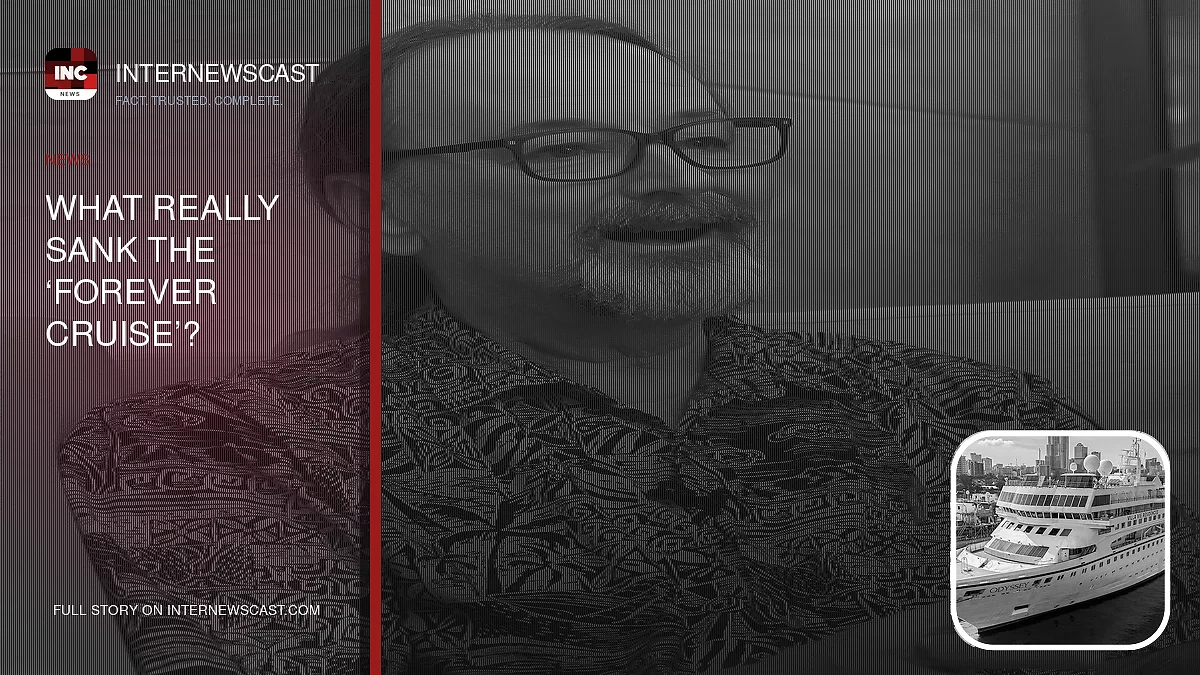

At least the ship did not sink, despite all 203 passengers and more than 150 crew members being ordered to leave it.
There were no lifeboats involved. But passengers’ life savings have effectively gone overboard, sinking without a trace as their dream of making a permanent home at sea dissolved in spectacular fashion.
The 509-cabin Villa Vie Odyssey, operated by Florida-based Villa Vie Residences, is stranded in Sihanoukville, Cambodia, after the company admitted it is under “unsustainable financial pressure” and can no longer afford to purchase enough fuel.
The vessel was marketed as a never-ending cruise, sailing around the world on three-year cycles. Cabins cost between £90,400 and more than £670,000, with residents also paying a monthly charge for food, housekeeping and internet access. Passengers, however, say the internet and televisions have not worked for weeks.
The promise was a permanent floating home visiting more than 400 ports, complete with endless buffets, fitness sessions, trivia contests, pickleball and nightly shows.
Several passengers, particularly those from the United States and Canada, committed fully to the idea. They sold their homes and vehicles and used their pension savings to fund what they believed would be a life-changing adventure.
It has undoubtedly been an adventure. But it has been far from the enriching experience they were promised.
Randy Cassingham, 66, was removed from the ship alongside his 71-year-old wife, Kit. This week he said: “We had built a house and it was our dream house. We decided to sell that and our car and almost all of our belongings and move onto the ship full-time, permanently. So, we don’t have a home to go to right now.”

The Villa Vie Odyssey is docked at Sihanoukville Autonomous Port after permanent residents were forced to disembark in Cambodia

Randy Cassingham and his wife, Kit, sold their home to live aboard the Odyssey, now stranded in Cambodia

Holly Hennessey has lived aboard the ship since the beginning, accompanied by her Siamese cat, Captain
Given the severity of the situation, the absence of an immediate apology was striking. Villa Vie Residences founder Mikael Petterson has since said he feels like “the villain” in the story and acknowledged that the circumstances are “awful”.
This week, passengers who paid substantial sums for relatively modest cabins on the 642ft vessel were presented with an explanation of the mounting costs. The account sounded more like a briefing from a sharp-suited accountant than an apology to people whose lives had been uprooted.
“On an equivalent per-cabin basis, monthly fuel expense that historically averaged approximately $1,800 (£1,350) has recently reached an estimated $6,000 (£4,500) to $8,000 (£6,000) in parts of Asia. The company cannot simply pass increases of that scale on to residents,” the company said.
That much may be understandable. But passengers might reasonably have expected considerably more warning.
Instead, the company issued a statement saying: “We are working with residents to co-ordinate disembarkation and temporary living arrangements and are supporting residents.”
The Cassinghams strongly dispute that account. They sold their family home in Colorado and most of their possessions to pay £284,000 for their permanent cabin, along with a monthly charge of £5,200, believing the ship would become their “forever home”.
“What’s happened didn’t come out of the blue,” Mr Cassingham said. “It was a cascade of problems piling up on one another, from the business model to mistakes by management to the mentioned crisis in fuel cost and availability, and more.”
On his blog, he explained that he first realised the situation was deteriorating on Monday, when Kathy Villaba, Villa Vie’s chief executive, posted a message on the ship’s internal communications board.
Passengers were reportedly given just seven hours to pack their belongings and leave, after which they were responsible for finding and paying for their own accommodation and meals in Sihanoukville.
Another resident, Margaret Carrasco, offered an equally scathing account of what happened.
“I want to set the record straight and clear up any confusion out there about what the company, Villa Vie Residences, is claiming in their PR announcements,” she said.
“They are providing zero support to residents despite claiming they’re helping us with temporary living arrangements. That is total bull****.”
Ms Carrasco said the only assistance she received came from “our loving crew and fellow residents in getting our luggage down the gangway and onto a shuttle. We were dropped unceremoniously in the middle of town, left to our own devices.”
Sihanoukville is hardly an ideal place to be abandoned without warning.
More than 70 casinos have reportedly been built there in the past three years, while plans are advancing for a $1 billion, 65-hectare Chinese-Malaysian development called Wisney World.
“The town itself is now an almost-permanent construction zone. Bricks and construction materials litter the streets, the crime rate is growing and Sihanoukville’s postcard beaches are now choked with plastic bags,” travel website Intrepid has said. Its slogan is “committed to using travel as a force for good”.
With a population of roughly 90,000, Sihanoukville has also become associated with human trafficking and online scam operations — an unfortunate backdrop for a residential cruise venture that has been plagued by difficulties from the outset.
Long Dimanche, the province’s deputy governor, expressed sympathy for those affected. “Being ordered to disembark so abruptly has left retirees and workers effectively homeless, thousands of kilometres away from their home countries,” he said.
Problems had dogged the cruise long before the Cambodian crisis.
The ship was scheduled to leave its dry dock in Belfast in early spring 2024, but remained there for another four months because of rudder and gearbox problems. The delays cost the company an estimated £15 million more than anticipated. During that period, passengers could spend their days aboard but had to stay in hotels or rented apartments overnight.
At the time, the Mail sought to visit the vessel in Belfast and speak to passengers about their experience. The request was flatly rejected by Villa Vie Residences. The company appeared to have little interest in publicity, and I was not welcome.
Then, in July this year, an email arrived from the company’s public relations agency announcing that it was “excited to share some big news”.
RELATED: Nasdaq Drops More Than 700 Points as Investors Sell Off Tech Stocks
The company clearly wanted attention by then — and I was invited to interview Mr Petterson.
“Following the success of Villa Vie Odyssey, which is now more than 85 per cent sold, the company is expanding into a two-ship fleet with the announcement of its second residential cruise ship, Legacy, with residences expected to be approximately 50 per cent larger, along with expanded dining, larger public spaces, enhanced wellness facilities and additional luxury amenities.”
That expansion now appears to be out of reach. Holly Hennessey, 70, from Florida, had been aboard since the beginning with her Siamese cat, Captain. She paid about £250,000 for a balcony cabin, as well as a monthly fee of roughly £5,000.
Ms Hennessey describes herself as a “cruise addict”. Although she does not expect to recover her money, she has responded to the collapse with striking stoicism.
“I don’t like losing money at all but it was worth it to me,” she said. “I wish different decisions were made but I got to live my dream.”
The ship’s age may not have helped. It is more than three decades old and previously operated under the name Braemar as part of the Fred Olsen fleet.
Villa Vie Residences is said to have spent around £17 million refurbishing the vessel. However, Judi Cuervo, a passenger who has documented her time aboard, said the ship’s age remained obvious.
Ms Cuervo reported missing ceiling tiles, dirty windows, ripped seat covers and “blinds askew”. She also said no safety drills took place during her nine-day stay.
A woman who asked not to be named reported similar shortcomings after taking a “try-before-you-buy” cruise last year.
“No heat. No air-conditioning, spotty wifi … and I’d heard about repeated toilet malfunctions aboard Odyssey in my research prior to sailing, but I believed the problem was resolved.
“Imagine my surprise when I returned to find a full-page of Toilet Use Guidelines.”
Our News Outlet has seen the guidelines, and they make distinctly unappealing reading.
“While our team works diligently to clean the filters every two days, we’ve recently discovered a growing number of inappropriate materials causing blockages, including plastic gloves, diapers, tissues, napkins and other non-flushable items,” the notice stated.
In April, the company attempted to introduce a fuel surcharge for passengers, but residents rejected the proposal.

Passengers board the Villa Vie Odyssey at Belfast Port after the residential cruise ship was delayed there for four months in September 2024

Angela Harsanyi and Gian Perroni fell in love while stranded in Belfast during delays to the Odyssey’s departure and became engaged in September 2024

The Odyssey’s interior, where residents were promised an all-inclusive lifestyle at sea
Earlier this year, the vessel was also forced to leave Australia ahead of schedule because of fuel-access problems. Passengers later contributed money to help the ship depart Singapore in August. Mr Petterson said fuel that had cost the company $600 to $700 per metric ton had risen to almost $2,000 after the escalation of the Israeli-American conflict with Iran.
For Villa Vie Odyssey’s residents, the reality of a permanent round-the-world cruise has proved very different from the carefree future they imagined. Yet the desire to live at sea is unlikely to disappear. Cruising remains hugely popular despite a steady stream of mishaps and disasters.
In May, the Dutch expedition ship MV Hondius was stranded in the Atlantic after an outbreak of hantavirus killed three people. The crisis deepened when Cape Verde refused to allow the vessel into port.
That same month, around 1,200 passengers, most of them British, were quarantined aboard Ambassador Cruise Line’s Ambition in Bordeaux after 48 people developed symptoms of norovirus, a highly contagious stomach illness.
A 92-year-old British passenger also died aboard the ship after suffering a heart attack — unrelated to the norovirus outbreak, but still damaging publicity for the cruise operator.
Even so, the industry continues to expand. Cruise tourism contributes £5.8 billion to the UK economy each year and supports approximately 60,000 jobs.
According to the Cruise Lines International Association, more than 2.4 million British and Irish holidaymakers are expected to cruise this year, making it the fastest-growing part of the travel sector.
Last year, I experienced life aboard a fully residential ship myself after being invited to spend several days on The World. The vessel contains 165 privately owned apartments, from studios priced at around £1.8 million to three-bedroom homes costing as much as £12 million.
Residents buy their apartments outright, much as they would purchase a house or flat, and can decorate them however they wish. The property remains theirs for as long as they choose, although it cannot be rented to someone else.
Owners can come and go according to the ship’s itinerary, which is mapped out three years in advance and includes destinations such as Antarctica, Australia, Papua New Guinea, Alaska and the Northwest Territories.
The ship has already circumnavigated the globe nine times. Residents travel around the world while enjoying the reassuring sense that the world is moving around them — and they can remain aboard year-round if they wish.
The World is essentially a floating apartment complex, or condominium in American terms, owned collectively by its exceptionally wealthy residents.
It is a highly personalised lifestyle. Residents’ “preferences” are recorded in detail, even down to whether they like their omelette soft in the centre or cooked more firmly.
That is a world away from life aboard Villa Vie Odyssey, where passengers are no longer sailing the oceans but stranded without a clear route home in a bleak-sounding Cambodian city.
For some, the experience may be enough to keep them off cruise ships for good.