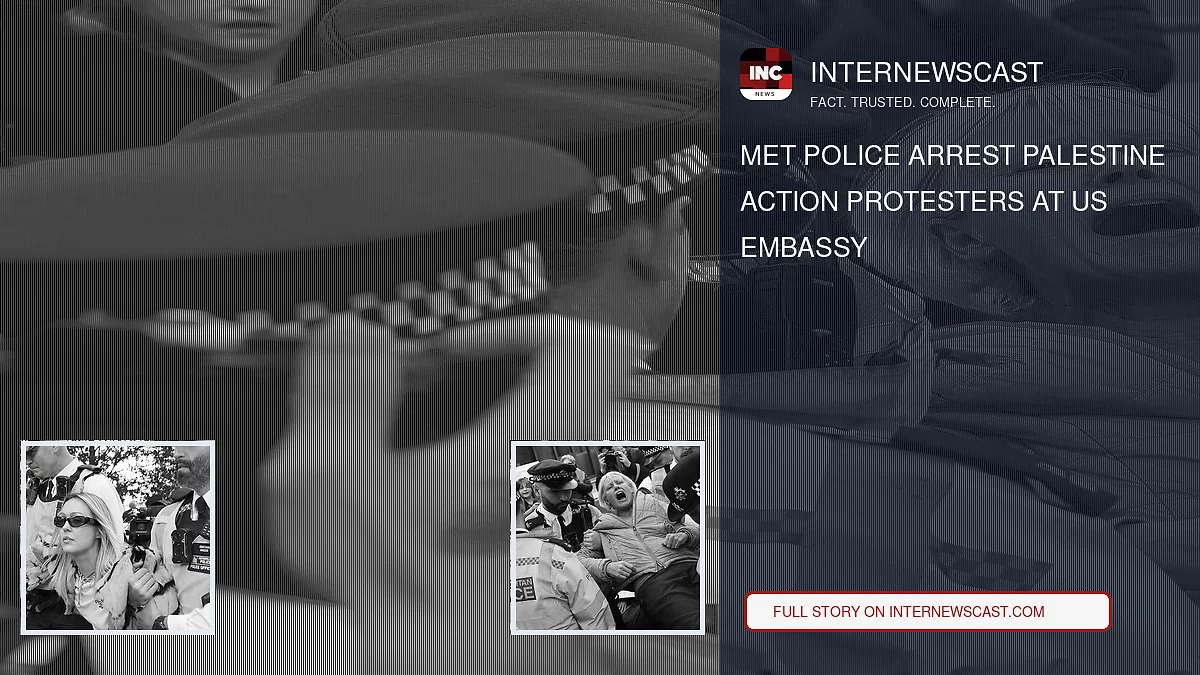

Police arrested 139 people outside the US Embassy on Saturday after demonstrators displayed messages supporting Palestine Action, a group banned by the UK government.
The Metropolitan Police said most of those detained were arrested on suspicion of expressing support for a proscribed organisation.
The protest was organised by Defend Our Juries, which had predicted that around 400 people would hold signs saying “I oppose genocide, I support Palestine Action”. Images from the demonstration, however, appeared to show just over 100 participants.
Under the Terrorism Act, publicly supporting Palestine Action became a criminal offence after the organisation was proscribed in June 2025.
As protesters assembled outside the embassy and raised their placards, Met officers moved in and began making arrests.
The force said shortly before 4pm that 48 arrests had been made, with the operation still under way.
Defend Our Juries said the demonstration had been timed ahead of a Supreme Court hearing examining the decision to ban Palestine Action.
Explaining the choice of venue, the campaign group said the US had “not shied away” from involvement in the conflict involving Israel and Palestine.
The US government announced sanctions against Palestine Action in August, formally designating it as a terrorist organisation.
Scotland Yard said protests linked to Palestine Action diverted “significant” police resources from local neighbourhoods and communities.

Police carry a person onto a bus after they took part in a protest organised by Defend Our Juries outside the US embassy in south London

A woman holds a sign reading ‘I oppose genocide, I support Palestine Action’ outside the US embassy on Saturday

Protesters are being arrested by the Met Police outside the US embassy

Protesters outside the British Embassy on Saturday held signs in support of Palestine Action, which is proscribed as a terror group by the government

A man is carried away by officers from the Met Police on Saturday afternoon

The Met has said Palestine Action-related protests ‘take significant police resources away from the neighbourhoods and communities where they are most needed’
Among those at the demonstration was 86-year-old David Polden, who carried a deliberately satirical placard reading: “I support genocide, I oppose Palestine Action (satire).”
Polden, a retired Campaign for Nuclear Disarmament activist, said he had attended because he opposed genocide and objected to what he described as the British government’s support for it.
He said the wording on his sign was intended to make clear that, despite its message, he did support Palestine Action because he believed the group was trying to prevent genocide.
Polden claimed officers had tried to arrest him earlier in the day before releasing him after reading the full wording of his placard.
He said he had previously been arrested for displaying messages backing the proscribed group and had since been charged with a terrorism offence.
ALSO READ: NFL Scouts Eye Emerging Top Prospect as Arch Manning’s Stock Plummets
Polden added that his court hearing had repeatedly been postponed until after the Supreme Court ruled on whether supporting Palestine Action was unlawful.
Retired lecturer Christopher Williams, 65, said he expected Saturday to be his first arrest and had already prepared his family for it.
He said he regarded the issue as serious and believed that failing to act left people collectively responsible for what was happening.
The Met spent £1.3 million policing six “Palestine-Israel public order events” during June and July, according to information released in response to a freedom of information request.
Before Saturday’s protest, the force warned that anyone displaying a sign supporting Palestine Action could be arrested. It also said people seen playing an important organisational role, including giving instructions or offering logistical assistance, could face enforcement action.
Met Commander Adam Slonecki, who was overseeing the operation, said those providing practical support to people carrying placards could also be arrested.
He said everyone attending was aware that supporting a proscribed organisation was illegal and accused participants of deliberately gathering to commit an offence.
The commander said officers were expected to act proactively rather than wait for offences to take place.
He stressed that the warning applied not only to people holding placards.
According to Mr Slonecki, anyone judged to be playing a central role in organising the protest, directing others or providing logistical help was likely to face enforcement action.
He said the police response was not intended to stop people expressing their opinions, but to intervene where that expression involved criminal conduct.

Defend Our Juries, which organised the protest, has accused the Met of ‘significant escalation’ and ‘double standards’ over its enforcement of the ban on Palestine Action

Defend Our Juries previously said it was expecting 400 people to protest in support of the group

Police officers detain a protester during a demonstration organised by Defend Our Juries outside the US Embassy

A woman is carried away by four police officers at a protest outside the US embassy on Saturday
He also warned that the operation would continue to draw substantial police resources away from communities where they were most needed, urging anyone considering attending to stay away.
A Defend Our Juries spokesman questioned how the Met could justify arresting people who were not themselves breaching the ban but were merely offering logistical assistance to peaceful demonstrators, many of whom were elderly or disabled.
The group said the expanded police approach represented a serious escalation and highlighted what it called an unprecedented assault on freedom of expression ahead of the Supreme Court hearing. It also accused officers of applying the ban inconsistently.
Defend Our Juries further argued that the police operation was reckless because it placed elderly and disabled protesters at greater risk.
In June, five Court of Appeal judges ruled that proscribing Palestine Action as a terrorist organisation was a justified and proportionate restriction on freedom of expression.
That decision overturned a February High Court ruling by three judges, who had found that then-Home Secretary Yvette Cooper acted unlawfully in banning the group. The earlier case was brought by Palestine Action co-founder Huda Ammori.


