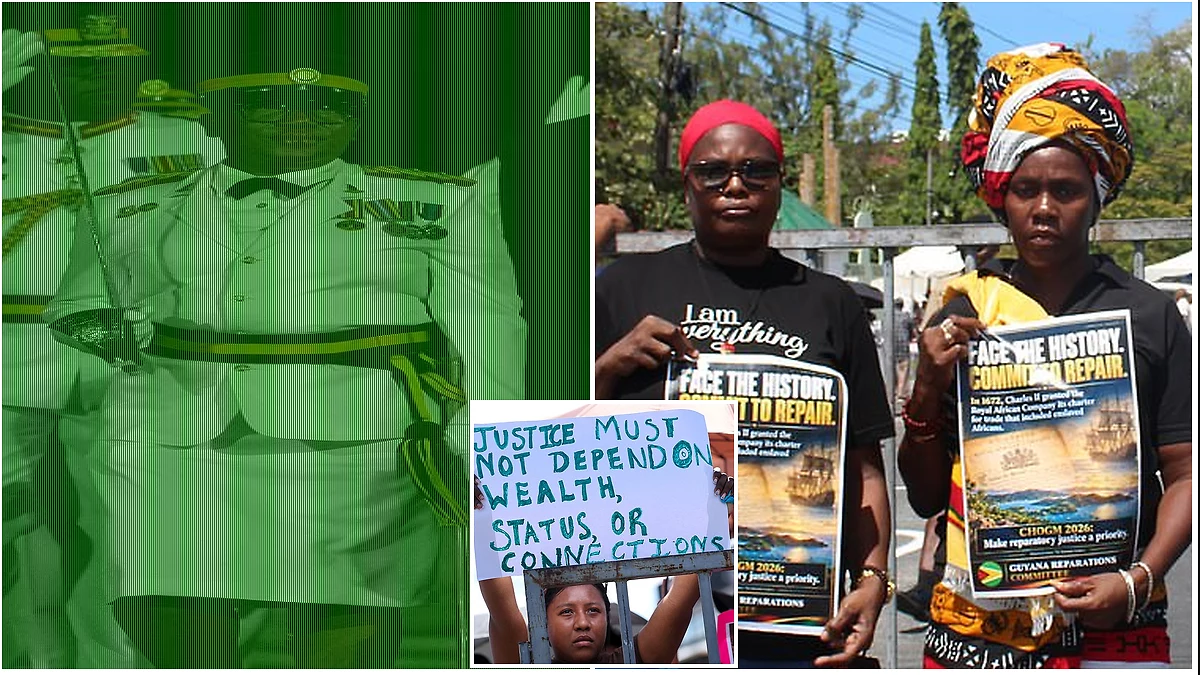

King Charles’s Caribbean tour has been plunged into uncertainty after Andy Burnham said he was ‘open’ to apologising for Britain’s historic role in the slave trade.
The Prime Minister’s remarks quickly prompted Caribbean leaders to renew calls for Britain to pay billions of pounds in reparations, while also raising fresh questions over the UK Government’s official position.
As recently as Thursday evening, journalists accompanying the King had been told that the Government’s stance was ‘absolutely no apology’.
The intervention also led Conservative leader Kemi Badenoch to question whether Britain should withdraw from Commonwealth summits if they become ‘an exercise in presenting Britain with demands for cash’.
Mr Burnham’s comments have fuelled speculation over whether the King, as head of the Commonwealth, could be expected to issue a public apology on Britain’s behalf—or substantially revise his keynote address to Commonwealth leaders in Antigua on Tuesday.
Speaking to The Guardian before travelling to the Caribbean for the Commonwealth heads of government meeting (CHOGM), Mr Burnham called for a ‘structured dialogue’ with communities affected by slavery. He said: ‘Listening to calls for a formal apology on behalf of the British state will form an important part of this process. I am open to them.’
The Prime Minister also spoke of his personal ‘sorrow and regret’, although he rejected demands for financial reparations.
However, Barbados Prime Minister Mia Mottley interpreted the remarks as a potential opening for reparations. She thanked Mr Burnham for ‘breaking new ground and recognising that this is the right thing, and the moral thing, to do by ensuring that we move to the next stage of engagement on this difficult and emotional issue’.

King Charles arrives at V.C. Bird International Airport in Osbourn, Antigua, at the beginning of his visit to Antigua and Barbuda ahead of the Commonwealth Heads of Government Meeting

Andy Burnham chairs a meeting of the National Economic Council in Glasgow on Friday
Philip J. Pierre, the Prime Minister of St Lucia and chairman of the 15-nation Caribbean Community, said: ‘No British prime minister has gone this far before… We are ready to engage.
‘The Caribbean Community does not accept that reparations are “not the right answer”. Nor do we accept the argument that responsibility falls away because the people of Britain today played no personal part in these crimes.’
Downing Street and Buckingham Palace both insisted last night that the King had not been caught off guard, saying palace officials had been informed in advance of Mr Burnham’s ‘significant’ remarks.
But royal biographer and Mail writer Robert Hardman described the Prime Minister’s intervention as a serious mistake.
‘This will not draw a line, as the PM claims, but will do the opposite. The reparationists have already said any apology is a first step on a path to legal, then financial redress. It could make the Chagos fiasco look like small change.
‘It is also very awkward for the King, as monarch of both the UK and of many nations demanding compensation. He has always dutifully maintained the government’s “no apology” position.
‘Now the PM has done a U-turn slap bang in the middle of the royal tour, blowing up months of careful planning and eclipsing all the King’s forward-looking engagements with toxic arguments about the past.’
The King’s visit, intended to deepen trade and diplomatic relations across the Caribbean, had so far been widely viewed as a success.
He was already expected to face difficult questions at the twice-yearly CHOGM gathering in Antigua, where campaigners had warned him ‘not to come empty-handed’.
During the previous week, Charles visited Guyana and The Bahamas. In the Bahamas, a reparations committee urged him to deliver a formal apology for the Crown’s ‘undeniable’ connections to slavery.
READ MORE: Meghan Markle Wanted to Go Public Over Thomas Markle Abuse Claims in 2019
‘For King Charles to come to our island and not be prepared to apologise for the wrongs of the past is unacceptable,’ said its chairman, Dr Niambi Hall Campbell-Dean.
Before the tour began, Foreign Office officials confirmed that the Government ‘has not advised His Majesty to apologise or pay reparations’, reflecting its established policy. As a constitutional monarch, Charles is required to act on ministerial advice.

People demonstrate in Georgetown, Guyana, calling for reparations over Britain’s role in the transatlantic slave trade

King Charles greets members of the public during a visit to the Kingston Seawall in Georgetown on October 30
That position has meant the King has not directly addressed campaigners’ demands during his eight-day journey. Instead, in a speech in the Barbadian capital Nassau, he acknowledged the ‘shameful aspects’ and ‘great suffering and injustices of the past’.
He also made an emotional visit to a site in Georgetown where enslaved people who rebelled against British rule were executed.
The question of reparations for former colonies affected by slavery has remained a deeply contentious issue for decades.
The British Government continues to oppose financial compensation, arguing instead for ‘mutual cooperation’ in fields including education and economic development.
Campaigners maintain that Britain will eventually be forced to pay, and drew encouragement from a landmark United Nations General Assembly resolution passed in March. It described the transatlantic trafficking of enslaved Africans as a ‘grave crime against humanity’.
Royal sources said last night that Buckingham Palace had received details of Mr Burnham’s comments in a ‘timely manner’. They added that no changes would be required to the King’s CHOGM speech or official programme.
A No 10 source likewise said the Palace had been briefed through the ‘usual dialogue’ between the Government and royal household. Echoing the Palace’s description of the timing, the source added: ‘It would be incorrect to suggest otherwise.’
A Buckingham Palace spokesman said: ‘The King will not shy away from confronting the most shameful aspects of the past during this visit.
‘You may therefore expect him to address them in his speech with unflinching honesty, sincere sorrow, and respect for the wider discussions that will be taking place between relevant governments on this issue at CHOGM and beyond.
‘He will be speaking at CHOGM in his capacity as head of the Commonwealth. It would not be appropriate for him to address matters of particular policy relating to the UK government’s position.’
A source said the King was experienced in navigating sensitive diplomatic issues and was willing to undertake visits where difficult questions were unavoidable. His role, the source added, was to ‘bat for Britain’ and the Commonwealth while seeking to ‘transcend’ party politics.

A Guyana Reparations Committee protester holds a placard during a demonstration coinciding with King Charles’s visit to Georgetown
Ms Badenoch said: ‘Slavery was an evil in which people from every continent and region participated.
‘There is no reason British taxpayers today should be held financially responsible for things that happened generations before any of us were born.
‘And I have even less patience for political elites in Commonwealth countries who don’t know how to make their own citizens prosperous looking for another opportunity to blame Britain.
‘If every Commonwealth summit becomes an exercise in presenting Britain with demands for cash, then we need to start asking if it is worth the effort.’
KEEP READING: Fashion Empire Chair Delays Court Date as Probe Into Company’s Collapse Continues


