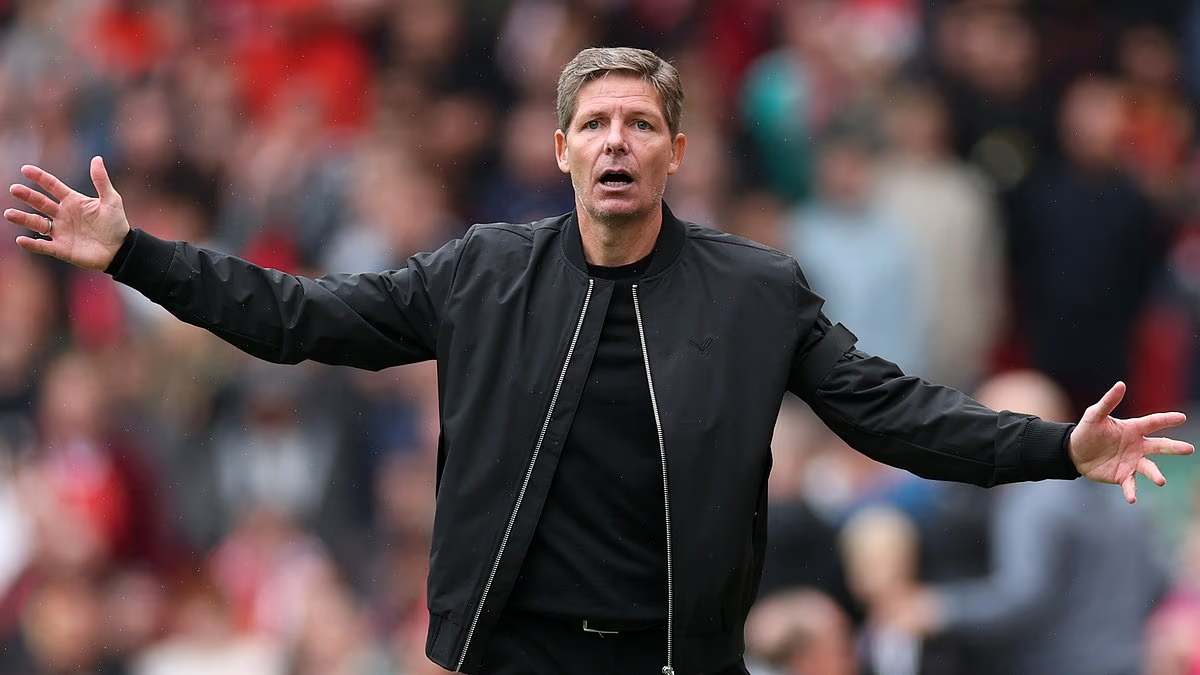

If football management were a game of chance, Oliver Glasner has just pushed all his chips into the middle and placed them on red at one of Nottingham’s most famous casinos.
After publicly criticising his Nottingham Forest players following Saturday’s 2-0 defeat by Brentford, Glasner took things further by sending the squad out for their usual Sunday recovery session along the banks of the River Trent. Footage shared on social media showed Premier League footballers jogging through an overgrown field, watched by a seemingly bewildered dog-walker.
Those decisions would carry a degree of risk even if Forest were flying and the dressing room was straightforward to manage. Instead, the club sit 19th in the Premier League and Glasner is attempting to steady a squad with a reputation for becoming unsettled quickly.
Forest are understood to be paying Glasner more than £10million a year, while owner Evangelos Marinakis has so far shown patience. Yet supporters are often wary when clubs speak of long-term plans and three-year projects. Only three of the Premier League’s current 20 managers have remained in their posts for that length of time.
At any club, a manager who continues to lose games will feel the pressure. That is especially true at Forest, who dismissed three managers last season and another during the summer. Glasner has suffered six defeats in his first 10 matches in charge and has recorded only one victory. Whatever the public messaging, the results have left him under serious pressure.
Unless Forest produce a clear response against Manchester City on Saturday, the November international break could prove a deeply uncomfortable period for the Austrian.

Without a clear Nottingham Forest response against Manchester City on Saturday, Oliver Glasner faces an uncomfortable November international break
Why Glasner finally lost patience
There was no single incident that caused Glasner to snap, although Brentford’s opening goal in the 30th minute undoubtedly played a significant part.
Forest centre-back Murillo, whose form has deteriorated alarmingly this season, appeared to watch as Bees goalkeeper Caoimhin Kelleher sent a long clearance over him and into the path of Dango Ouattara. The Brentford forward then moved beyond Murillo before Nikola Milenkovic inadvertently turned the cross into his own goal. Glasner had already been unhappy with Murillo’s physical condition when he returned for pre-season and was furious at the defender’s lack of urgency.
This was not an isolated lapse. Jay Dasilva’s winning goal for Coventry at the City Ground in September also followed a similar diagonal ball from goalkeeper Carl Rushworth. On that occasion, Daniel Munoz — another player coached by Glasner — was responsible. The pattern was the same: poor concentration and avoidable mistakes.
Daily Mail Sport understands that Glasner believes his squad does not always show sufficient seriousness. The players are said to have good relationships with one another, but there is a growing sense that disappointing results do not affect them deeply enough. After taking just one point from a possible 15, Glasner appears to question whether there should still be so much laughter and casual behaviour around the training ground.
Most of Forest’s players have never won a European competition or lifted a major trophy in one of Europe’s top five leagues. Glasner has achieved both. Those close to the manager believe some members of the squad act as if they are established superstars despite having done little to justify that status.
Glasner is also understood to be questioning his own decisions. In hindsight, he may wish he had imposed himself more forcefully from the beginning, particularly after being alarmed by Forest’s physical data from previous campaigns.
Forest covered fewer kilometres than any other Premier League side in 2024-25, while only Liverpool and Chelsea covered less ground last season. The club ranked second-bottom for sprints in 2024-25, ahead of only Arsenal, and last season only Everton recorded fewer. Glasner’s Crystal Palace teams never finished lower than 12th in those four measurements.
When Glasner has criticised his players or club publicly in the past, the approach has generally produced a reaction. His teams at Wolfsburg and Eintracht Frankfurt improved after similar interventions. At Crystal Palace last January, he openly challenged the club’s hierarchy following a match at Sunderland and many expected him to be dismissed. Instead, he remained until the summer and delivered the Conference League. Forest, however, presents a very different challenge — one that may soon expose the risks of his methods.

Glasner was unhappy with Murillo’s condition when the defender returned for pre-season and was angered by the Brazilian’s lack of urgency at Brentford
Inside a difficult Nottingham Forest dressing room
Player power played a significant role in the departures of Ange Postecoglou and Sean Dyche last season. Once footballers feel able to bypass a manager and take their complaints directly to the club’s decision-makers, the manager’s authority can quickly weaken. That is the threat facing Glasner.
Daily Mail Sport understands that some Forest players are unhappy both with Glasner’s tactical preferences and his demanding personality. The Austrian is committed to a back-three system, while several members of the squad feel more natural playing in a back four. His strict methods also contrast sharply with the relaxed style of Vitor Pereira, whose warmth and approachable manner helped unite the group after Dyche and contributed to Forest’s survival in the Premier League.
There is also surprise that Glasner has not appeared to make bringing the dressing room’s influential figures onside a central priority. Morgan Gibbs-White, Ola Aina and Callum Hudson-Odoi are among the squad’s strongest voices, and isolating any of them could be dangerous. Ibrahim Sangare and Nico Dominguez are also highly regarded within the group, yet both have spent periods on the fringes, along with Aina and Hudson-Odoi.
Gibbs-White is unquestionably Forest’s most gifted player, but he is not always an easy personality to manage. If the captain does not fully buy into a manager, that manager’s position can become particularly fragile.
It was already a difficult summer for Gibbs-White. He was disappointed that no Champions League club made a move for him, changed agents and was subsequently omitted from England’s World Cup squad. Some observers feel Glasner’s disciplined tactical structure does not maximise the midfielder’s strengths. Gibbs-White likes to drift across the attacking line and drop into deeper areas, freedom that Pereira was willing to give him but Glasner does not naturally provide.
Gibbs-White’s body language has also stood out at times this season. He is visibly frustrated when team-mates make mistakes, yet the 26-year-old has contributed only one goal — a penalty — and two assists so far this campaign.
He also watched Elliot Anderson leave Forest for Manchester City during the summer, which may have prompted questions about why his own career has not followed a similar path towards the Champions League.
It is fair to question some of the advice Gibbs-White has received from those around him. If he is asking why he remains at a bottom-half Premier League club, a degree of honest self-reflection would not go amiss.

Callum Hudson-Odoi is one of Forest’s influential dressing-room voices, making it important that Glasner does not push him aside

If Morgan Gibbs-White is questioning why he remains at a bottom-half Premier League club, some honest self-reflection may be required
What is Evangelos Marinakis thinking?
Marinakis did not make Glasner the highest-paid manager in Nottingham Forest’s history with the intention of dismissing him at the first setback. During their discussions, Glasner is believed to have made clear that he would need time to implement his ideas.
Both men are known to have strong personalities, and Marinakis may even have agreed with some elements of Glasner’s public criticism. However, that does not guarantee the manager protection. Marinakis took player opinion into account when he dismissed Postecoglou and Dyche.
Should the Glasner project collapse, attention will inevitably turn to George Syrianos. Forest’s chief football officer has greater influence at the club than ever before and was a strong advocate for Glasner, whom he has known for years through his connections in German football.
The pair are believed to have discussed potential transfer deals while Glasner was at Crystal Palace, and the manager would probably have welcomed the opportunity to work with Syrianos at Selhurst Park.
Syrianos had wanted Glasner to replace Steve Cooper in December 2023, but Marinakis opted for Nuno Espirito Santo. Marinakis’ son, Miltiadis, is a regular presence at the training ground and will report directly to his father. For Glasner and his main supporter at the club, the current moment is becoming increasingly demanding.
Dyche has also offered his perspective. During Forest’s difficult run last season, he brought players and staff together to ask what they believed needed to change.
Expecting discussions about formations and tactics, Dyche was reportedly stunned when one player focused instead on the decision to move the team’s weekly barber appointment from Friday to Thursday. That player remains at Forest, while Dyche was gone within four months.
Dyche made plenty of mistakes during his time at Forest, but his most recent posts on Threads appeared particularly relevant to Glasner’s situation.

If the Glasner project unravels, George Syrianos will face difficult questions after strongly backing the Forest manager

Forest’s underlying problem is that even when players fail to take responsibility, they are rarely the ones who pay the highest price
He wrote: ‘The badge is bigger than everyone… and yet it does not seem that way anymore. I can only hope the situation changes and that the culture we insisted upon is now being examined and recognised as what was, and still is, required. Oliver is saying many of the same things I was saying, in his own way.
‘Nottingham Forest are still struggling to score goals — something my staff and I experienced too. We scored, but nowhere near as often as the underlying data suggested we should. Was that not enough to keep us in our jobs?
‘We had 35 attempts on goal against Wolves and still drew 0-0. That result ultimately led to myself and my staff being dismissed. I hope Oliver is given more time, that the supporters remain behind him and that the players take responsibility.’
The central problem at Forest is that, even if the players fail to stand up and accept responsibility, they are seldom the ones who pay the ultimate price.


