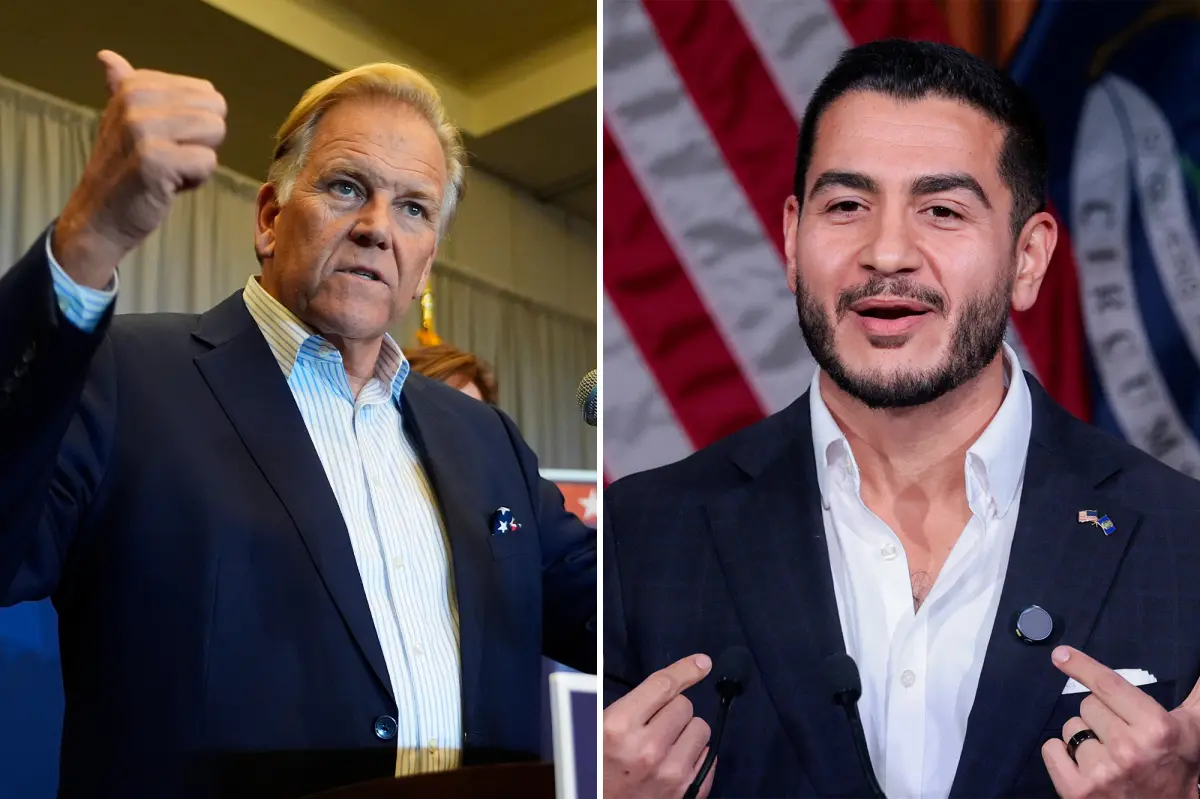

WASHINGTON — Democrat Abdul El-Sayed stunned political observers by defeating Republican Mike Rogers in Michigan’s pivotal Senate race, overturning the conventional wisdom that a candidate from the party’s far left could not prevail in a purple-state battleground.
El-Sayed becomes the first Muslim elected to the US Senate.
“Michigan, we did it,” El-Sayed told supporters at a victory celebration in Detroit.
“I am so proud and honored to stand here as your senator-elect from the great state of Michigan.”
The Associated Press called the race at 2:27 a.m., with El-Sayed ahead of Rogers 52% to 46%.
The seat, opened by the retirement of Sen. Gary Peters (D-Mich.), was widely viewed as essential to Democrats’ effort to regain control of the upper chamber.
El-Sayed campaigned from the party’s far-left flank, promising to replace the existing health insurance system with universal Medicare for All coverage, abolish Immigration and Customs Enforcement, impose substantially higher taxes on the wealthy and end military assistance to Israel.
He also declined to commit to supporting Senate Minority Leader Chuck Schumer (D-NY) as the Democrats’ leader, saying he would prefer Sen. Chris Van Hollen (D-Md.) for the role.
“The current minority leader has given all of us ample reason to question whether or not he would be our best bet heading into a cycle where we might have the majority, and I think there’s absolutely room for change,” El-Sayed told The Post in August.
“A vote is a choice between two or more options. I don’t know what other options are. If it happened to be a guy named John Fetterman from Pennsylvania, or Chuck Schumer, well then, I’d make a different decision,” the progressive Democrat added.
El-Sayed entered the general election politically battered after surviving a bruising three-way primary in August. During that contest, he appealed to the far left by campaigning alongside controversial streamer Hasan Piker and other prominent progressive figures.
He also made opposition to Israel a central issue in his primary fight with Rep. Haley Stevens (D-Mich.), a self-described Zionist and more moderate Democrat. El-Sayed’s comments on Israel alienated Jewish Democrats, a constituency Rogers actively sought to attract.
More coverage of the 2026 midterm elections:
Two days before Election Day, Stevens jolted the contest by unexpectedly endorsing Rogers. She appeared with him at a Detroit church and publicly criticized El-Sayed.
RELATED: Mother and Daughter Killed in Suspected Grizzly Bear Attack
Stevens had faced pressure from her mother and fiancé to support Rogers. But she also cited El-Sayed’s refusal to call for the removal of a controversial ad by Cenk Uygur and her anger over being excluded from a unity event involving his campaign.
“Our Democratic nominee for US Senate, Abdul, said that I was no longer welcome in his campaign and that I should stay away. And he’s right,” Stevens said in a video endorsing Rogers.
“And that’s why I am endorsing Mike Rogers for the United States Senate today. I don’t belong in Abdul’s campaign. I do not stand with Hasan Piker.”
The race between Rogers and El-Sayed grew increasingly bitter as the stakes rose, with Senate control hanging in the balance. Rogers repeatedly portrayed El-Sayed as a national security risk.
The former House Intelligence Committee chairman pointed to alleged ties between members of El-Sayed’s family and organizations including the Muslim Brotherhood. El-Sayed’s biological mother worked for the Islamic American Relief Agency, which the US designated as a terrorist organization in 2004 for supporting Al Qaeda and Hamas.
El-Sayed said he was raised by his American stepmother and condemned organizations such as the Muslim Brotherhood.
Follow for live updates on the 2026 Midterm Elections
He also faced backlash over several remarks, including his refusal to say that Iran posed a greater threat to the United States than Israel. Leaked audio also captured him sounding uneasy about commenting on the death of former Iranian Supreme Leader Ayatollah Ali Khamenei because he feared alienating voters.
El-Sayed additionally refused to disavow Piker, who has said, among other offensive things, that “America deserved 9/11.” While campaigning with the streamer, however, the Democratic candidate condemned those remarks.
At times, El-Sayed framed his positions as a progressive version of an “America first” foreign policy and expressed frustration that his name and Muslim faith were being used against him politically. Even so, he predicted that he would “smoke” Rogers by seven points.
El-Sayed attacked Rogers with similar force, accusing him of being bought and paid for, criticizing his ownership of a “yacht,” and portraying him as a carpetbagger, a stooge for President Trump and an advocate of expanded government surveillance.
Although he called himself a capitalist and was never formally affiliated with the Democratic Socialists of America, El-Sayed received support from prominent DSA allies including Sen. Bernie Sanders (I-Vt.) and Rep. Alexandria Ocasio-Cortez (D-NY).
Ocasio-Cortez said in October that an El-Sayed victory would upend the “entire political calculus in America.”
“If Abdul can win in Michigan, anybody can win anywhere,” she said.


