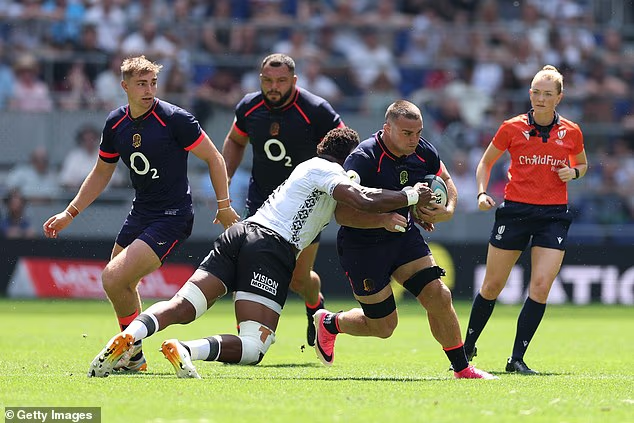

International rugby returns in spectacular fashion this month, and with the next World Cup less than a year away, November’s fixtures carry enormous importance.
The matches will determine the remaining places in the inaugural Nations Championship while also providing crucial preparation for the 2027 World Cup in Australia.
Time is running out for any side hoping to prevent South Africa from becoming the first team to win three consecutive World Cups. That makes every game particularly significant.
The opening round of the Nations Championship in the summer was overshadowed by the FIFA World Cup. November should be different, however, because this has traditionally been one of rugby’s biggest months.
Adding a competitive edge to both the summer and autumn windows is a major positive.
The Nations Championship’s availability on terrestrial television through ITV is another important development. To preview the action, I sat down with my ITV colleague and former fly-half rival Ronan O’Gara…

International rugby is returning this week with the inaugural Nations Championship

Daily Mail Sport’s Dan Biggar sat down with the legendary Ronan O’Gara to discuss the action
England
England’s opening match against Australia is enormous. If they win that contest and then overcome Japan, they will have recorded four successive victories. That momentum would give them a genuine chance against New Zealand, just as it did this time last year. But defeat by the Wallabies would bring back all the pressure and criticism generated by their worst-ever Six Nations campaign.
‘The England-Ireland match left me completely unsure about where England are,’ O’Gara tells me. ‘I have never seen such a complete 80-minute demolition. Coaches do not easily forget or forgive performances like that, and neither does the public. It could leave a scar.’
England won just once in the Six Nations and suffered their first defeat by Italy. They then lost to South Africa in the summer before victories over Fiji and Argentina. The verdict on Steve Borthwick’s side remains undecided.
‘England have historically performed well at World Cups,’ O’Gara says. ‘You can usually rely on the mentality of their forwards. For England to move to the next level, they need to kick intelligently, as every Test team must.
‘Where I feel England do not always reach their maximum is when they fall back on the box kick instead of trusting their instincts and playing what is in front of them. Their rugby can become too prescribed rather than instinctive.’
England have some fitness concerns ahead of the Australia game, particularly at No 10 with Fin Smith. However, every team is dealing with injuries and England possess impressive depth. They need to beat Australia.
‘We have not seen much defence like Test-match defence in the PREM this season,’ O’Gara adds. ‘The way the sport is developing generally favours attack. What is interesting is that many PREM matches—not every one, but many—are decided in the final 10 minutes.
‘At Test level, most games are settled in that period. Whether that helps or harms England is something we will discover this month.’

Ronan O’Gara and Dan Biggar with The Debrief presenter Claire Thomas

If England struggle in these games the pressure will ramp up on head coach Steve Borthwick
Ireland
It is clear that Ireland are not the same side they were at the last World Cup. There is work to do. Yet before the 2023 tournament in France, Ireland were ranked No 1 and still failed to progress beyond the quarter-finals. Perhaps they are intentionally flying under the radar this time.
‘We are still no closer to knowing who is in charge of the team at fly-half: Sam Prendergast or Jack Crowley?’ says O’Gara, who won 128 caps for Ireland and toured three times with the Lions.
‘That remains an obvious question. The centre combination is another concern. Bundee Aki, Garry Ringrose, Robbie Henshaw and Stuart McCloskey are all on the other side of 30. Experience matters, but you also need young, vibrant players desperate to compete. In modern rugby, you have to allow for an average of three or four injuries per match. Physically, it is incredibly brutal.
‘If Ireland lose players from their strongest 23, do they have enough depth to reach a World Cup final? I hope they do. Winning a World Cup is about the strength of the entire squad rather than simply the starting team.
‘There is certainly a significant drop at scrum-half once Jamison Gibson-Park is unavailable, but that is the reality when you have a world-class player.’

Ireland aren’t the team now they were at the last World Cup but will hope to go under the radar
Wales
Wales have plenty to address. Their immediate priority is continued development. The team appeared to make encouraging progress towards the end of the Six Nations, which made the subsequent summer Nations Championship performances particularly disappointing.
The positive for Wales is that several of their players are in excellent form. Some of the PREM Rugby’s leading performers this season have been Welsh, including Jac Morgan, Louis Rees-Zammit and Aaron Wainwright. There are many others. Morgan has been outstanding for Gloucester and, if he were English, I believe he would start for England.
The political debate over reducing Wales’s four professional teams continues in the background, but it cannot be used as an excuse for poor performances. ‘Winning at club level is hugely important,’ O’Gara says. ‘Wales have not had enough of that historically, and their players have been starved of confidence at Test level.
‘However mentally strong you are, you cannot simply switch that confidence on. Winning becomes a habit.
‘I watched Gloucester play Bordeaux in the Champions Cup. The best players on the field were not French. That is encouraging for Wales as well as England.
‘For Wales, success should not be judged only by wins at this stage. It should be measured by progress, and I think their coaching team has delivered that. There should be renewed energy in the camp.
‘Beating Japan has to be non-negotiable.’

Wales have endured a difficult period and they need to start winning games to gain confidence
Scotland
‘Scotland are another side that appear to make huge progress before undoing much of their good work with a flat performance,’ O’Gara says.
‘Their opening match against New Zealand is extremely difficult to predict. Most people will favour the All Blacks, but a closer look suggests it could be fascinating—particularly if conditions at Murrayfield are wet.’
Scotland came agonisingly close to defeating New Zealand this time last year, producing an impressive performance before falling short when Damian McKenzie scored a decisive try.
Gregor Townsend’s team have regularly performed well against England. But, like Australia, they have generally been consistently inconsistent. It has been said for some time, but that must change if Scotland are to make a statement before the World Cup.
Defeating the All Blacks would be an ideal way to start.

Gregor Townsend’s Scotland side have been consistently inconsistent over recent times
What about the rest?
In my view, only four or five teams have a realistic chance of lifting the World Cup.
Those sides are South Africa, New Zealand, France, Ireland and perhaps England. The global game needs Australia, Argentina and Wales to be strong, but none of them currently appear capable of challenging the leading teams. It will be particularly interesting to see the influence of my former coach Shaun Edwards on Argentina.
The All Blacks already look significantly improved under Dave Rennie compared with their performances while Scott Robertson was in charge. France’s depth will be tested severely, with several key players unavailable. Thomas Ramos, Emmanuel Meafou, Thibaud Flament and Julien Marchand are all injured.
France against South Africa is the standout regular fixture this autumn, and the two teams could meet again in the Nations Championship final, even with Les Bleus affected by those absences.
‘France are missing important locks and they still do not know their best tighthead prop,’ says O’Gara, who has agreed a long-term extension with French club La Rochelle.
‘If the World Cup final were played tomorrow, South Africa and France would be the two favourites. France’s problem is a huge gap in their set-piece. Nobody has replaced Uini Atonio.’
Japan and Fiji are expected to occupy the bottom two positions in the southern hemisphere table, with those teams likely to face either Wales or Italy on finals weekend. Italy lost all three summer matches and have been badly hit by injuries, so they face a difficult campaign.

South Africa are hoping to become the first team to win three World Cups in a row
Things to watch out for…
‘Rugby has only begun to understand how important the bench is,’ O’Gara tells me. ‘Test matches are now often decided by the replacements, and they are incredibly influential.’
South Africa coach Rassie Erasmus almost reinvented the game through his use of the Springbok ‘bomb squad’. O’Gara says: ‘We have reached a stage where coaches must decide whether to begin with their strongest side or finish with it. That is now a genuine tactical choice.
‘Fans should also watch the growing influence of hybrid players—those capable of operating as both forwards and backs. South Africa’s Andre Esterhuizen is one example, while France have several.
‘There are plenty of rumours in France that Louis Bielle-Biarrey could move to No 10 during the second half of matches rather than remain on the wing.’
The emergence of hybrid players will only increase the speed of international rugby. When a back-row forward such as Henry Pollock possesses the pace of a wing, it creates new possibilities.
A hybrid player can allow a team to select six forwards and two backs on the bench—or, as Erasmus has sometimes done, seven forwards and one back.
The most effective way to score points today is to attack an unstructured defence. Those chances are uncommon, so teams must exploit them when they appear.
My three players to watch are New Zealand’s Jordie Barrett, France’s Theo Attissogbe and Fiji flyer Jiuta Wainiqolo. Barrett produces moments of X-factor, but he is also the glue holding the All Blacks together. He carries out an enormous amount of hard, often unnoticed work. Watch him in person and you will see how outstanding he is. Attissogbe is expected to get an opportunity for France with Ramos injured and offers a serious threat with ball in hand.
As for Wainiqolo, search for his name on YouTube, sit back and enjoy the highlights.

New Zealand star Jordie Barrett is one of my three players to watch for the upcoming action
It’s just a game…
If England lose to Australia, the pressure on head coach Borthwick will become immense and it will dominate the rugby headlines. However, professional sport must also be viewed in a wider context. The sudden death of former Sale lock Hyron Andrews last month reminded us to enjoy Test rugby for what it is: competitive and serious, but also entertainment.
Andrews died on the eve of representing South African side Lions against O’Gara’s La Rochelle. ‘I don’t think what happened has fully sunk in yet,’ O’Gara says of Andrews’ tragic death.
‘When you are inside such a bubble, you go into denial. I was the coach and had to tell my players the news. You try to be bulletproof, but you keep asking yourself: “Is this really happening?” I woke the next day wondering how the match could go ahead. I have to say, it still feels like a haze.
‘We got through the game and shared beers with the Lions players in the changing room, but much of it still feels unclear to me. It has reinforced one truth: whether in rugby or in life, your health is your wealth.’

Watch Dan Biggar and Ronan O’Gara discuss all the major Nations Championship talking points on The Debrief, in association with Allianz, every Sunday in November. The programme begins this Sunday at 7pm on ITV4, 11.30pm on ITV1 and on ITVX. This week’s guest is former England head coach Eddie Jones.