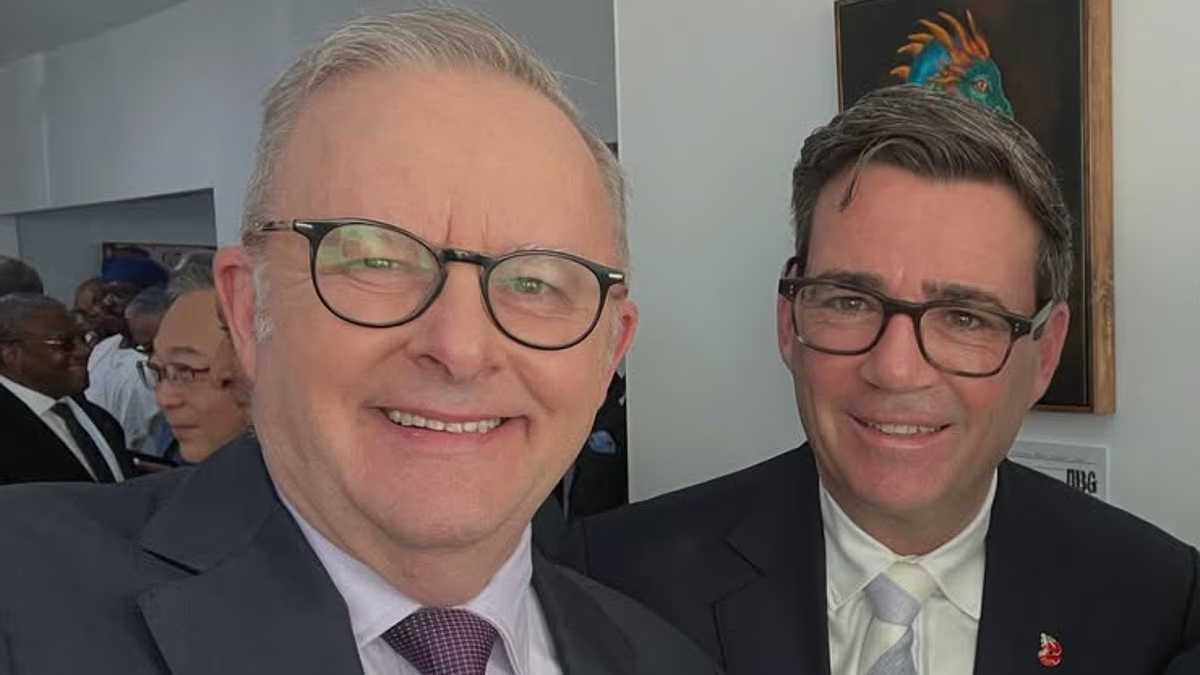

Prime Minister Anthony Albanese has defended his Caribbean trip for a Commonwealth leaders’ summit as “worthwhile”, despite dining with members of the royal family and visiting a vessel owned by mining billionaire Andrew “Twiggy” Forrest as Australian borrowers endured another interest rate rise.
Mr Albanese returned to Australia after travelling to Antigua and Barbuda for this week’s Commonwealth Heads of Government Meeting, known as CHOGM.
During an official dinner, the Prime Minister joined King Charles III and Queen Camilla for a specially prepared Caribbean menu.
He also attended the launch of the Commonwealth Nature Initiative aboard Mr Forrest’s Green Pioneer, alongside Antigua and Barbuda Prime Minister Gaston Browne and Guyanese President Irfaan Ali.
While Mr Albanese was overseas, the Reserve Bank delivered its fifth interest rate increase of the year, leaving many homeowners facing hundreds of dollars in additional monthly repayments, according to industry modelling.
Asked about the decision during the trip, the Prime Minister said the government remained focused on building a stronger economy.
Following his return on Saturday, Mr Albanese maintained that the summit had been “worthwhile”. He also said the cash rate, now at an 18-year high, would not alter the government’s plans for the Mid-Year Economic and Fiscal Outlook, or MYEFO.
“We’ll be consistent. We’ve looked for savings in each and every economic statement, and we’ll do so again in MYEFO,” he said, according to ABC News.

Anthony Albanese said CHOGM offered a valuable chance to hold talks with UK Prime Minister Andy Burnham and Canadian Prime Minister Mark Carney

Australians faced another mortgage increase on Tuesday while Albanese was abroad, after the Reserve Bank raised rates by a quarter of a percentage point. RBA Governor Michele Bullock is pictured

Anthony Albanese (left) met King Charles III (right) and Andrew “Twiggy” Forrest (centre) during the Commonwealth summit in Antigua and Barbuda
He said Labor was preparing a “savings package” for the economic update, although the government has released few details and the measures may not deliver net savings.
“We’re working on all of this,” Mr Albanese said, gesturing towards documents he was carrying.
Asked by The Australian why Australia’s inflation rate remained above those of comparable economies, Mr Albanese said price pressures were affecting countries around the world. He also pointed to the inflation rate inherited by Labor, saying it had “a six in front of it” when the government took office.
Defending his attendance at CHOGM, Mr Albanese said the gathering created an opportunity to address major international issues with Commonwealth leaders without the United States or China dominating the discussion.
“I see the relationship between Mark Carney, Andy Burnham and myself as being very important,” he said.
“If there wasn’t a forum that didn’t feature the strategic competition between [the] US and China, and didn’t have authoritarian regimes like Russia involved, you might have to make it up. But there is, it’s called the Commonwealth.”
The meeting concluded without any major policy announcements from the participating leaders.
Mr Albanese also described discussions with Mr Burnham about regional work arrangements for British backpackers as “constructive”, but provided no further details.
MUST READ: Trump’s 72-Hour Clash With Chief of Staff Susie Wiles

Anthony Albanese attended the official CHOGM dinner with Queen Camilla
Opposition Leader Angus Taylor accused Mr Albanese and Treasurer Jim Chalmers of being “in denial” about the state of Australia’s economy.
“We do need to lower government spending,” he said.
“This [inflation challenge] is homegrown. This is specific to Australia because of this government’s failures.”
Mr Albanese had earlier argued that attending the summit was in Australia’s national interest, noting that he had accepted a personal invitation from King Charles.
Asked on ABC News Breakfast whether he would have accepted the invitation, Mr Taylor said the answer would depend on the circumstances.
“Let me say in any normal circumstances, going to CHOGM would be the right thing for any Prime Minister to do. But these are not circumstances that are normal,” he said.
Mr Albanese is expected to leave Australia again within days for a series of international meetings, including COP31 in Türkiye, ASEAN in the Philippines and APEC in China.
The overseas travel comes as households across Australia confront mounting financial pressure ahead of Christmas, with elevated borrowing costs adding to broader cost-of-living concerns.

Opposition Leader Angus Taylor indicated Australia’s economic circumstances could have influenced whether he accepted the summit invitation
On Tuesday, homeowners suffered another mortgage blow when the Reserve Bank lifted interest rates by a quarter of a percentage point, pushing borrowing costs to a new high as policymakers continue their fight against persistent inflation.
The increase lifted the cash rate from 4.60 per cent to 4.85 per cent, its highest level since the global financial crisis in 2008.
According to Canstar modelling, a borrower with a $600,000, 30-year mortgage taken out when Labor came to power in May 2022 would initially have faced repayments of $2,399 a month.
Following the latest increase, the monthly repayment would rise to $4,056 — an additional $1,657 a month, or $19,884 over a year.
For a $600,000 loan, an increase in the interest rate from 2.5 per cent to 6.74 per cent adds $2,120 a month, or $25,440 annually, in interest alone. The comparison assumes the loan balance remains unchanged and does not include principal repayments.
Reserve Bank Governor Michele Bullock did not indicate how high interest rates might go, saying the central bank would continue tightening monetary policy for as long as required.
The RBA acknowledged that economic growth was slowing but said stubborn inflation and rising international risks, including the war in the Middle East and higher oil prices, justified another rate rise.
Mr Chalmers said earlier in the week that Labor accepted responsibility for its role in addressing inflation, while arguing that the conflict in the Middle East had been the main factor behind the latest increase.
Finance Minister Katy Gallagher said the government also deserved recognition for the “hard work we have done over the last four years” to control spending.


