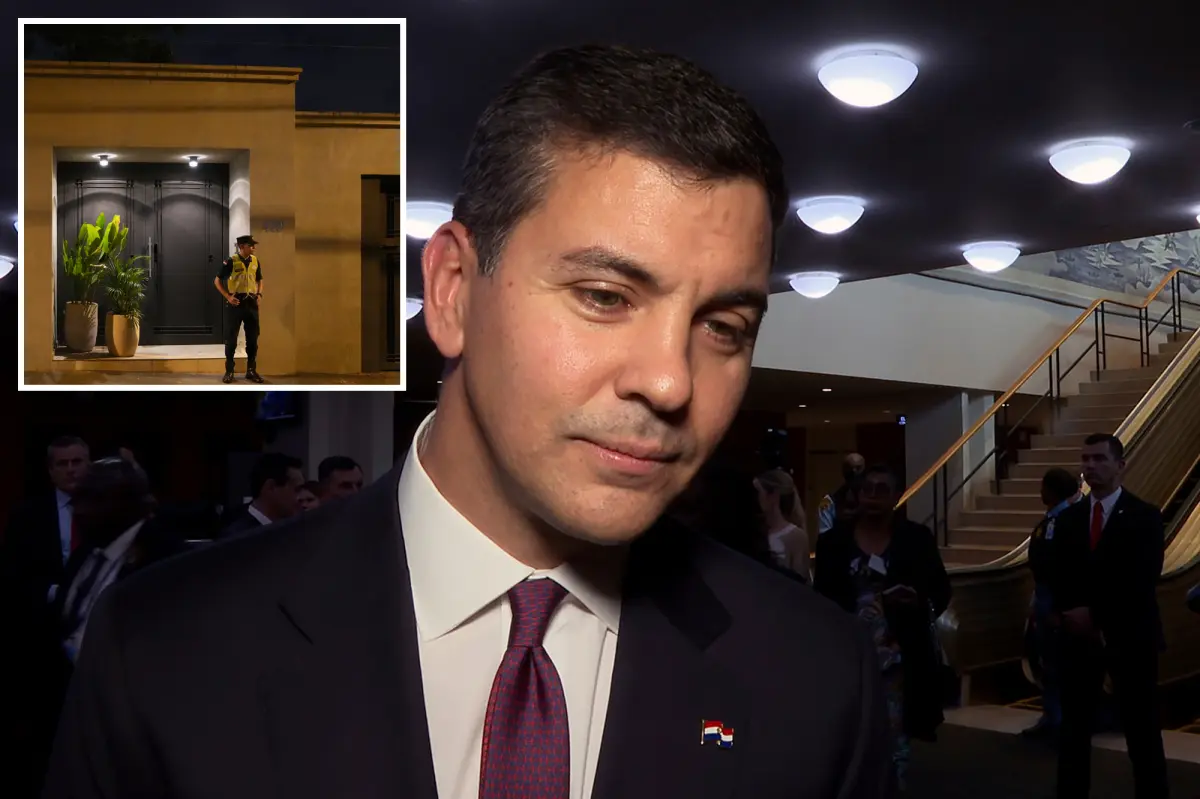

Paraguay’s ousted president, Santiago Peña, was placed under house arrest Friday on allegations including breach of trust and influence peddling. The move came hours after the Senate removed him from office over the collapse of Ueno Bank, a government-connected lender whose failure left nearly half of the nation’s 6 million residents unable to access their savings.
All 44 senators present voted to impeach Peña for misconduct, making him the second Paraguayan president forced from office since Gen. Alfredo Stroessner’s 35-year dictatorship ended in 1989.
As lawmakers delivered the verdict, bringing down what had been regarded as one of South America’s most stable governments, cheers erupted from the crowd gathered outside Congress.
Depositors, pensioners and students wearing Paraguay’s national soccer jerseys waved flags, sang and embraced one another while chanting, “Dictatorship never again!”
The political earthquake followed regulators’ seizure of Ueno Bank just three days earlier, an event that rattled the financial system and triggered Paraguay’s deepest political crisis in more than a decade.
An ousted president, under house arrest
Peña was ordered to stay at one of his homes in Asunción until appearing before prosecutors Saturday morning. He faces accusations of breach of trust, influence peddling and abusing public office for personal benefit. The most serious charges carry potential prison sentences of up to 10 years.
Lawmakers allege that Peña used his political power to direct hundreds of millions of dollars in public funds to Ueno while regulators failed to intervene over questionable insider lending.
Peña has rejected the accusations and denied any wrongdoing.
Police surrounded the residence Friday night as protesters gathered outside, raising flags and promising to remain there until morning to ensure the former president did not flee.
Prosecutors also ordered the arrest of Carlos Carvallo, the former head of the finance company that later became Ueno. Peña appointed Carvallo to lead the central bank in 2023. It was not immediately known whether authorities had taken him into custody.
Vice President Pedro Alliana was sworn in Friday as president and will complete the current term, which runs through August 2028. “The Paraguay we receive today has urgent needs,” Alliana said. He is also being investigated in connection with Ueno and now faces pressure to recover depositors’ funds and hold those responsible to account.
Before the Senate vote, Peña issued a farewell message saying he did not want his “presence to become a source of greater division or instability.”
“I say goodbye with gratitude, without ignoring the anguish of those who are waiting for answers today,” he wrote.
Anger among Paraguayans has intensified with each passing day. While senators debated his fate Friday, demonstrators demanding the return of their frozen savings marched through central Asunción, shouting, “Santi Peña to Tacumbú!” The chant referred to the capital’s main prison, where Ueno founder and former chief executive Miguel Vázquez is being held.
“This was an enormous betrayal of trust,” said Yinal López, an employee of the state electricity company whose workplace pension fund also held money at Ueno. “The president has made a mockery of the people.”
Frozen accounts, rising anger
After regulators took control of Ueno, customers were unable to withdraw cash, access their savings or use their bank cards for purchases.
The digital lender had aggressively pursued low-income and unbanked customers with attractive supermarket rebates. According to Ueno, more than 1 million Paraguayans opened their first bank account with the institution.
Members of Paraguay’s national soccer team, which Ueno sponsored during its run to a World Cup victory over Germany this year, have also said they cannot access their funds.
The consequences have reached far beyond individual depositors. A ride-hailing service that depended on Ueno’s banking system shut down, leaving roughly 3,000 drivers out of work.
The state electricity company said $21 million in loans from the Inter-American Development Bank and Taiwan, intended to finance public infrastructure, was stuck inside the failed bank. Paraguayan bonds suffered some of the steepest losses among emerging markets this week, while the guaraní weakened against the dollar.
SEE ALSO: U-Haul Seen at Karen Bass Home After Nithya Raman Wins LA Mayor Race
Some customers began receiving their money Thursday, with initial payments going to depositors holding up to 10 million guaraníes, or approximately $1,500.
Deposits are insured up to roughly $35,000, a threshold the central bank says protects 97% of Ueno customers. Officials have described the bank’s collapse as an isolated failure and maintained that Paraguay’s broader financial system remains secure.
Separately, prosecutors have charged 27 people connected to Ueno, including Vázquez, with offenses such as breach of trust and attempted fraud.
A judge ordered six former directors, including Vázquez, to remain in pretrial detention. Two other former executives were placed under house arrest and fitted with electronic monitoring devices.
Authorities have also confiscated luxury vehicles, a yacht and two small aircraft linked to Vázquez.
A bank built on public money
Ueno expanded from a little-known lender into one of Paraguay’s biggest banks by deposits within only a few years. More than $800 million in public funds helped fuel its rapid growth.
The bank attracted more than two-thirds of the country’s adults, with its highly visible logo appearing everywhere from Paraguay’s national stadium to the bank cards used by street vendors.
The impeachment case pointed to Peña’s former ownership interest in Ueno’s parent company, which he surrendered under pressure last year, as well as his decision to appoint Carvallo to head the central bank responsible for regulating the lender. Legislators also accused him of allowing the state pension fund to place $355 million with Ueno, exceeding legal limits.
Analysts say Peña’s political and business ties may have protected Ueno from closer scrutiny even as questions about its financial condition mounted.
“Under Peña, the central bank began to lose credibility, lose neutrality and then relax all its control mechanisms to favor the business group that had Ueno Bank as one of its pillars,” said José Tomás Sánchez, a political theory professor at the National University of Asunción.
Peña continued defending Ueno until only weeks before its collapse. Last month, he told reporters that a regulatory investigation did not mean the bank was about to close and accused the media of spreading unnecessary fear.
A bank collapse becomes a political reckoning
Peña’s descent was remarkably swift. In late October, he was being welcomed in Washington as a key ally and meeting with Treasury Secretary Scott Bessent. Within days, he had become a president confined to his own home.
Ueno was seized before dawn Tuesday. By Thursday afternoon, Peña had offered to resign after his conservative Colorado Party turned against him under the leadership of former President Horacio Cartes, the party’s chairman and Peña’s longtime political mentor.
By Friday, Peña was under arrest. His impeachment stripped away the legal immunity he would have retained had the Senate accepted his resignation.
A former International Monetary Fund economist, Peña rose politically with Cartes’ backing. The tobacco magnate appointed him finance minister and supported his presidential campaigns twice.
After taking office, however, Peña began trying to establish an independent power base and move out from under Cartes’ influence, according to analysts. Ueno’s access to public money became a central part of that strategy.
“It’s like a Shakespearean drama. He tried to displace his mentor, his political patron,” said Miguel Carter, director of the Paraguayan research organization DEMOS. “But he did so on very fragile grounds.”
Cartes eventually pushed back. In September, senators aligned with him began publicly challenging the central bank over Ueno’s high-risk lending to related companies.
When Ueno collapsed this week, Peña’s political leverage collapsed with it. Cartes, who was once sanctioned by the U.S. Treasury over alleged corruption, then publicly demanded the removal of his former protégé.
“Cartes put the nail in the coffin,” said Andrew Nickson, a Paraguay specialist at the University of Birmingham. “Peña had no political base to rely on, and he was left high and dry.”


