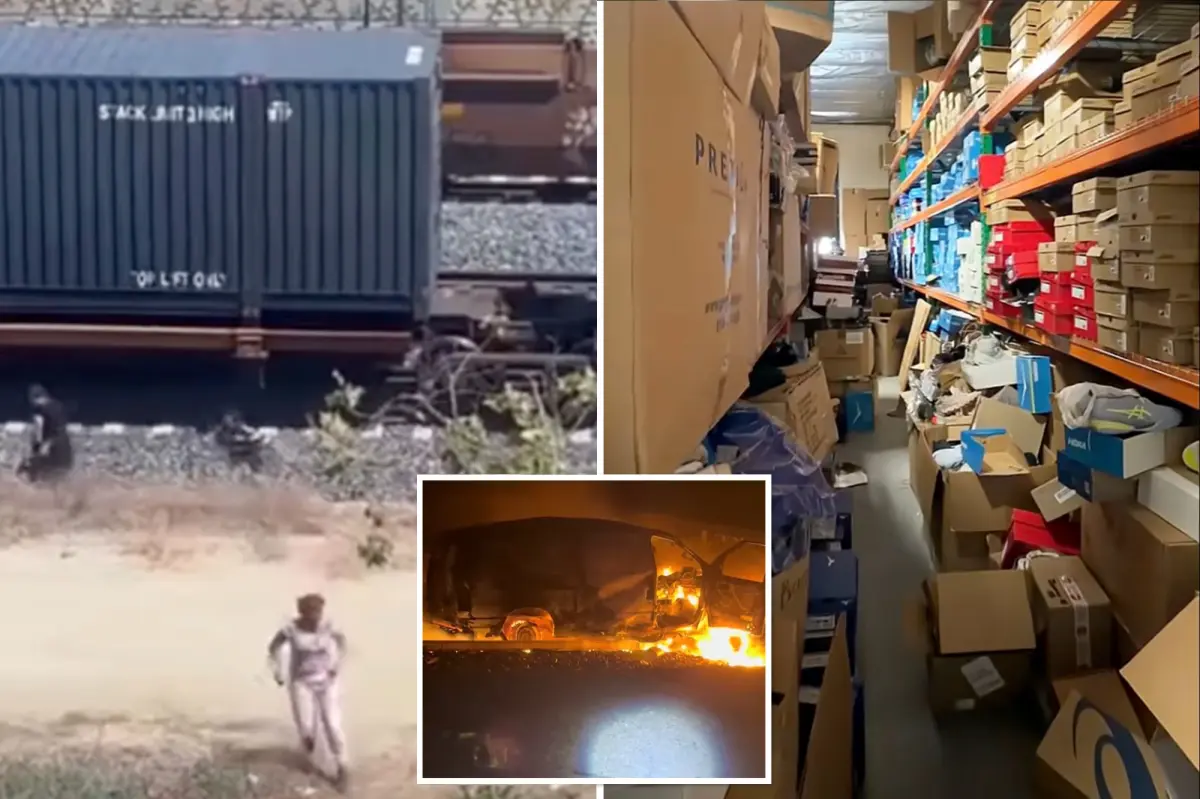

Brazen train robbers are increasingly targeting Southern California’s vast rail network to pull off sophisticated heists and quickly traffic their loot — even flaunting their crimes on social media.
More than 65,000 train heists occur nationwide each year, with anywhere from a 25% to 40% of the thefts hitting Southern California annually, investigators told The California Post.
The value of the bandits’ plunder reaches into the tens to hundreds of millions of dollars, according to sources with knowledge of the crimes.
Investigators revealed that tracking the crimes is difficult because they often go unreported, stoking fears that the epidemic could be even worse than imagined.
They say the trend is growing and more trains are being hit, as cartel-run crime rings behind the operations grow bolder in their thefts of shoes, clothing, tools and electronics quickly resold at deep discounts online.
“We call it shopping,” Supervisor Detective Carlos Monteroso of the LAPD’s Cargo Theft Task Force told the California Post. “The crews break into individual containers until they find what they’re looking for that’s high value. Then they’ll do their thing.”
Insiders working at the Port of Los Angeles have access to computer files with sensitive information about valuable train loads, investigators say, feeding those tips to crime bosses who dispatch their cavalries to remote train tracks.
LA has managed the busiest container port in the Western Hemisphere for the past 25 years, with roughly 2.65 million 20-foot containers leaving the port annually via railway. Thefts aren’t always reported because they occur on private railways, investigators say.
With Christmas coming and new products making their way to stores for holiday shoppers, the detective said train thefts are set to explode, disrupting supply chains for sought-after holiday presents.
Monteroso explained that the thieves are highly organized.
“These crews have identified vulnerable points along the tracks where they’ll get onto the trains coming from the Port of Los Angeles,” he said. “They’ll ride them out to into a remote part of the desert where they cut the brake hose, to force an emergency stop.”
Once the trains are stationary, robbers have anywhere from minutes to hours to pilfer freight cars before police arrive, Monteroso explained.
As masked bandits cut into containers with electric handsaws, dozens of accomplices will arrive at the tracks in vans, SUVs and box trucks, sometimes filming the heists and posting them online.
“You’re seeing 20 guys, offloading several hundreds or thousands of boxes,” the detective said. “You know, just taking as much of the property as they can.”
Nike shoes, Victoria Secret pajamas, Yeti Coolers, DeWalt tools and more have been recovered by police or seen in viral videos of recent heists.
The stolen merchandise is then funneled to resellers, who market it to customers through eBay, OfferUp and similar online platforms. Those websites, Detective Monteroso said, “have become the places for these guys to sell all this stolen property.”
“There’s a whole network of buyers,” Monteroso said. “One person buys electronics, another specializes in shoes, while others focus on tools or e-bikes. There’s a lot of money to be made because of the sheer volume of goods being taken.”
Monteroso’s team recently dismantled a theft operation involving roughly $1 million worth of shoes. Among the stolen merchandise was an unreleased collaboration between Brooks and Disney that had been taken from a train and listed on eBay before the shoes were available to the public.
Working undercover, investigators purchased several pairs and followed the trail to a sprawling warehouse in Chatsworth. Inside, they found 35 pallets packed with Hoka, New Balance, Adidas, ON and Salomon footwear, as well as a large shipment of JanSport backpacks.
The warehouse was linked to 51-year-old Heros Tasci of Simi Valley, who was booked into Van Nuys Jail on suspicion of receiving stolen property. Tasci allegedly used a company called DesignerDeals4Less to sell the merchandise, Monteroso said.
But investigators believe suspects such as Tasci occupy only the middle tier of a much larger criminal enterprise.
Those directing the operations are often far more difficult to reach. Authorities say they coordinate extensive cargo-theft networks from a distance, in some cases while living overseas. Investigators have linked members of the Russian mafia, Turkish organized crime groups and Mexican cartels to the schemes.
Late last month, San Bernardino County sheriff’s deputies arrested nine suspected train thieves with alleged ties to the Sinaloa Cartel. The operation recovered $333,000 in stolen merchandise, including JBL speakers, Logitech computer equipment, Victoria’s Secret clothing, Nike and New Balance shoes, and Husky tools.
Deputies also seized four semiautomatic handguns, a surveillance drone, a large quantity of cash, equipment used to break into train containers, fentanyl believed to be intended for sale and four vehicles allegedly connected to recent cargo burglaries.
The arrests followed a yearlong investigation that brought deputies to a home on East 35th Street in San Bernardino. All nine suspects were Mexican nationals from the state of Sinaloa, which has been plagued by cartel-related violence.
A sheriff’s department sergeant said the investigation remains active.
Keith Lewis, a cargo-theft specialist with 45 years of experience and the vice president of operations at Verisk CargoNet, a cargo-theft intelligence and recovery network, said bringing the people who organize the heists to justice is extraordinarily difficult.
“The guys we catch, nobody speaks English, and if you do have somebody who speaks English, they want a lawyer and have no idea who hired them to do the job,” Lewis said.
Investigators may trace one phone number only to another burner phone, Lewis said. The person answering that second device typically offers no information and leaves authorities with nowhere to go.
“Meanwhile, the shot caller is sitting somewhere drinking a margarita or a glass of vodka, telling these guys what to do,” Lewis said. “The shot caller isn’t the one breaking in, so you rarely get to that person.”
Rail companies have invested heavily in drones, fencing and surveillance cameras, Lewis said. But with thousands of miles of track running through isolated areas, protecting every section of the rail network is nearly impossible.
“They’re very proactive. They do a very good job,” Lewis said. “They have their own police departments, so they’re not calling 911 to make a report. But they’re not going to share much of this information because it reflects badly on them.”
A senior cargo-theft investigator for a major corporation said the amount of merchandise stolen from trains is severely underreported. National losses could total tens of billions of dollars each year, the investigator said.
California’s relatively light penalties for property crimes also make it harder for investigators to persuade suspects to cooperate, leaving the full scope of the network unclear and its top operators largely insulated from punishment.
“There is no threat of prosecution for any of these people,” one senior investigator said. “That’s the core of the problem. The whole thing is very poorly defined.”


