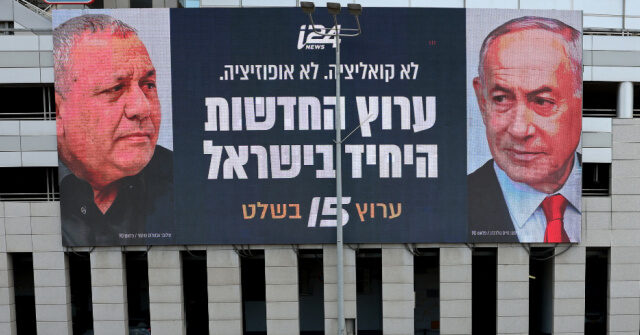

Israeli President Isaac Herzog announced Saturday that former military chief Gadi Eisenkot would be given the first opportunity to form the country’s next government, dealing Prime Minister Benjamin Netanyahu a major political setback nearly two weeks after parliamentary elections.
The decision puts Eisenkot, the leader of the opposition Yashar party, in position to challenge Israel’s longest-serving prime minister, though building a governing coalition will be exceptionally difficult.
Although 67 of the Knesset’s 120 newly elected lawmakers recommended Eisenkot, his four-party “change bloc” controls only 48 seats. Netanyahu’s outgoing coalition holds 53, leaving both camps short of the 61 seats required for a parliamentary majority.
Herzog notified both leaders of his decision Saturday after consulting representatives of the newly elected parliament and holding additional discussions over the weekend. Eisenkot will formally receive the mandate Sunday at 5 p.m. local time, starting a 28-day period to form a government. The president may extend that deadline by as many as 14 days.
Netanyahu, whose Likud party won 27 seats in the October 27 election — the largest total of any party — will continue serving as prime minister while coalition talks take place.
If Eisenkot cannot form a government, Herzog could turn to Netanyahu or another lawmaker, potentially extending the political stalemate that has sent Israelis to the polls repeatedly in recent years.
Herzog’s decision followed an election in which Netanyahu’s long-standing parliamentary alliance failed to reach the 61 seats needed for an outright majority, even though it performed better than expected. During consultations with the president, 46 lawmakers backed Netanyahu, while the seven members of United Torah Judaism, an ultra-Orthodox party traditionally aligned with him, declined to support either candidate.
Eisenkot received 67 recommendations, including support from 19 lawmakers representing the Arab parties Ra’am and the Joint List. Their backing has become a key hurdle in efforts to form a government that could replace Netanyahu.
Netanyahu warned in a video statement Saturday that a government reliant on Arab-party support would weaken Israel’s ability to confront Hamas and other security threats, including Iran.
“A government dependent on terror supporters will not fight terror,” Netanyahu said, accusing the Arab parties of holding positions that conflict with Israel’s security interests.
“With such a government, Israel simply will not survive,” he added.
Netanyahu instead urged the creation of a national unity government that would include his current coalition partners as well as other Zionist parties, arguing that Israel’s security challenges required broader cooperation.
“Therefore, there is only one choice: not national suicide, but national unity,” he said.
“A national unity government will permanently remove the nuclear threat from Iran, preserve Israel as a Jewish state, and bring unity among us,” Netanyahu continued.
The possibility of a government dependent on Arab-party support has taken on added significance after Hamas’s October 7, 2023, massacre. Israel’s first parliamentary election since the attack has revived questions about the parties’ views of Hamas and the country’s security.
Ra’am, an Islamist party led by Mansour Abbas, joined the coalition headed by former Prime Minister Naftali Bennett in 2021. The Joint List, an alliance of predominantly Arab factions that includes communist and Arab nationalist parties, has never joined an Israeli governing coalition.
While both parties recommended Eisenkot during Herzog’s consultations, neither has pledged to join his government or guarantee the support needed to keep it in power.
During consultations earlier this week, Herzog asked Abbas directly whether he regarded Hamas as a terrorist organization. The Ra’am leader declined to answer yes or no, later saying he needed flexibility to act as a bridge while protecting himself and his family.
The exchange highlighted a potential problem for Eisenkot, who has made recognition of Hamas as a terrorist organization and a commitment to dismantling its military and governing capabilities prerequisites for joining his government.
His other conditions include recognizing Israel as a Jewish and democratic state, accepting the principles of its Declaration of Independence, and supporting mandatory military, national, or civilian service for all citizens.
After Herzog’s announcement, Eisenkot said that “now is the time for the formation of a national emergency government,” promising to seek an agreement among parties prepared to accept those conditions.
His Yashar party rejected Netanyahu’s proposed unity plan and challenged Likud to drop its current coalition partners, accept Eisenkot’s four governing principles, and join a government led by Eisenkot. Eisenkot has previously ruled out serving under Netanyahu.
However, Eisenkot also faces divisions within his four-party change bloc. Its leaders campaigned against forming a government with Arab parties or ultra-Orthodox factions — the very groups whose cooperation could now be needed to remove Netanyahu from power.
Avigdor Liberman, leader of the nationalist Yisrael Beytenu party, has ruled out supporting a minority government dependent on abstentions from Ra’am and the Joint List. He has instead demanded a coalition with at least 61 lawmakers.
In an effort to find another route to a majority, Liberman said Friday that he was willing to reconsider his long-standing opposition to governing with ultra-Orthodox parties and offer concessions on military conscription, a major issue during the election campaign.
The change could lead to negotiations with United Torah Judaism. Its seven seats would raise Eisenkot’s four-party bloc to 55, still below the threshold for a majority. Shas, another ultra-Orthodox party traditionally allied with Netanyahu, has publicly dismissed reports that it plans to join Eisenkot’s government as “complete fake news.”
The proposed concessions could also face opposition within Eisenkot’s bloc. Yair Golan, head of the left-wing Democrats party, has said he is open to working with ultra-Orthodox factions but insists on military conscription, increased workforce participation, and other reforms.
For Netanyahu, who has repeatedly returned to power through Israel’s volatile coalition politics, Herzog’s decision is a setback — but not necessarily the end of his premiership.
Eisenkot has the first chance to form a government, yet turning 67 recommendations into a functioning coalition will require him to overcome deep political divisions and campaign promises by potential partners not to govern with the very parties whose support may now be essential.
Until a new government wins the confidence of the Knesset, Netanyahu will remain prime minister. If Eisenkot fails, Netanyahu could receive another opportunity to form a government.


