

Static Media
Few children’s authors become as deeply woven into popular culture as Theodor Seuss Geisel, better known as Dr. Seuss. His rhyming stories fill imaginative worlds with unforgettable characters while delivering simple moral lessons that can stay with readers long after childhood. Most of his books are remarkably concise, often ending in fewer than 70 pages, which creates a natural challenge for filmmakers attempting to turn them into feature-length movies.
Stories including “The Cat in the Hat,” “How the Grinch Stole Christmas” and “The Lorax” have generally thrived as television specials, where their compact plots and quick rhythms fit comfortably into roughly 30 minutes. The six theatrical films based on Seuss’ work have had a tougher time. Whether animated or live-action, each has had to stretch a short story into a much longer experience, sometimes burying the source material’s strongest ideas beneath extra plot and comedy.
This ranking is therefore less about literal faithfulness than about whether each film brings a distinctive creative voice to a familiar tale. The movies placed highest are not necessarily the most restrained adaptations. Instead, they are the ones that most clearly transform their Seuss-inspired foundations into something memorable — for better or worse.
6. The Grinch (2018)
Universal Pictures
The Grinch has become one of the defining symbols of holiday resentment, thanks to a beloved picture book, a classic animated special and a wildly memorable live-action movie. Across those versions, his nastiness is essential to the story’s appeal. Watching the misanthropic recluse try to ruin Christmas makes his eventual discovery of the season’s true meaning feel earned. Illumination’s 2018 animated film, however, takes much of the conflict out of the character.
The broad outline remains familiar. Benedict Cumberbatch voices a green loner living in a mountain cave above Whoville with his loyal dog, Max. He despises Christmas and decides to steal the holiday from the town. The problem is that this Grinch is barely cruel enough to justify his reputation. His irritation feels more passive-aggressive than villainous, and whenever he crosses a line, the movie is quick to soften the moment with an apology. The result is a remarkably harmless take on a character whose bite has always been part of the fun.
Directors Scott Mosier and Yarrow Cheney lean heavily on sweetness and sympathy, but the film rarely does enough to make those emotions feel deserved. Its bright holiday visuals are attractive, yet all that colorful polish cannot disguise how sanitized the movie feels. By sanding away the Grinch’s rough edges, “The Grinch” becomes pleasant background entertainment rather than a Christmas classic likely to endure.
5. The Lorax
Universal Pictures
When “The Lorax” was published in 1971, its environmental warning was direct and unmistakable. A television special followed a year later, and the 2012 animated feature offered another opportunity to introduce that message to a new generation. Unfortunately, the movie often dilutes its strongest ideas with broad comedy, commercial gloss and a plot that turns a complicated warning into a much simpler battle between good and evil.
Thneedville is a city built almost entirely around artificial conveniences, a reality that frustrates Audrey (Taylor Swift), who dreams of seeing the Truffula trees that once covered the land. Twelve-year-old Ted (Zac Efron) sets out to discover what happened to them and finds the Once-ler (Ed Helms) living beyond the city. The aging recluse tells Ted how, as a young man, he encountered the orange guardian known as the Lorax (Danny DeVito) before destroying the surrounding forest in pursuit of profit.
The original “Lorax” remains powerful because it asks viewers to consider their own role in damaging the world — while insisting that change is still possible. The film is most effective when it explores the painful relationship between the Lorax and the Once-ler, even though that material moves too quickly. It is far less persuasive when it returns to Thneedville, where Mayor O’Hare (Rob Riggle) provides an overly convenient villain and an easy solution to a much larger problem. The movie’s best ideas could have used more room, not more distractions.
4. The Cat in the Hat (2026)
Warner Bros.
The Cat in the Hat may be Dr. Seuss’ most instantly recognizable creation. After the character’s critically panned live-action debut in 2003, a return to the big screen seemed inevitable, and the animated “The Cat in the Hat,” now playing in theaters nationwide, arrives with considerably better intentions. It has warmth, energy and several genuinely charming sequences, but its ambition eventually overwhelms the simple story at its center.
Here, Bill Hader voices the Cat as an employee of the Institute for the Institution of Magic, a fantastical organization that sends otherworldly beings into the human world to entertain children. Following a string of expensive mistakes, the Cat receives one final assignment: help siblings Gabby (Xochitl Gomez) and Sebastian (Tiago Martinez), who are struggling after a major move. When the Cat loses a portable time machine known as the Go-Backer, the trio embarks on a frantic journey through their unpacked belongings to recover it. Along the way, they contend with a talking fish (Matt Berry), a demanding landlady (Paula Pell) and another creature determined to claim the machine.
The movie works best when its vivid animation embraces the boundless logic of childhood imagination. It becomes less effective when it tries to combine the emotional formulas of “Monsters Inc.,” “Inside Out” and “Turning Red” with the enormous spectacle of “Avengers: Endgame.” There are plenty of entertaining pieces here, but they compete rather than complement one another. A tighter, more focused version of this adventure might have made a much stronger impression.
3. Horton Hears a Who!
20th Century Fox
Among the feature films adapted from Dr. Seuss, 2008’s “Horton Hears a Who!” comes closest to preserving the shape and spirit of its source. The animated movie expands the original story, but it does so with enough personality and care to feel like more than a padded translation from page to screen.
In the Jungle of Nool, Horton (Jim Carrey) is a gentle elephant whose enormous size is matched by his compassion. When he hears a voice coming from a tiny speck resting on a flower, he discovers an entire community living there, including Whoville’s mayor, McDodd (Steve Carell). Although Horton cannot see the Whos, he commits himself to protecting them. That decision puts him at odds with the skeptical Sour Kangaroo (Carol Burnett), who refuses to believe that life exists on such a small scale and recruits the vulture Vlad Vladikoff (Will Arnett) to destroy the flower.
Carrey’s performance is surprisingly understated compared with his more famous Dr. Seuss role, and he is often eclipsed by Carell’s warm, funny and increasingly urgent portrayal of Mayor McDodd. The mayor’s attempts to convince Whoville that disaster is approaching form an unexpectedly compelling subplot, one that sometimes feels more engaging than the central adventure. Burnett is equally memorable as Sour Kangaroo, a character whose hostility is fueled not only by personal prejudice but by her ability to encourage an entire community to share it.
2. How the Grinch Stole Christmas (2000)
Universal Pictures
Dr. Seuss’ creations generally feel more natural in animation, and Ron Howard’s live-action version of “How the Grinch Stole Christmas” demonstrates why. The Whos’ elaborate prosthetics push them toward an unsettling human-rat appearance, while the impressive production design by Michael Corenblith is muted by a murky, smoke-colored visual palette. Still, those choices become easier to overlook once Jim Carrey’s Grinch storms into the story.
The film follows the familiar outline of Seuss’ book, but it is ultimately built around Carrey’s extravagant comic performance. His hyperactive style will not appeal to everyone, yet he commits completely to the role. The makeup process was famously demanding, but the transformation helps him disappear into the character. His Grinch also develops a touching connection with Cindy Lou Who (Taylor Momsen), whose kindness allows her to recognize the wounded figure beneath his snarling exterior.
Fans of the original story may understandably object to the movie’s occasional detours into crude adult humor. A joke involving a “key party” is particularly startling in a family Christmas film. But the movie’s willingness to be excessive is also what gives it a distinct identity. If it was never going to remain a purely faithful adaptation, “How the Grinch Stole Christmas” chose to turn its strangeness and star power all the way up.
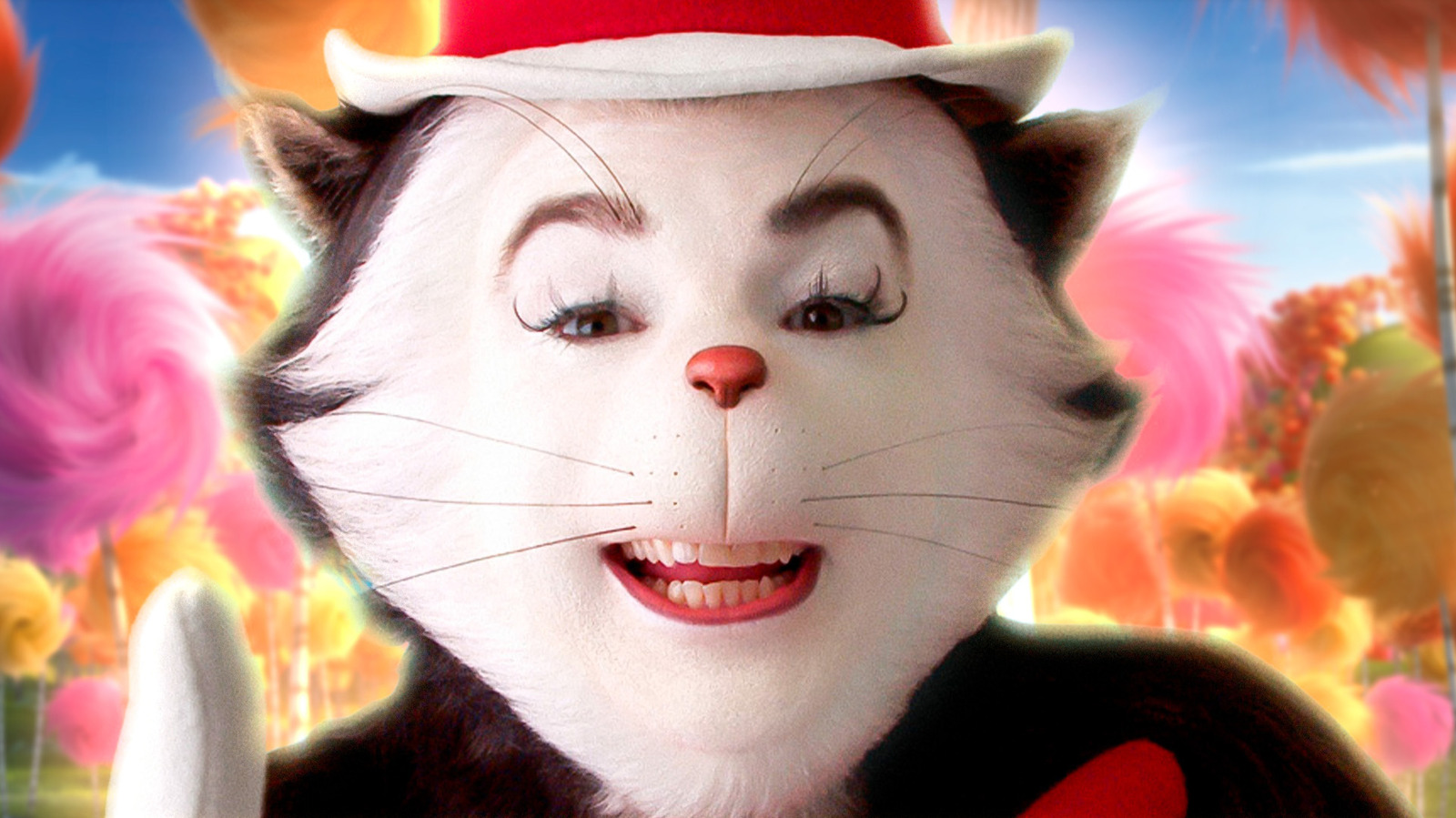
1. The Cat in the Hat (2003)
Universal Pictures
The 2003 version of “The Cat in the Hat” was widely criticized upon release, but its harshest review came from Audrey Geisel, whose reaction helped end plans for additional live-action adaptations of her late husband’s work. Even so, the movie has endured as one of the strangest studio children’s films of the early 2000s. It is undeniably a chaotic departure from the qualities that made Dr. Seuss special, yet its exaggerated visual style and anarchic humor arguably capture more of the book’s disruptive spirit than its reputation suggests.
While their mother (Kelly Preston) is at work, Conrad (Spencer Breslin) and Sally (Dakota Fanning) are left at home with their sleeping babysitter (Amy Hill). Their day is already complicated by their mother’s intrusive boyfriend, played by Alec Baldwin, but matters become truly unpredictable when the Cat in the Hat (Mike Myers) arrives. He sets out to teach the children how to enjoy themselves, using an especially destructive form of play that quickly turns their house upside down.
Buried beneath layers of makeup, Myers plays the Cat like a mischievous comedian — or perhaps a feline creature from another dimension — determined to turn every room into a stage. The performance is bizarre, abrasive and occasionally hilarious, but it also understands the unsettling side of the character: inviting the Cat into your home means surrendering control to an unstoppable force of theatrical chaos. As the sole film directed by production designer Bo Welch, “The Cat in the Hat” remains a garish, crude and feverishly inventive oddity unlike anything else in the Dr. Seuss movie canon.