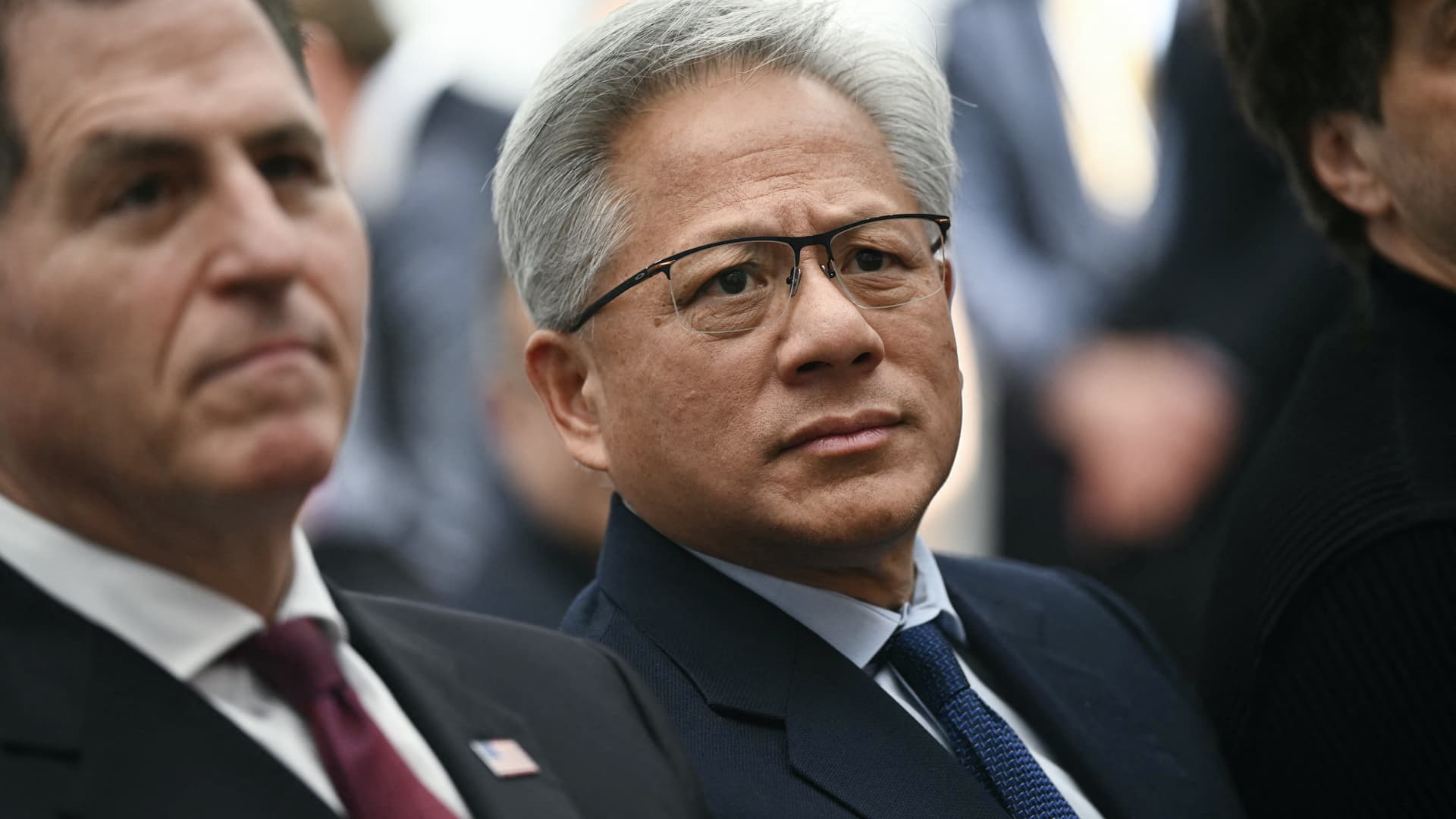

(L-R) Dell Technologies CEO Michael Dell and Nvidia CEO Jensen Huang attend the “Golden Age of American Innovation Summit” at the Institute of Peace in Washington, D.C., on Oct. 8, 2026.
Kent Nishimura | AFP | Getty Images
The scandal surrounding Nvidia CEO Jensen Huang is strengthening the case for U.S. lawmakers who want tighter limits on China’s access to advanced artificial intelligence chips, just days before President Donald Trump is expected to meet Chinese President Xi Jinping.
Washington and Beijing are competing for global leadership in artificial intelligence. For years, the United States has restricted China’s access to Nvidia’s most sophisticated processors in an effort to slow its technological advances. Huang was one of the most prominent industry voices opposing strict U.S. export controls on advanced chips to China, a position that frustrated some China hawks.
The alleged affair with Alice Huang, a Chinese citizen who is not related to Jensen Huang and was reportedly recruited by Chinese intelligence to obtain information, has given lawmakers renewed momentum to include several chip-control measures in this year’s National Defense Authorization Act (NDAA).
The proposals include the AI Overwatch Act, the Chip Security Act and the MATCH Act. Each measure is intended to restrict the flow of advanced semiconductors to U.S. adversaries, particularly China.
Jensen Huang had been “the industry’s most effective lobbyist against tighter rules,” said David Meale, head of Eurasia Group’s China practice and a former American diplomat who served as deputy chief of mission at the U.S. Embassy in Beijing.
However, the scandal has undercut Nvidia’s “singular ability to slow the progress of those bills,” Meale said. The measures had faced opposition from companies and the White House, but the allegations have made it “politically harder for negotiators to strip chip provisions out of this year’s NDAA.”
Senate Democratic Leader Chuck Schumer called on Congress Tuesday to approve the bills and demanded a full accounting of Trump’s defense of Huang. Rep. John Moolenaar, R-Mich., who chairs the House Select Committee on China, likewise urged lawmakers to include chip export controls in the annual defense policy legislation.
Trump’s reduced influence over congressional Republicans after the midterm defeat has also made it more difficult for his administration to block the measures, said Kyle Chan, a China fellow at the Brookings Institution.
Targeting offshore hubs
The fallout from the alleged affair is also expected to bring greater scrutiny to offshore data-center hubs that give Chinese customers access to Nvidia chips barred from direct export to China.

Alice Huang helped facilitate at least $7.5 billion worth of Nvidia chip shipments to China, according to The Information.
Short seller Culper Research estimated in May that more than 20% of Nvidia’s revenue for the year ending July 2025—about $43.2 billion—came from China through illegal GPU diversions and Southeast Asian intermediaries.
Pressure is mounting inside the White House for Trump to address remote access to restricted chips, and action “now appears likely,” said Gabriel Wildau, managing director at political risk consultancy Teneo. Possible steps include blacklisting Megaspeed and other entities, as well as imposing rules that would close the loophole altogether, he said.
The Commerce Department is preparing a rule designed to stop Chinese AI companies from remotely accessing advanced chips through data centers in other countries, The Information reported. Technology companies including Nvidia have long opposed the effort, but the initiative has gained fresh momentum following the revelations involving Nvidia.
More Chinese AI companies have reportedly begun seeking Nvidia-powered computing capacity at data centers outside China. At the same time, traders and intermediaries are building processor stockpiles in anticipation of stricter U.S. enforcement.
If legislation such as the Remote Access Security Act, which passed the House in January, is enacted next year, it would increase compliance risks for cloud providers and data-center operators outside China—including those in Southeast Asia—that serve Chinese customers, Meale said.
Shenzhen summit
The renewed push for tighter semiconductor controls comes just days before Trump is expected to meet Xi on the sidelines of the Asia-Pacific Economic Cooperation (APEC) leaders’ summit in Shenzhen on Nov. 18-19.
Despite the political uproar in Washington over the spying allegations, Trump appears “unconcerned,” at least for now, Wildau said. Trump and Xi are expected to focus on extending their broader truce beyond January, he added.
Chinese officials have been clear that they will respond to the passage of this legislation, and could ratchet up controls on rare earths and magnets that would be very damaging to U.S. industry.
Paul Triolo
Partner, DGA-Albright Stonebridge Group
Treasury Secretary Scott Bessent, who is scheduled to travel to China for next week’s summit, said Tuesday that he wants to “build a constructive relationship on the basis of balance and reciprocity.”
Still, the latest developments could generate new tensions with Beijing. Paul Triolo, a partner at DGA-Albright Stonebridge Group, said the MATCH Act could threaten the Busan truce by pressuring Japan and the Netherlands to impose tighter restrictions on chipmaking equipment already in China.
“Chinese officials have been clear that they will respond to the passage of this legislation, and could ratchet up controls on rare earths and magnets that would be very damaging to U.S. industry,” he said.
It remains uncertain whether Huang, who played a prominent role during Trump’s visit to Beijing in May and Xi’s trip to Washington in September, will be part of next week’s delegation. Asked Sunday whether Huang would accompany him, Trump said, “I don’t know, but I’d certainly take him.”


