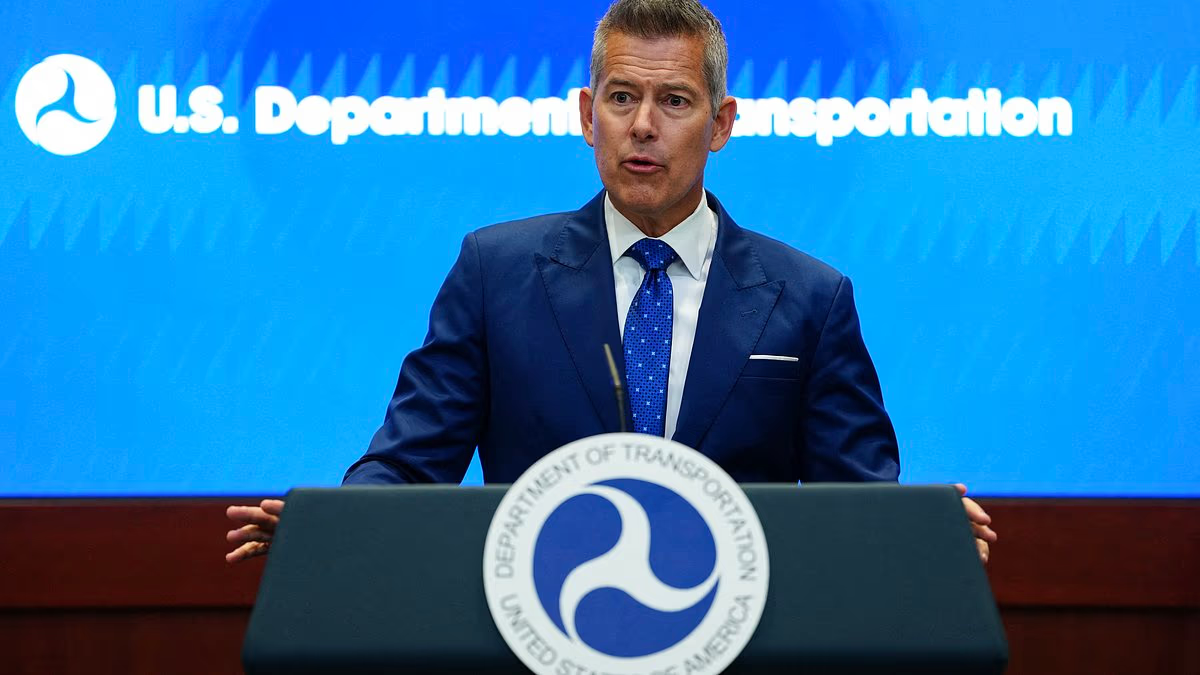

Transportation Secretary Sean Duffy has identified outdated equipment at a “remote location” as the preliminary cause of the historic ground stop that brought air travel across the nation to a halt for several hours.
Speaking at a news conference at the Department of Transportation’s headquarters on Saturday, Duffy said contractor L3 Harris had been replacing aging technology at a remote site when an air traffic control communications problem began.
Duffy said a contractor was carrying out maintenance at at least one of four remote Federal Aviation Administration (FAA) locations, switching communications lines from old copper wire to fiber before the system became unstable.
He described L3 Harris as the department’s “legacy provider” and accused the contractor of failing to “meet the moment,” contributing to the outage.
“What we’re working to determine was whether we had incompetence — meaning, was it user error or installation error from L3 Harris — or did they install a faulty router? We haven’t determined what the fault was. Was it the router? Or were they not doing great work for us at L3 Harris?” he said.
Duffy said the copper wire being replaced was so old that it was being phased out, prompting the routine maintenance work.
He explained that the transition from copper to fiber caused a surge that affected other routers and disrupted radar feeds, making it difficult for air traffic controllers to communicate.
Duffy again said officials do not believe the incident was caused by a cyberattack. He added that communications returned after the problem was identified at the FAA’s remote location.

Transportation Secretary Sean Duffy said a contractor was performing maintenance at a “remote location” for the FAA when the communications problem emerged

The FAA issued a historic ground stop on Friday afternoon. Passengers were stranded and are pictured above trying to fly on Saturday morning after the order was lifted

The halt lasted about five hours. More than 3,500 airplanes were in the air when the ground stop was issued on Friday
Duffy also renewed his call for greater funding for the FAA. He said air traffic control systems still rely on equipment dating from the 1970s and 1980s, urging Congress to approve billions of dollars to modernize the nation’s aviation infrastructure.
The transportation secretary said L3 Harris owns the telecommunications system used by the FAA.
MORE ON THIS: Travel Expert Reveals Why Boarding Your Flight Last Can Make Flying Less Stressful
He said he would prefer to work with telecommunications companies such as AT&T and Verizon, but the FAA is “stuck” with L3 Harris until the agency receives additional funding.
“Many of our contractors, many of our partners, they take our money and they provide really poor service to us, full stop. And we have demanded more,” Duffy said.
“We need L3 Harris, or whoever provided that router to us, to do a better job.”
L3 Harris is a technology distributor with contracts across multiple US agencies. Earlier this year, the company announced a proposed partnership with the Department of War to manufacture rocket motors used in US and allied missiles.
FAA Chief Bryan Bedford also addressed Saturday’s news conference, saying officials ordered the ground stop after being unable to identify the source of the communications problem for about 45 minutes.
There were 50,000 flights scheduled across the US when the ground stop began, and 30,000 had been completed, Bedford said.
Of the 40,000 flights scheduled for Saturday, Bedford estimated that between 4,000 and 5,000 would likely be canceled.

FAA Chief Bryan Bedford (left) and Sean Duffy (right) said Saturday that routine contractor maintenance is believed to have triggered a communications problem, leading to a five-hour nationwide ground stop
The FAA chief said cancellations and delays would continue through the weekend, but flights were expected to return to normal by the end of the day Sunday.
Bedford clarified that the telecommunications system had not completely gone “down.” Instead, officials detected “instability” and imposed the ground stop as a precaution.
He said air traffic controllers at several facilities reported connection problems, prompting the FAA to issue the ground stop after officials realized the disruption was more widespread.
This is a breaking news story…


