
The war in Ukraine is now only months away from entering its fifth year.
Having served as an officer in both Afghanistan and Iraq, I can say without hesitation that this is the most intense and savage conflict I have witnessed in my lifetime.
It has revived the kind of industrial warfare that many Europeans believed belonged to the first half of the 20th century. Entire towns and cities have been pulverised by relentless, large-scale artillery attacks.
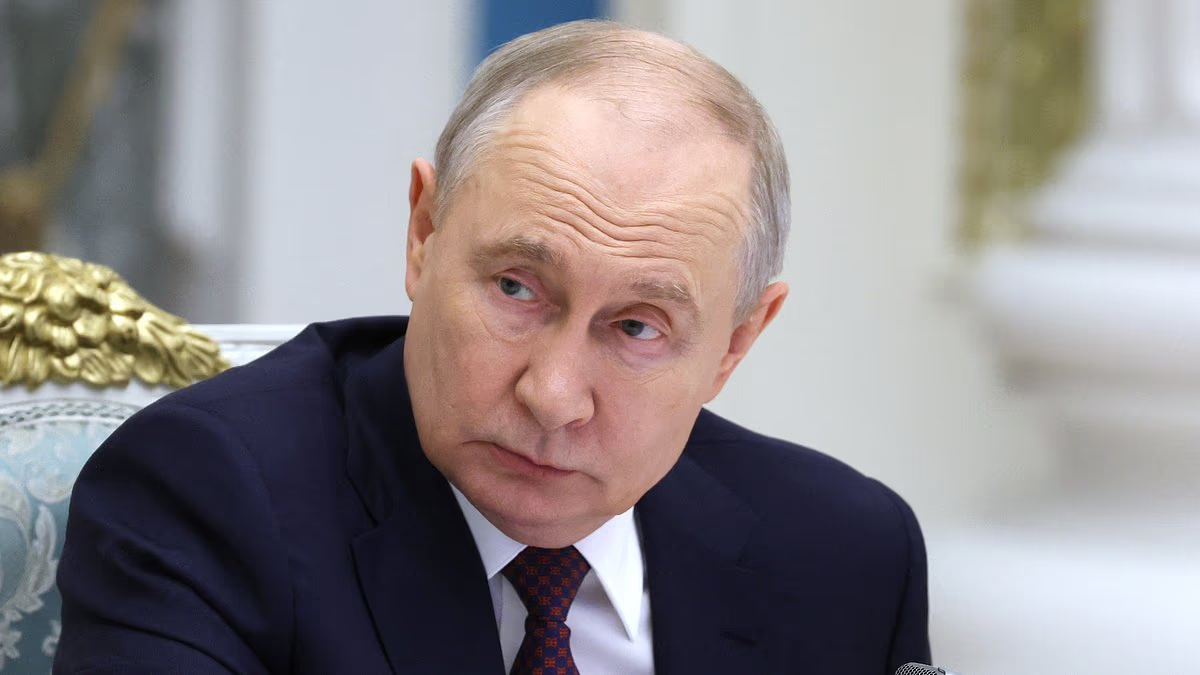
As Nigel Farage has observed, Vladimir Putin now resembles a cornered rat: reckless, hostile and impossible to predict.
Ukraine is not the only country in his sights. He provokes the West by sending warships through the Channel, surveying critical undersea cables for potential sabotage and authorising cyber attacks against hospitals.
In Britain, where our own military reserves urgently need to be rebuilt, voters are asking why we should continue supporting Ukraine.
It is a legitimate question. But there is another one we must confront.
What would happen if Putin’s forces advanced beyond Ukraine?

Nigel Farage has described Vladimir Putin as a cornered rat — reckless, aggressive and unpredictable
Make no mistake: anyone who believes Ukraine’s defeat would mark the end of President Putin’s ambitions is deceiving themselves.
History offers painful warnings that we ignore at our peril. Dictators are not deterred by surrender or appeasement.
If Putin prevails in Ukraine, what would prevent him from seeking a buffer zone against the West like the one the Soviet Union maintained after the creation of the Warsaw Pact? Estonia and the other Baltic states could once again come under intense pressure.
An attack on any NATO member would bring Britain directly into a catastrophic European conflict — one likely to be vastly more destructive and expensive than the military assistance we are providing today.
DISCOVER MORE: Russell Brand’s Past TV Interviews With Australian Stars Resurface
Our support for Ukraine should therefore be understood not merely as charity, but as a matter of strategic self-interest. In straightforward terms, it is a pragmatic investment in Britain’s own national security.
Whenever Ukraine’s front line retreats, Putin’s ambitions expand. He remains profoundly shaped by the legacy of the Soviet Union and the expansionism of the Stalin era.
I know Reform UK’s critics have questioned the party’s commitment to defence.
There has also been widespread criticism of Reform’s former Welsh leader Nathan Gill, who was rightly imprisoned after accepting bribes in exchange for pro-Russian interviews. My view is simple: good riddance.
I would not have left a 40-year military career unless I was convinced that Reform would put Britain’s interests first.
My first step in the role was to launch a National Security Review. As part of that process, we have identified Russia, Iran and China as fundamental threats to the West.
Confronting such aggression requires a clear and unmistakable display of strength — one capable of deterring further attacks and defending our national sovereignty.
Yet successive Conservative and Labour governments have hollowed out the Armed Forces.
That is why Reform UK would raise defence spending to 3 per cent of GDP by 2030 and 3.5 per cent by 2035. The aim is to replenish depleted stockpiles and restore Britain’s ability to sustain military operations during a prolonged conflict.
The reality is that adversaries such as Putin understand one language above all others: credible military readiness.
However, stronger armed forces will not be enough if our borders remain effectively open. If Iran has sent spies across the Channel in small boats, as we now know, what would stop the Kremlin from attempting the same? Ending the invasion of the Channel is therefore a national security emergency, and every illegal migrant should be deported.
The threats confronting Britain are serious. But Nigel Farage and I will not retreat.
READ MORE: Nigel Farage’s new defence spokesman signals ‘clean break’ with his past accusations of being a Vladimir Putin apologist


