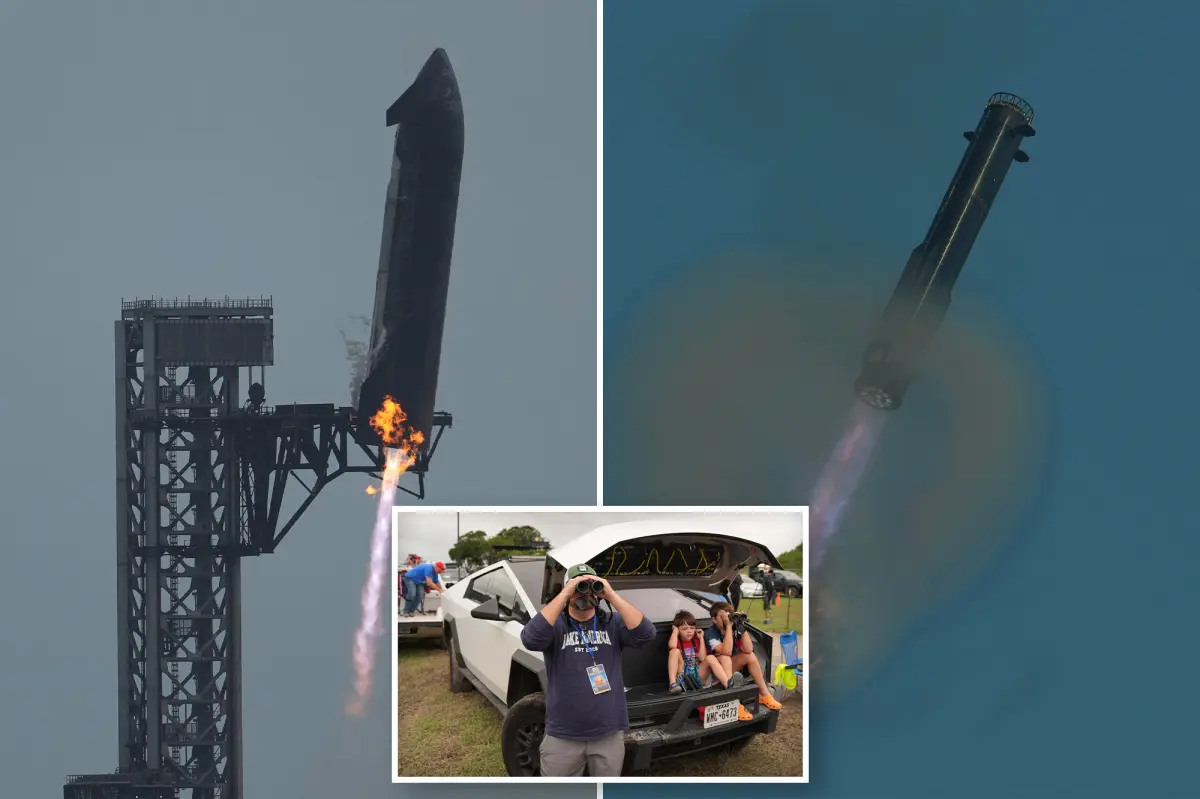

This catch belongs on SportsCenter.
SpaceX’s Starship returned from more than 22 hours in orbit Saturday and was secured by the launch tower’s enormous mechanical arms after a controlled descent — the first time a spacecraft has been recovered from space in this manner.
The Mechazilla tower’s “chopstick” arms grasped the upper section of Starship at Starbase, Texas, after its 15th test flight. The achievement came despite the rocket’s lower stage exploding over the Gulf of Mexico soon after Friday’s liftoff.
During its 22-plus hours in space, Starship — the largest and most powerful rocket ever built — completed 14 orbits of Earth at roughly 17,600 mph, or nearly 23 times the speed of sound. It then returned for the first-ever orbital recovery of an upper stage, according to CNN.
SpaceX CEO Elon Musk celebrated the result Saturday afternoon.
“Congratulations to an incredible team at SpaceX!!” Musk wrote on X.
Starship’s launch system is made up of two primary components: the Super Heavy booster and the Starship upper stage.
SpaceX did not achieve a double recovery because the Super Heavy booster exploded over the Gulf of Mexico shortly after Friday’s launch.
The broader aim of the Starship program is to enable future crewed and cargo missions to the moon and Mars.
“Can you believe it?” SpaceX commentator Dan Huot shouted at the Texas launch site, stretching out each word.
“Look at her! Baby, she’s back!”
Saturday’s recovery was SpaceX’s 15th flight of a fully assembled Starship since 2023 and only the vehicle’s second mission to orbit. The flight was broadcast live through Starlink, and the spacecraft had earlier released 26 Starlink satellites.
NASA hailed the milestone. The agency has hired SpaceX to use Starship to land Artemis astronauts on the moon later this decade as part of plans to establish a permanent lunar base.
“It was almost magic,” NASA Administrator Jared Isaacman wrote on X.
NASA is spending billions on SpaceX’s effort to return Artemis astronauts to the lunar surface by 2030.
SpaceX is also preparing to launch Starship from NASA’s Kennedy Space Center in Florida in the coming months.
NASA is aiming for Artemis III in 2027, a crewed Earth-orbit docking test involving the lunar landers. Artemis IV is planned for 2028 and is expected to mark the first American moon landing in more than 50 years.
With Post wires


