
Some phone calls stay with you forever. For Lior Raz, that call came in the early hours of October 7, 2023.
The Israeli actor, one of the country’s biggest stars and the co-creator of Netflix’s hit espionage drama Fauda, was in a Romanian hotel when his sister told him she was trapped with her children inside a kibbutz shelter near the Gaza border as rockets fell around them.
More than 1,000 miles from the unfolding disaster, and unaware until then of the deadly Hamas attack, Raz struggled to process what he was hearing.
‘My sister said: “Lior, you need to save me because I’m with my kids at the shelter. There are terrorists around us,”’ Raz, 54, tells The Mail on Sunday in an exclusive interview.
‘I didn’t know what she was talking about… She said: “Look at your camera. Look at your phone. Look at your TV.” Then I saw all those terrible videos that we have all seen.’
Millions of Fauda fans around the world know Raz as Doron Kavillio, the central figure in the explosive political thriller. Doron is one of Israel’s elite undercover commandos, driven by an unrelenting determination to pursue enemy forces, often at a heavy cost to his family life.
Since its debut in 2015, the series has become an international phenomenon, powered by its rapid twists, violence, betrayals and intense undercover operations.

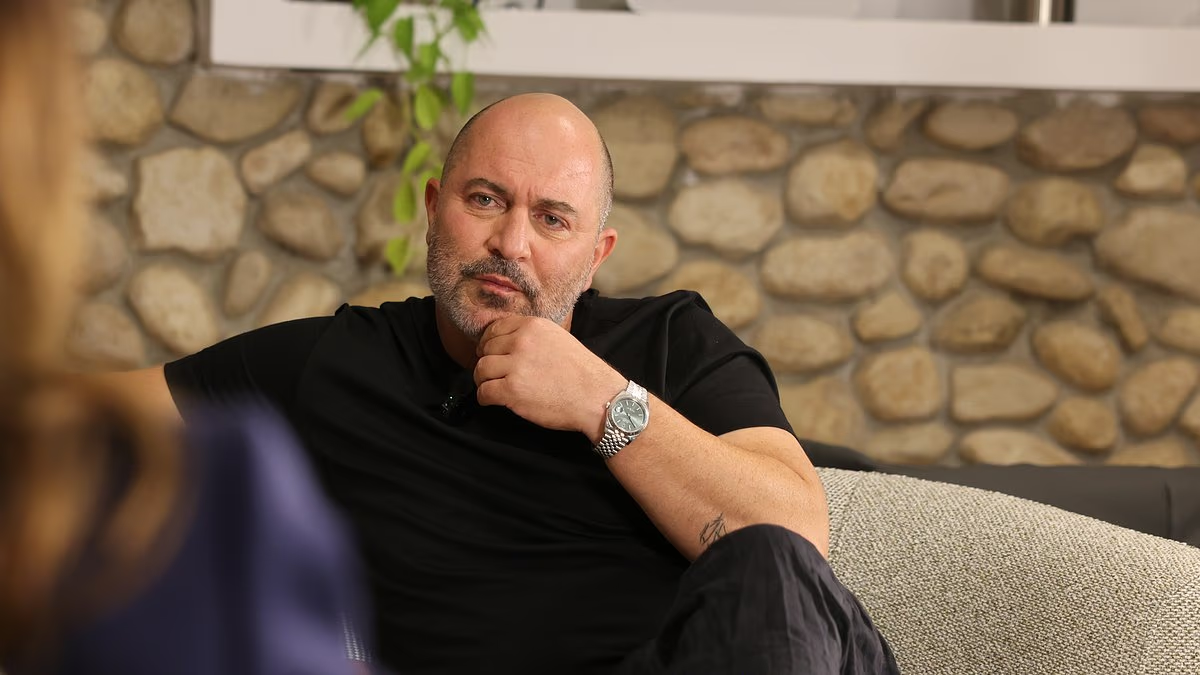
Lior Raz, star and co-creator of Fauda, tells the Daily Mail about the harrowing phone call he received from his sister on October 7

Lior Raz and Lucy Ayoub appear in Netflix’s hit espionage drama Fauda
But on the day that would become etched into the world’s memory, as Hamas-led terrorists stormed southern Israel, killing around 1,200 people and taking 251 hostages, the terrifying reality Raz had portrayed for years suddenly entered his own life.
Videos of Israelis being abducted, including Nova music festival attendee Noa Argamani, showed almost in real time as the attackers spread fear and chaos.
Raz’s response reflected his own military background. He had once served as a covert operative with Israel’s counterterrorism unit Duvdevan, and his first instinct was to get home and protect his sister and her family at any cost.
By the time he reached Israel the following day, his sister was safe. Yet Raz says he felt ‘like a lion in a cage’, furious at being unable to help. He travelled south and joined the Israeli volunteer groups Brothers and Sisters in Arms, helping evacuate families trapped in their homes.
‘I took my Jeep and my gun, and I went down to the south because there were still terrorists,’ he says. ‘There were missiles. Families were stuck in their houses. They needed to be rescued.’
‘You don’t think about whether you might die. It was simply a case of knowing there were things you had to do.’ The words might have been spoken by Doron Kavillio himself.
Raz is so recognisable in Israel as the complicated action hero that the day produced several surreal moments.
‘I’m knocking on someone’s door. I’ve got my gun, and there are missiles,’ he recalls.

Raz plays Doron Kavillio in the political thriller, portraying an elite Israeli undercover commando driven to track down enemy forces

Images of Israelis being abducted, including Nova music festival attendee Noa Argamani, captured the chaos almost in real time
‘They see me and get confused. They say, “Doron, what are you doing here?” They thought they were watching a scene from Fauda.’
The experience, however, has never stopped haunting him. ‘It was the hardest day ever. Since then, there hasn’t been a single day—not one day—when I haven’t thought about it.’ Those memories helped shape the fifth season of Fauda, which includes some of the most emotionally powerful scenes ever seen on Netflix.
Raz, who writes the series with Avi Issacharoff, made the painful choice to depict October 7 across two special episodes.
The production took a profound emotional toll on the cast and crew, many of whom knew someone who had been killed or injured. Production team member Matan Meir died in November 2023 while serving as an Israel Defence Forces reservist in Gaza. Actor Idan Amedi survived his own IDF service, but was seriously injured in an explosion in January 2024, suffering burns and shrapnel wounds to his eye sockets, jaw and neck.
During filming, soldiers travelling into Gaza also passed by the set.
‘For me, as an actor, returning to that situation and performing something that had genuinely happened in real life was incredibly difficult,’ Raz says. ‘We felt we were doing something far more important than simply making a television show.’
Some scenes were, understandably, almost impossible to endure.
In one sequence, Doron cannot remember eight hours of October 7 and visits a therapist. The plot was inspired by a real survivor known to the writers who experienced a similar gap in his memory.

More than 1,000 miles from the tragedy in his home country, Raz could barely take in what his sister was telling him about the Hamas massacre

The cast of Fauda. The 2023 attack placed an enormous emotional burden on the cast and crew, many of whom knew people who had been killed or wounded
‘I broke down. I cried a lot,’ Raz tells the MoS. ‘I went outside. It was a very difficult scene for me.’
When he watches the completed episodes, Raz—who has four children and is married to Israeli actress Meital Berdah—finds it difficult to distinguish his performance from his own memories. ‘I can see that I’m not acting. I’m actually in the situation. There’s no acting there.’
Another deeply disturbing scene recreates the fate of young Israelis who hid from Hamas militants inside a rubbish container during the attacks.
The terrified group believed they had found a place of refuge. But after the attackers discovered them and opened fire, their bodies were left piled inside the container.
In Raz’s version of the tragedy, Doron climbs into the container and comes face to face with what happened.
‘The container story is real. It really happened,’ he says. ‘Being there was one of the hardest things ever.’
Raz and Issacharoff intentionally avoided showing the full horror of October 7, concerned that an overly graphic recreation would inflict further trauma on Israeli viewers.
When the episodes were broadcast, viewers were warned that they could be distressing and were given the option to skip them.

The fifth season of Fauda avoided depicting the full brutality of October 7 to prevent further trauma for Israeli viewers

Hamas fighters on a glider during the October 7 attacks
The decision nevertheless triggered an unexpected response from some viewers, many of them Arabs, who accused the show of softening the historical record.
‘We tried to be very sensitive,’ Raz says. ‘We didn’t want to make a snuff movie. It had to be delicate and watchable.’ That approach has not diminished the show’s reach. Fauda has become a global hit, ranking among Netflix’s ten most-watched series in more than 40 countries.
Despite writing Doron Kavillio specifically for himself, Raz nearly missed the opportunity to play the character who would become his most famous role.
When he and Issacharoff pitched the series to Israeli broadcaster Yes, executives initially wanted an established star in the lead. Raz therefore agreed to audition.
With two final candidates under consideration, the director reportedly asked the casting team a straightforward question.
‘They’re both fantastic actors, but who would you follow into war? Who would you walk behind?’
The decision was unanimous. ‘Everyone in the room voted for me,’ Raz says. ‘So I got the part.’
Perhaps that outcome was not surprising. Raz had trained for the dangers Doron faces during his time with Duvdevan, whose operatives sometimes disguised themselves as Palestinian civilians to capture wanted terrorists. He later worked for a period as Arnold Schwarzenegger’s bodyguard.

The Daily Mail’s Natalie Lisbona with Lior Raz
Fauda draws extensively on Raz’s undercover experience, although he is careful not to disclose the real missions behind its most explosive storylines. ‘I have to protect the unit,’ he says. ‘What I can say is that it is one of the best and most remarkable special forces units in the world.’
A separate personal tragedy inspired one of Fauda’s most heartbreaking storylines in its first season—an episode Raz rarely discusses.
At 16, he fell deeply in love with Iris Azulai, whom he describes as the most beautiful girl in Jerusalem. They were each other’s first love and spent three happy years together. Raz says the relationship gave him confidence and helped shape the man he became.
But in October 1990, shortly before Raz’s 19th birthday and while he was serving in the army, tragedy struck.
The night before, Iris had spent time with Raz. The following morning, after leaving her home in Jerusalem’s Baka neighbourhood, she was stabbed to death by a Palestinian terrorist. As reports emerged
of an attack in Baka, Raz was gripped by the awful suspicion that Iris was the victim.
He called her brother, who told him to come immediately. By the time Raz arrived, Iris had been taken away. He never saw her body.
Raz believes Iris might have survived if another victim of the attacker—a special forces operative carrying a gun—had shot to kill rather than aiming at the terrorist’s knees.

Raz, who co-writes Fauda with Avi Issacharoff, made the painful decision to explore October 7 in two special episodes
For years, he kept his grief locked away. ‘It was the hardest thing that had ever happened to me,’ he says. ‘I didn’t talk about Iris. It was like a wound I didn’t want to reopen.’
When he and Issacharoff, who had also known Iris, began writing Fauda, Raz finally confronted the loss.
The first season, dedicated to Iris, includes a storyline in which the girlfriend of a member of Doron’s unit is killed in a terrorist attack at a bar. The plot was drawn directly from Raz’s own experience.
‘His reaction to her death was the same as mine,’ Raz says. ‘The conversations they had were the same conversations we had.’ Yet despite losing the woman he loved to terrorism, and despite the brutal acts of revenge depicted in Fauda, Raz says he never wanted vengeance.
‘I don’t want to hurt anyone else,’ he says. ‘I don’t want to become someone who just does terrible things.’
Instead, he came to feel that Iris had entered his life for a reason, even though their time together was cut tragically short.
Raz also believes that creating Fauda has helped him confront and process his own trauma.
He remains concerned, however, about the psychological scars being left on a new generation of Israelis, including his own children.
‘I think all Israelis are traumatised. Even my children don’t want to sleep alone because they remember the missiles. They’re frightened of the missiles and the sirens.’
Remarkably, Fauda has also become a major success across the Arab world. In Lebanon, it has reached the top of the Netflix charts—something Raz sees as a hopeful sign for the Middle East.
‘I think people are ready for peace much more than our governments are,’ he says.
‘People on the streets of Lebanon and Israel are longing for peace. They want peace. They want to know one another.’
Raz says it matters to him that Arab characters are played by Arab actors and Jewish characters by Jewish actors, creating what he describes as a ‘bubble of creativity and love’ on the set.
He also rejects the idea that Fauda is Israeli propaganda. ‘It’s not propaganda. Sometimes we are the bad guys. Sometimes we are the good guys. Sometimes they are the good guys, and sometimes they are the bad guys.’
For now, the boundary between Raz and his on-screen alter ego remains intriguingly blurred.
‘Doron and Lior are very similar in some ways, but in many other ways they are completely different,’ he says.
‘At the end of the day, though, I think Doron and I would both fight for our families and for our country.’


