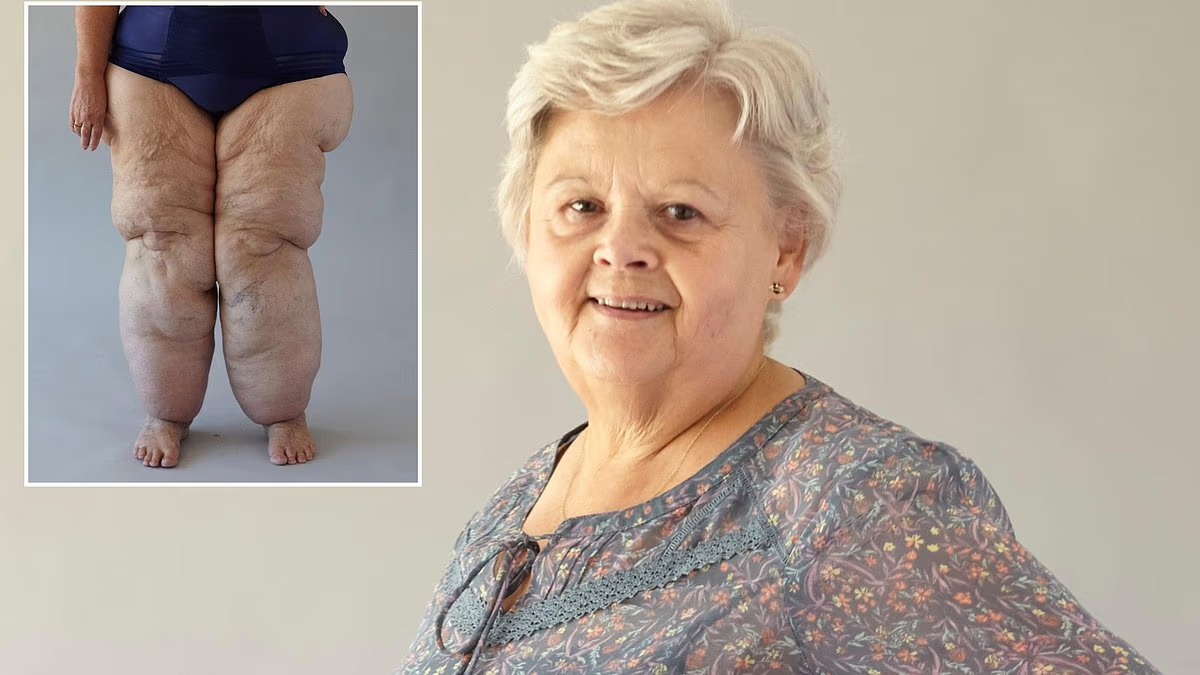

Each morning, Glynis Coley looks into the bathroom mirror, but only from the shoulders up. That is all she can bear to see.
The 69-year-old avoids the full-length mirror behind her wardrobe door because it shows her legs — a part of her body she has spent years trying not to look at.
“My legs are enormous, bulky and completely out of proportion with the rest of me,” says Glynis, who lives in Andover, Hampshire, with her 84-year-old husband, Geoffrey. Both are retired bookkeepers.
“They cause constant pain. I can’t turn over in bed, so I have to sleep sitting up, and I can barely walk any distance.”
For decades, doctors told Glynis that losing weight was the answer. When she was 14, she was even admitted to hospital and placed on a diet. Nothing, however, changed the size or pain in her legs.
“I only lost weight from my breasts and other places I didn’t want to lose it from. My legs stayed huge and painful,” she says. The experience severely damaged her confidence, and repeated visits to her GP for depression led to prescriptions for antidepressants.
“I’ve spent my whole life dealing with obvious side-glances and cruel whispers,” says Glynis, who has four children and four grandchildren.
She believes the impact extended to her family. “My youngest son never told me when school sports events were taking place. It broke my heart to think he was ashamed of me.”

Every morning, 69-year-old Glynis Coley looks in the bathroom mirror only from the shoulders up — she does not want to see her legs
In 2003, doctors diagnosed Glynis with lymphoedema, a condition in which fluid accumulates because of problems with the lymphatic system, the body’s drainage network.
She was given compression stockings to help move the trapped fluid, but the treatment did not prevent her legs from continuing to enlarge.
Then, in 2016, Glynis happened to hear a woman on television describing lipoedema — a little-known but relatively common disorder involving an abnormal build-up of fat, usually around the legs and hips and sometimes the arms.
“Everything she said sounded familiar,” recalls Glynis. She immediately returned to her GP and was referred to a specialist, who confirmed that she had lipoedema.
Her relief quickly turned to disappointment when she discovered that the treatment most likely to help — specialist liposuction to remove the abnormal fat cells — was not routinely available through the NHS.
Private treatment was her only option, but at the time it cost around £12,000 per leg, far beyond what Glynis could afford.
A decade later, her legs are so swollen and painful that she can barely walk. She now fears she may eventually need a wheelchair.
Around three million women in the UK are estimated to have lipoedema.
“Many women spend decades trying to obtain a diagnosis,” says Mary Warrilow, a nurse specialist and adviser to the charity Lipoedema UK. “Sadly, even after diagnosis, NHS services offering appropriate support or treatment are often unavailable.”
Lipoedema is not simply a cosmetic concern. The affected limbs can feel heavy and tight because the condition causes persistent, low-level inflammation. “That can restrict movement and interfere with everyday life,” says Mary Warrilow. “It may also cause fatigue and a lack of energy.”
People with the condition may also bruise more easily and develop more prominent varicose veins. The additional pressure placed on the joints can bring forward the need for hip or knee replacement surgery.
Reduced mobility can also contribute to weight gain, increasing the risk of conditions including diabetes, heart disease and stroke.
There is no specific diagnostic test, and limited awareness among doctors means many women, including Glynis, are simply advised to lose weight, Mary Warrilow says.
But the abnormal fat associated with lipoedema does not respond to dieting and is not caused by overeating.
The condition is thought to involve unusually enlarged fat cells, along with thickening of the surrounding connective tissue — a process known as fibrosis.
The precise cause remains unclear, although hormones appear to play a role. Lipoedema often begins during major hormonal changes, including puberty, pregnancy or menopause. It is rare in men and, when it does occur, is generally linked to hormonal abnormalities.
Genetics may also be involved. Glynis suspects her paternal grandmother had lipoedema because photographs show she too had unusually large legs.
Lipoedema produces “a striking imbalance between the upper and lower halves of the body”, says Guido Köhler, a consultant plastic surgeon at Norfolk & Norwich University Hospital who specialises in the condition.
“Crucially, the hands and feet are not affected. That creates a distinctive cuff around the ankles or wrists, with fat appearing to spill over it.”
In many cases, he adds, the fat beneath the skin can be felt as small, pea-like nodules.
Lipoedema is frequently mistaken for lymphoedema. Although lymphoedema can also cause swelling, it often affects just one limb rather than both and commonly extends into the hands or feet, says Mr Köhler.
The two conditions can occur together. Over time, the excess fat associated with lipoedema can put pressure on the lymphatic system and trigger secondary lymphoedema.
Following diagnosis, people with lipoedema are usually advised to stay active, maintain a healthy diet, avoid weight gain and use compression garments. Manual lymphatic drainage massage may also be recommended. Although fluid build-up is not always substantial, these measures can ease pain and heaviness — but the benefits are often temporary.
None of these treatments removes the abnormal fatty tissue. Only lipoedema reduction surgery, a form of specialist liposuction, can do that, says Mary Warrilow.
However, after a patient receiving liposuction for lipoedema died in 2019, the National Institute for Health and Care Excellence (NICE) restricted NHS use of the procedure to research trials. Mr Köhler nevertheless says it remains the most effective treatment currently available.
“The abnormal fat cells do not grow back once removed, so patients generally achieve long-lasting results. They still need to exercise and follow a healthy diet to maintain those results.”
Could the results of a new study persuade NICE to reconsider its guidance?
Published in The Lancet, the research followed 410 lipoedema patients in Germany who received either liposuction or conservative care, including lymphatic drainage, compression stockings and physical activity.

At 42, Nicola Clothier had tried every diet she could find. She lost weight from her upper body, but her lower half remained stubbornly large

In July 2025, Nicola had 10 litres of fat removed from both thighs in procedures carried out two weeks apart, costing £15,000. Six weeks later, a further four litres were removed from her lower legs for £7,500. Pictured: Her legs before and after surgery
After a year, almost 70 per cent of patients who underwent liposuction reported a substantial reduction in pain, compared with 7.6 per cent of those who received conservative treatment. Surgery also led to significant improvements in quality of life, while around 37 per cent experienced fewer symptoms of depression. NICE is reviewing its guidance in light of the findings, with a decision expected next year.
“Making liposuction available through the NHS would undoubtedly transform lives,” says Mr Köhler.
Nicola Clothier, 42, from Essex, knows that first-hand. She paid £22,500 for private liposuction.
Her legs began to look out of proportion during puberty, shortly before her teenage years.
As an adult, Nicola followed every diet recommended by GPs. She worked as a hospice nurse until 2020 and is now a stay-at-home mother to three children. Despite losing weight from her upper body, her lower half remained markedly larger.
“Trousers wide enough for my thighs would hang loose around my waist,” she says. “I couldn’t wear boots because they wouldn’t zip over my ankles.
“I began to believe it was my fault. I became depressed and deeply embarrassed by my body.
“Then the pain started. By the end of a shift, my ankles would be throbbing.”
In 2019, when she was 5ft 9in, weighed 21st and wore a size 24 to fit her legs, Nicola booked a lymphatic drainage massage for what she believed was water retention. Doctors had incorrectly suggested this might be contributing to the problem.
“As soon as the therapist saw my legs and narrow waist, she said it looked like lipoedema,” Nicola recalls. She had never heard of the condition, but a vascular surgeon at the private hospital where her mother worked later confirmed the diagnosis.
After learning that lipoedema surgery was not available through the NHS, Nicola underwent private treatment with GP Dr Puneet Gupta, a member of the Lipoedema World Alliance.

Nicola is now a size 10/12 and weighs less than 11st. “I feel confident and go to the gym every day in close-fitting workout clothes — I would never have felt able to do that before,” she says
Lipoedema liposuction differs significantly from cosmetic liposuction. Cosmetic procedures typically use high-force techniques to break up and remove fat, which can be too aggressive for inflamed, sensitive lipoedema tissue. Treatment for lipoedema requires gentler methods, such as water-assisted liposuction (WAL), which uses a water jet to loosen fat, or power-assisted liposuction (PAL), which applies minimal force. Surgeons also require specialist training.
In July 2025, Nicola had 10 litres of fat removed from both thighs during procedures two weeks apart, at a cost of £15,000. Six weeks later, a further four litres were removed from her lower legs for £7,500.
“The first two procedures were not painful at all. I was simply numb,” she says.
“The third operation, on my lower legs, was much more difficult. I was extremely sore and felt unstable when standing. It was like having to learn to walk again.”
Because of the swelling that followed, Nicola was warned that it could take as long as a year before she saw the full result.
Within six weeks, however, she says the change was “amazing”. “For the first time in years, I could walk into a shop and buy clothes and boots that fitted me,” she says.
Nicola is now a size 10/12 and weighs just under 11st. “I feel confident and go to the gym every day in tight-fitting gym clothes. There is no way I would have felt confident enough to do that before,” she says.
She has been left with some loose skin, a side effect she had been warned about because of the severity of her lipoedema, her age and the elasticity of her skin. But she says it does not bother her. “I’m much happier with how I look, but the most important thing is that I’m no longer in pain,” she says. “It has completely changed my life.”
That kind of transformation is no longer an option for Glynis. “My legs are simply too large now,” she says.
At 17st and 5ft 2in, she has been told that surgery carries too great a risk of pulmonary embolism — a potentially fatal complication in which a clot travels to the lungs and blocks an artery.
The consequences of her condition continue to accumulate. She has had both knees replaced and was forced to give up the water aerobics she loved. “Since January, carers have had to come every morning to moisturise my skin and help me put on my compression stockings. They help me shower because I couldn’t get in and out of a bath, and I use morphine patches, tramadol and gabapentin for the pain,” she says.
“Geoffrey keeps me going. On the worst days, he tells me he loves me for who I am, and that my legs are part of me too.
“Now my focus is on staying out of a wheelchair for as long as possible.”
Glynis hopes greater awareness will lead to earlier diagnosis and better treatment for lipoedema.
“I had to wait half a century to find out what was wrong,” she says. “I want other women to have the opportunity to live better lives.”
lipoedema.co.uk


