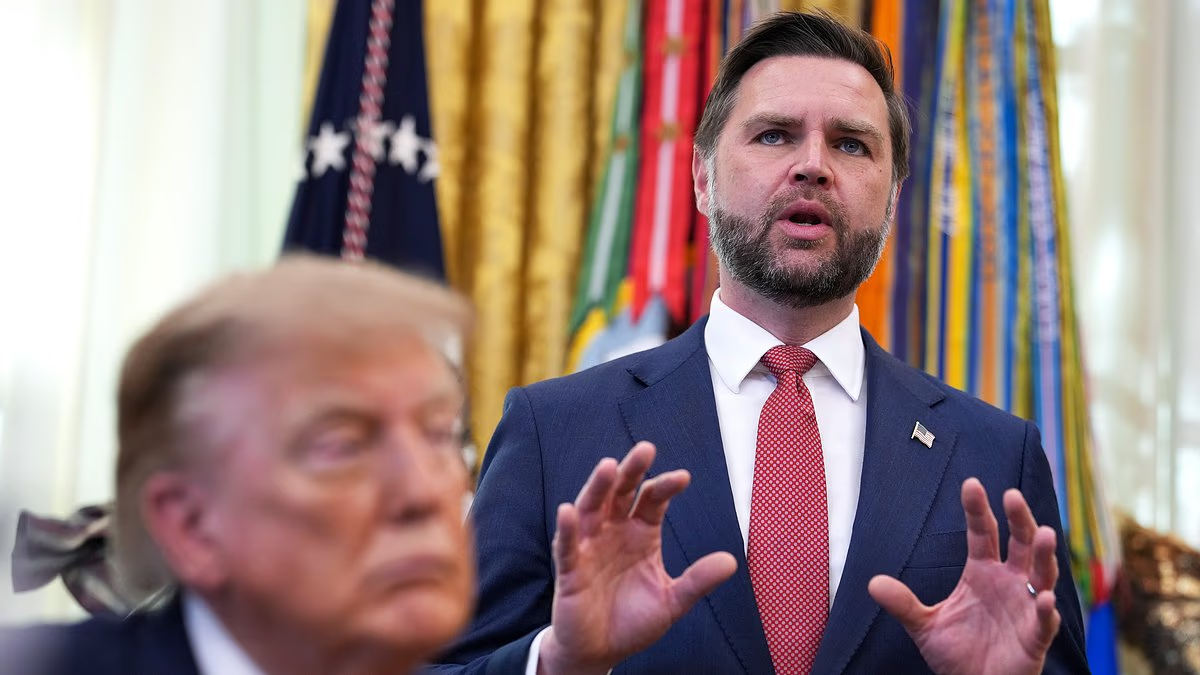

Vice President JD Vance has sought to reassure Americans that there is no need to build a bunker or hoard food, even as a series of major technology, transportation and banking disruptions has fueled public anxiety.
During an appearance with Fox News host Laura Ingraham on Monday night, Vance said several friends had contacted him to ask whether they should begin stockpiling food and water or preparing an underground shelter.
“We don’t see a crisis coming down,” Vance said, while adding that people should nevertheless remain ready for unexpected events.
He said the administration was focused on preventing the most serious scenarios while ensuring the country could respond if a major emergency occurred.
Ingraham had asked directly whether Americans should prepare for a large-scale global catastrophe. Her question came after officials in Britain and France advised residents to keep several days’ worth of food and water at home.
Vance dismissed reports that Pentagon facilities were preparing to operate independently from the power grid for up to 90 days, describing those plans as routine government preparation intended to ensure the military could function during a crisis.
At the same time, Google has warned businesses that artificial intelligence is being used to power autonomous cyberattacks against major digital systems.
In a report released Monday, the company said AI-driven hackers could continuously evade security updates, create functional exploits and deploy them against internet-connected servers.

Vance has urged Americans not to build bunkers or stockpile food despite a string of recent technology, travel and banking disruptions

Google says artificial intelligence is helping hackers launch autonomous attacks against major computer systems

Tens of thousands of passengers were stranded after the FAA ordered a nationwide halt to flights over the weekend
Google has not linked its findings to the outages reported last week, and federal officials say they have found no evidence that the disruptions were caused by a deliberate attack.
Separately, hackers have breached tools used by some of the world’s most visited websites in a wide-ranging campaign aimed at stealing money and payment-card information.
Researchers found malicious code in web tools used by 178 organizations, including Zoom, CNN, the BBC, HSBC, Equifax, Salesforce, Peacock, IKEA, Fox News, NPR, the ASPCA and Invisalign.
The breach, discovered on Monday evening, focused on Optimizely, a platform companies use to test website designs, layouts and features.
Microsoft’s Outlook, Teams and Copilot services also went offline on Thursday, leaving users in 74 countries without access into the weekend.
On Friday, around 10,000 flights were disrupted when the Federal Aviation Administration temporarily stopped departures nationwide. It was the second countrywide ground stop since the September 11 attacks.
Transportation Secretary Sean Duffy attributed the incident to a router installed by contractor L3Harris Technologies at a remote FAA communications site in Arkansas.
The device overwhelmed a network that was still operating on equipment installed in 2001 and originally scheduled to be replaced in 2006.
Duffy asked FBI Director Kash Patel to involve federal agents in the investigation. The router was sent to a laboratory in Florida, while the FAA disabled the broadcasting function on all 69 devices of the same type across the national airspace system.
By Monday, the disruption had also affected banking services, with thousands of customers at Chase, Wells Fargo, US Bank, Capital One, Truist and Bank of America reporting that they could not view account balances or transfer money.
United Airlines experienced additional delays that afternoon after pilots lost access to the weight-and-balance data required before aircraft could leave the gate, grounding hundreds of flights.


