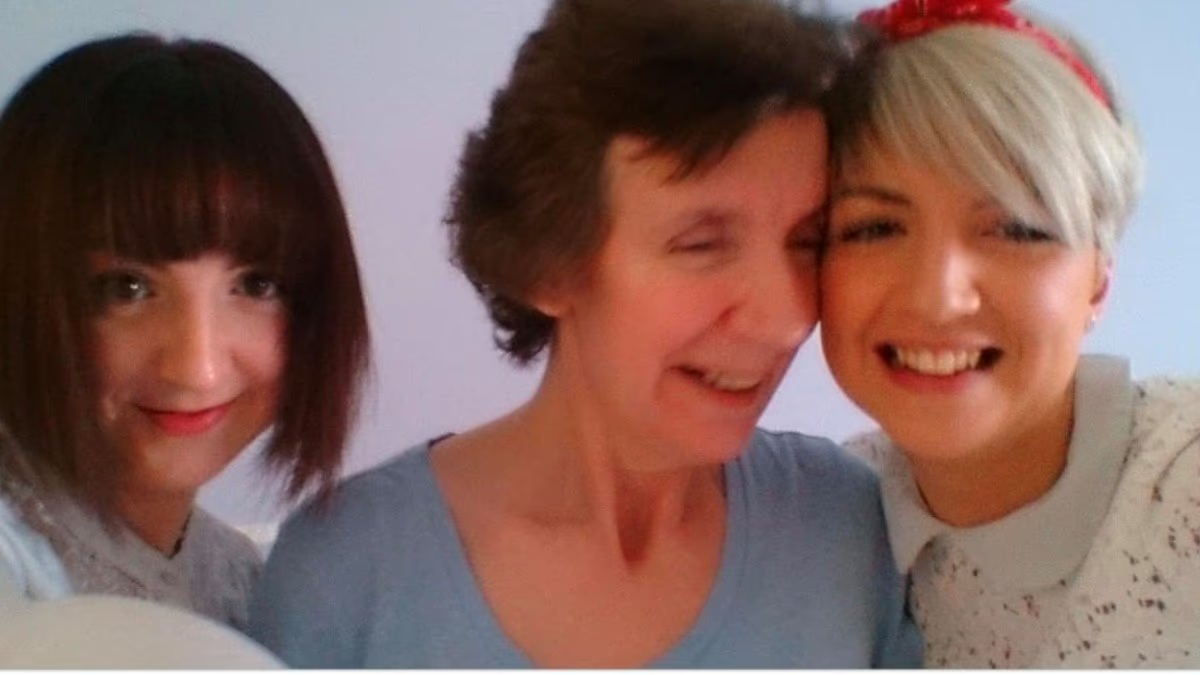

At 17, while many teenagers are enjoying time with friends and preparing to leave home for university, Jenny Molloy became her mother Laura’s carer after she was diagnosed with Alzheimer’s at just 53.
At first, caring for Laura was a shared family responsibility involving Jenny, her 14-year-old sister Barbara and their father. But within two years, unable to cope with the pressure, their father ended his 20-year marriage, leaving the sisters to manage largely on their own.
The bewildered teenagers took turns leaving school during free periods or giving up their weekends to make sure one of them was always at home with Laura.
The situation transformed both girls’ lives. Jenny abandoned her plans to attend university, while Barbara was forced to grow up quickly and take responsibility for household tasks. Neither daughter resented caring for their mother, however, and for the next three years they remained Laura’s main carers.
Even after Laura moved into a care home, the sisters visited at least every other day until her death in 2023.
‘We loved Mum and we wanted to look after her,’ says Jenny, now 34. She lives in Rossendale, Lancashire, with her husband Josh, also 34, a pension administrator, and their eight-year-old daughter Matilda.

Jenny Molloy (left) became a carer at 17, alongside her younger sister Barbara (right), after their mother Laura was diagnosed with early-onset dementia

Before her diagnosis, the ‘most brilliant hands-on mum’ balanced a full-time job with helping at the school parent-teacher association and volunteering at their local church
‘It wasn’t easy, but we did the best job we could. I often look back and wonder how we managed.’
Jenny’s story highlights the enormous sacrifices made by people caring for relatives with dementia, while exposing how little support is often available to even the most vulnerable young carers.
That gap has prompted the Daily Mail, Mail Force and Alzheimer’s Society to launch the Dementia Carers Together campaign. It aims to offer carers courses on their medical and financial rights, as well as practical guidance for supporting loved ones as their condition worsens.
The campaign will also give carers the chance to meet others in similar circumstances, helping to tackle the isolation and loneliness many experience. Such support could have made a significant difference to Jenny and Barbara, whose mother had always been the family’s anchor.
Before becoming ill, Laura was the ‘most brilliant hands-on mum’, combining a full-time job with helping at the school parent-teacher association and volunteering at the local church.
Warm-hearted and sociable, Laura was known as ‘the hostess with the mostest’. She and her husband regularly welcomed neighbours for laughter-filled evenings, serving her signature meat and potato pie.
But shortly after Laura turned 50, small signs began to suggest that something was wrong.
At first, the mistakes seemed insignificant, such as pouring boiling water into the tea caddy instead of a cup. Then the meticulous former Post Office worker began making unusual errors while operating tills in her new job at Asda.
‘Mum must have realised something wasn’t right because she went to the family doctor and said, “Something isn’t quite right”,’ Jenny recalls. The doctor suggested that Laura was likely experiencing menopause and recommended HRT.
Laura was moved from the tills to the clothing department at work. ‘But then she started doing strange things, like putting shoes in the fruit and vegetables section,’ says Jenny.
Early-onset Alzheimer’s, which develops before the age of 65, can initially cause problems with vision, language or behaviour rather than the more familiar memory difficulties, says Simon Wheeler, senior information officer at Alzheimer’s Society.
It was Laura’s employer who advised the family to seek a second opinion. A brain scan followed, and Laura was diagnosed in 2010.
‘Dad told me while we sat on the bed crying,’ says Jenny.
‘Barbara was too young to understand what was happening – she was only 14. It was awful. There was nobody my age I could talk to who would understand.’
Accidents became increasingly common, including one incident in which Laura switched on the gas hob without lighting it.
She needed constant supervision because she would wander away and quickly become lost outside the house.
On the day Jenny’s father decided he could no longer cope, she came home from school to find him pacing in the garden.
‘I do understand. It must have been incredibly difficult for him to watch the woman he loved effectively change into someone else,’ says Jenny.
Jenny, however, did not hesitate to take responsibility. ‘I wanted to study languages at university, and all my friends were leaving to study or moving away – but there was no way I could leave Mum,’ she says.
Instead, Jenny became an apprentice at a travel agency. She cared for Laura after work and at weekends, while Barbara returned home between school lessons.
Their uncle Ronnie, Laura’s brother, and his wife Cath ‘became like parents to us. They helped with money and the bills, and would sit with Mum when my sister and I couldn’t be there,’ Jenny says.
Jenny waited nearly a year for the authorities to transfer power of attorney from her father to her, allowing her to manage the family finances. The only guidance the sisters received about available support came through Cath, who took them to Citizens Advice.
‘We had to be organised. I arranged a weekly online shop, and Barbara and I handled the cleaning, cooking and laundry,’ says Jenny.

Even after Laura moved into a care home, the sisters visited at least every other day until her death in 2023. Jenny’s baby daughter also met her grandmother
Ronnie arranged visits from carers funded by the local authority, who helped Laura wash and dress. But Laura ‘hated that’, says Jenny, so the two teenagers did their best to keep her clean themselves.
No one explained what they should do or how they might cope. ‘We simply had to learn as we went along,’ says Jenny. ‘It was lonely at times, and it would have been even harder if I hadn’t met Josh at college when I was 17. He was wonderful with Mum.’
By 2013, three years after Laura’s diagnosis, her care needs had increased significantly. ‘She was doubly incontinent, which was very difficult for us to manage, and she had started waking during the night,’ says Jenny.
‘We had a baby gate installed to stop her going downstairs, but she would go into Barbara’s room and wake her. Barbara was studying for her A-levels, so it was very challenging.’
Seeing how exhausted the girls had become, Ronnie contacted social services, which found a care home for Laura. For Jenny, it was an extremely painful period.
‘People assumed I would feel relieved, but I really didn’t,’ she says.
‘She was still Mum. Not because she could do things for me, but because I could sit with her, talk to her and give her a cuddle. The roles had reversed. I didn’t want her to leave, but we couldn’t carry on. Even now, I regret that she moved when she did.’
Laura moved into a care home in December 2013. Her daughters continued to visit every day or every other day. ‘At first, Mum refused to eat the food, so I took her biscuits just to make sure she had something,’ says Jenny.
Laura’s condition continued to decline, and within four years she spent much of the day with her eyes closed.
‘But if I touched her hand, she would squeeze it, and she smiled when she heard our voices,’ says Jenny.
‘I truly believe she knew who my sister and I were right until the end.’
Carers brought Laura to Jenny’s wedding in 2018. Later that year, after Matilda was born, Jenny proudly took her daughter to meet her grandmother at the care home.
Laura spent the final six months of her life in and out of hospital with lung infections. She died in hospital in February 2023, aged just 65.
Early-onset Alzheimer’s can have a genetic component. Jenny and Barbara, now a mother of two, have been offered testing to determine whether they may be at risk. ‘But I don’t want to know,’ says Jenny.
Her advice to anyone caring for someone with dementia is simple: ‘Try to appreciate the good moments. We had so many with Mum – sitting on the sofa with a pink teddy she loved and dancing to X Factor. It’s important to remember that it wasn’t all bad.’
Dementia Carers Together


