

RATING: 5 / 10
- Elizabeth Debicki delivers the film’s standout performance
- Tarantino’s screenplay still provides some genuinely funny moments
- It lacks the emotional warmth of Once Upon a Time in Hollywood
- Cliff Booth is written as an implausibly idealized hero
- The cinematography and visual effects are uneven
Seven years have passed since audiences first met stuntman Cliff Booth (Brad Pitt) in “Once Upon a Time in Hollywood.” Since then, Quentin Tarantino has largely made headlines for two reasons: his abrasive opinions and his failure to deliver the long-promised 10th movie that is supposedly meant to be his last. The first has never exactly been unusual, but without a new film to showcase Tarantino’s singular talent, the noise has become harder to overlook. His explanation for retiring after 10 movies has also shifted. He once argued that directors lose their creative spark after turning 60 — a claim that Martin Scorsese, Steven Spielberg, and Akira Kurosawa, among others, would dispute. Now 63, Tarantino’s insistence that cinema died in 2019, the year “Once Upon a Time in Hollywood” arrived, only makes him sound increasingly stuck in the past.
Tarantino wrote a 230-page sequel screenplay, “The Further Mis-Adventures of Cliff Booth,” but handed it to David Fincher because he did not want the project to become his 10th and final film. Cut down to a still substantial two and a half hours, the resulting collaboration is watchable. Tarantino is too gifted a writer, and Fincher too accomplished a director, to produce something outright unwatchable. Yet the movie also feels largely unnecessary, perhaps even directionless. The filmmakers’ strengths pull against each other: Tarantino enjoys digression and has pushed Cliff’s adventures toward nearly plotless hangout-movie territory, while Fincher’s precision and command of tension rarely find a natural fit in this loose material. The result misses both the relaxed charm the story needs and the sharper focus Fincher does best.
A duller, thinner follow-up to its predecessor
“The Further Mis-Adventures of Cliff Booth” marks a major stylistic departure from “Once Upon a Time in Hollywood,” and it is, unfortunately, a downgrade. Some of that difference may come from the setting: 1977 is simply less visually inviting than 1969. But the period change does not explain why Erik Messerschmidt’s cinematography is so much darker and more desaturated than Robert Richardson’s work on the earlier film. The movie is further weakened by distracting visual effects. Fincher has always relied more heavily on CGI than Tarantino, yet some of the effects here fall well below the director’s usual standard, particularly in IMAX. A montage of fictional vintage television programs, narrated by Tarantino, should be entertaining world-building. Instead, the noticeably artificial look of several stunts kept pulling me out of the scene. It would be premature to claim AI was used without evidence, though the sequence has already prompted that speculation.
Wherever Cliff goes, he tends to hear one of two questions. Strangers ask whether they know him from somewhere, while people who recognize him want to know what happened to Rick Dalton, Leonardo DiCaprio’s character from “Once Upon a Time in Hollywood.” The first running joke eventually lands a terrific payoff. The second goes nowhere, returning again and again to the same comment about Rick gaining weight and relocating to Australia. The previous film centered on the friendship between Rick and Cliff, so brushing past the separation — without exploring the loneliness of losing a longtime companion — feels like a missed opportunity.
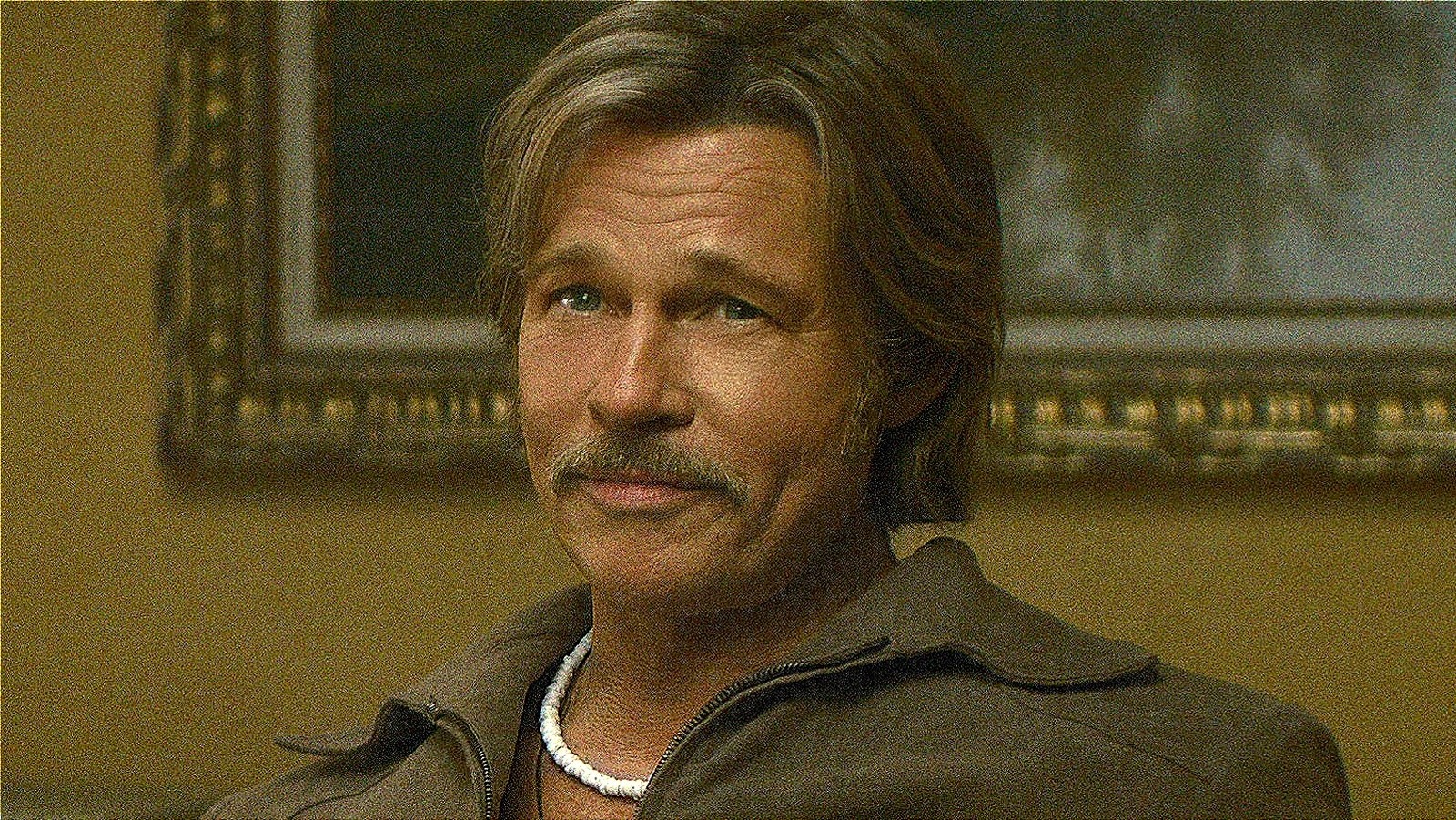
Without Rick beside him, Cliff is not especially compelling as a dramatic character. Tarantino has turned him into a classic “Gary Stu,” a fan-fiction term for an idealized self-insert who is effortlessly admired and capable. If Cliff’s victory over Bruce Lee in the previous movie made you skeptical, this sequel reveals that he also defeated Jim Brown and helped liberate the Philippines during World War II. His only serious blemish — the implication that he may have killed his wife, made explicit in the novelization — becomes especially uncomfortable in light of the domestic abuse allegations against Pitt. At least this film places Cliff in a story about preventing another man from carrying out similar violence.
The limited story struggles to hold together
There is, technically, a plot. Talent agent Karen Crosby (Elizabeth Debicki) hires Cliff to work with Charlie Peters (Scott Caan), an actor famous for performing his own stunts. Charlie is married to Cliff’s former partner Toni (Carla Gugino), while Cliff hopes Karen will dominate him. The scenes involving these four characters provide much of the movie’s best comedy. Eventually, Charlie explains why he needs Cliff’s help: during a trip to the Philippines, he hired two criminals, Eddie and Fernando Verdusco (Matt Groove and JB Tadena), to murder his wife. Now remorseful, he wants Cliff to stop them.
The Verdusco brothers appear only intermittently, but their arrival brings a sharp tonal shift. They are genuinely frightening, and the brutality they unleash is unusually vicious even for a Tarantino film. I cannot remember another Tarantino movie in which children are graphically shot in the head. Fincher handles these violent sequences with skill, but he struggles to connect them to the film’s broader collection of comic detours, which occupy roughly 90% of the runtime. The climax, in which Cliff confronts the killers, contains flashes of excitement, but the murky cinematography and hurried resolution keep it from making the impact it should.
Debicki gives the film its strongest performance by far. She is funny, magnetic, and benefits from the most engaging character in the screenplay. Karen was once a film critic, and some aspects of the role appear to echo Tarantino’s abandoned proposal for a final movie, “The Movie Critic.” In one of the film’s sharper exchanges, she argues that Hollywood movies are not art, dismissing even “The Godfather” as a simple fast-food burger with a few artistic qualities layered on top.
Tarantino and Fincher presumably do not share Karen’s view, but the speech captures their apparent approach to this movie. They are not trying to create high art; they are serving up a burger. The trouble is that this particular burger is disappointingly bland — perhaps the most mediocre film either filmmaker has made.
“The Further Mis-Adventures of Cliff Booth” opens in theaters November 25. It will begin streaming on Netflix December 23.


