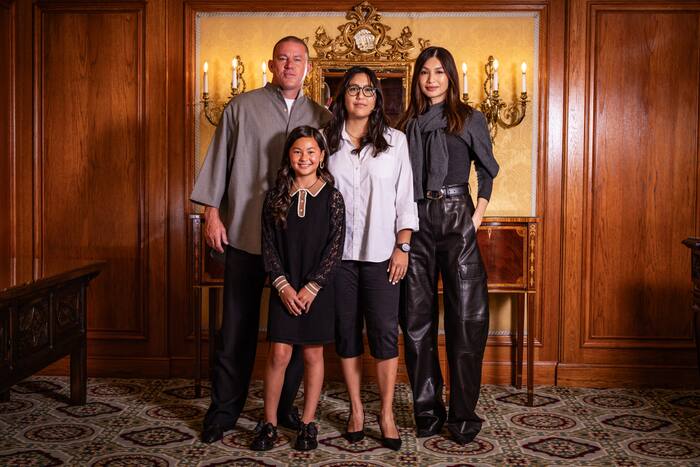


NEW YORK – The 8-year-old at the center of Beth de Araújo’s devastating film “Josephine” is based on Araújo herself. As a child, she and her father were walking through San Francisco’s Golden Gate Park when they came upon a rape in progress—an experience that took much of her adult life to confront.
Yet when Araújo began transforming that memory into a drama, one of her key reference points was Travis Bickle, the haunted vigilante from “Taxi Driver.”
“It’s so complicated because you see the world through his eyes,” Araújo says. “The world is dark and dangerous, and there are some truly horrible people in it. He thinks, ‘Well, I’m going to do something about it.’ And you’re thinking, ‘But the darkness has taken over you. You can’t become the vigilante you imagine yourself to be.’”
Point of view is central to “Josephine,” which opened in theaters Friday. Mason Reeves plays the 8-year-old title character, with Channing Tatum and Gemma Chan portraying her parents. Much of the film unfolds through Josephine’s eyes. After witnessing a terrifying glimpse of the adult world, she begins to unravel, coming dangerously close to being consumed by darkness, much like Bickle.
But Josephine does not follow that path—and neither did Araújo. Instead, she became a filmmaker.
“There is a way to find true resilience,” Araújo said in a recent interview. “For me, it came through becoming an artist. The ending of ‘Taxi Driver’ isn’t true for me. At one point, the incident nearly overturned my entire life. But it didn’t.”
A ‘vomit draft’ launches a long creative journey
Reaching that perspective took time for Araújo, now 41. The childhood memory did not fully surface until she was an adult. In 2014, she spoke about it during a “Moth” storytelling event. She also spent time volunteering for a rape and battering hotline in Los Angeles. Eventually, in an act of emotional release, she wrote what she describes as a 70-page “vomit draft.”
As the project evolved, “Josephine” became more than a retelling of Araújo’s past. It became an exploration of how to move beyond it. The film premiered at the Sundance Film Festival earlier this year, where it won both the grand jury prize and the audience award.
By any standard, “Josephine” is a triumph. It stands among the year’s most piercing and unforgettable films—an unusually precise portrait of childhood and a rare work that confronts sexual abuse without looking away. Getting it made, however, was anything but simple.
“To build a career and make money from films about subjects people don’t consider commercial is daunting,” Araújo says. “Somehow, I’m suited to it. I don’t mean that as a positive thing. Go be happy and become a dairy farmer in Ireland. I don’t know whether I would wish this on anyone.”
Tatum and Chan portray parents under extraordinary pressure
Araújo has made an uncompromising entrance into filmmaking. Her debut feature, 2022’s “Soft & Quiet,” centered on a white supremacist and elementary school teacher. The film caught Tatum’s attention.
“Beth’s first movie was just …,” Tatum says, clapping his hands. “It was singular. I watched it and thought: (Expletive), this is someone who made a choice.”
In “Josephine,” the child’s parents disagree over how to help her process what she has witnessed. Her father, Damien, believes Josephine should be taught how to defend herself. Her mother, Claire, played by Chan, wants to respond with greater emotional care. Both, though, are overwhelmed by the sudden arrival of adult horrors in their daughter’s life—and by the consequences that follow.
“When I read the script, I moved back and forth,” Chan says. “Sometimes I empathized more with Claire, sometimes with Damien, and sometimes I just wanted to shake both of them. They’re two people doing their best, but they bring their own flaws, traumas and upbringing into the situation.”
Tatum, who has a 13-year-old daughter, found the material particularly personal. Parenthood, he says, comes without a reliable guidebook.
“I saw a lot of my father and a lot of myself in the way Damien handles those moments,” Tatum says. “I’m a combination of both: the uncompromising anger, but also the effort to become a gentler person than perhaps the one Beth experienced. I didn’t know what that exploration would reveal. Every scene felt like it was unfolding in real time.”
The film also features a widely praised performance from 9-year-old Reeves, whom Araújo discovered at a farmers market. Because of the story’s sensitive subject matter, the production took steps to protect her from its harshest details. Reeves never read the screenplay; instead, her mother read it to her. At the Sundance premiere, she entered the theater midway through the film, after the park sequence. Even so, Araújo was repeatedly struck by the young actor’s natural instincts.
“Sometimes when you talk to Mason, it feels like you’re speaking with your grandmother. She’s ageless,” Araújo says. “The main difference was that she needed snacks.”
‘Silence was really not helpful’
After Araújo’s childhood experience, her parents chose not to discuss it. She remains unsure when children should be told about sexual assault, but she is certain that avoiding the subject entirely is not a solution.
“For me, silence was really not helpful,” she says. “It left me spiraling into a dangerous imagination without clear guidance. Some direction from an adult could have helped enormously. I didn’t receive it not because I wasn’t loved, but because the adults around me didn’t know how to respond. We like to believe children aren’t absorbing as much as they sometimes are.”
Her time answering calls on the Los Angeles hotline also exposed Araújo to recurring patterns in sexual assault. That experience deepened her frustration with the limited public investment in understanding perpetrators and teaching young men about sexual violence.
“We’ve decided it’s acceptable to tell young girls, ‘It’s basically your responsibility to keep yourself safe because no one else will. Don’t go into the woods alone. Don’t get into an Uber late at night,’” Araújo says.
“Look at the situation we’re in,” she adds, pointing to the lack of charges connected to the Jeffrey Epstein case. “We’re telling every little girl in the world that protecting herself is her responsibility.”
Araújo tries to separate her personal outrage from her role as an artist. “Beth, the citizen, is infuriated,” she says. But she is not a policymaker—and creating and releasing “Josephine” has already demanded nearly everything she has.
“It’s a difficult place to live,” Araújo says. “It’s an incredibly difficult film to edit. I’m ready to challenge myself in new ways and move forward. I’m ready to keep making art.”


