
Vladimir Putin could inadvertently set off a third world war, according to a warning from the UK’s defence intelligence chief.
Lieutenant General Matthew Jones, Chief of Defence Intelligence, said he did not think Russia was deliberately seeking a direct conflict with Nato. However, he cautioned that Moscow’s increasingly reckless conduct was raising the danger of a potentially catastrophic mistake.
His remarks, published on Saturday, came after Russian missiles and drones entered Poland earlier this week, close to the area where hundreds of British troops were taking part in military exercises.
They also followed claims that Moscow was involved in an alleged plot to assassinate a Ukrainian-American rapper in Denmark.
General Jones cited a series of incidents he said demonstrated Russia’s aggressive approach, including the 2018 Salisbury poisoning, where the Novichok nerve agent was deployed and ultimately killed Dawn Sturgess.
Speaking at the Cambridge intelligence seminar on Friday evening, the former British Army officer said: ‘I can say with some confidence that Russia is not actively pursuing war with Nato.
‘But my greatest concern is the possibility of a serious miscalculation. Putin is under pressure, and that appears to be driving a more assertive and aggressive strategy as he attempts to challenge us.
‘There have been far too many examples of reckless Russian behaviour recently. Had circumstances been only slightly different, the consequences could have been extremely serious.’

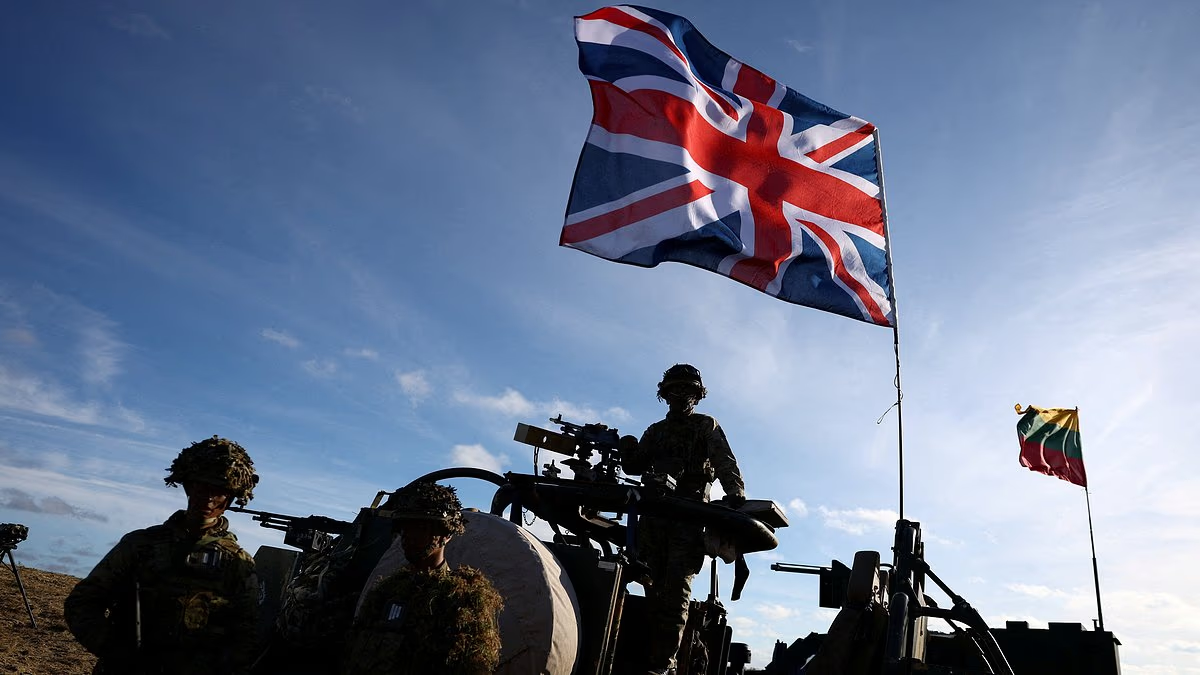
British soldiers take part in the Koalicja 26.2 military exercise in Nowa Deba, Poland, on November 16, 2026

CCTV captured the moment a Russian missile struck Polish territory on Friday
He described the drone attack at Leipzig airport in Germany as the ‘most egregious recent example’. Defence intelligence officials are also monitoring a series of merchant ship sinkings in the Black Sea, in waters near Nato member Romania.
In Britain, he pointed to an arson attack on a Ukrainian-owned business in east London that was allegedly backed by Russia, the ‘near shootdown’ of an RAF Rivet Joint surveillance aircraft over the Black Sea and the Salisbury poisoning, which ‘claimed one life but could have been so much worse’.
The Novichok attack was aimed at former Russian spy Sergei Skripal and his daughter, Yulia. Dawn Sturgess later died after coming into contact with the nerve agent in a discarded perfume bottle.
‘I want to be clear that the UK’s position is that we do not seek conflict or confrontation with Russia,’ General Jones said.
‘But when our national security or that of our allies is threatened, we will defend it robustly.’
Defence Secretary Wes Streeting has said Britain must be prepared for war by 2030, warning that Russia’s expanding military capability could make an attack possible within roughly 1,000 days.
Mr Streeting called preparing the country for conflict a ‘defining priority’. He said: ‘First, that means strengthening our capabilities so our adversaries think twice before attacking us. If that deterrence fails, Britain must be ready for war.’
General Jones said on Friday: ‘This is not a prediction about when Britain and its allies might face a military attack, but given the threats we face, this approach is eminently sensible.’
The latest indication that Russia may be prepared to operate inside Nato countries emerged as Denmark announced it had stopped an alleged assassination attempt against an American citizen of Ukrainian origin. Danish authorities said the plot had been organised by Russian intelligence.
Foreign Secretary Ed Miliband said: ‘We stand with Denmark following this egregious attempted assassination on the territory of a Nato ally.
READ MORE: Europe’s Worst Christmas Markets, According to Travel Experts
‘We will continue working with Denmark and our allies to deter and disrupt efforts by the Russian state to undermine our collective security, including through threats against individuals.’
On Friday morning, two Russian missiles and what was believed to be a drone came down in Poland. Warsaw said the incident was likely a deliberate provocation timed to coincide with military drills involving troops from several European nations, including British soldiers preparing for a possible post-war security mission in Ukraine.
Nato aircraft were scrambled after two Kh-101 cruise missiles and a jet-powered suicide drone crossed into Polish airspace.
One missile struck a field and exploded approximately 47 miles from the location of 300 UK troops taking part in the so-called ‘Coalition of the Willing’.
A second missile hit Rudnik na Sadem, around 22 miles from the military base, while the third impact was recorded near Molodycz, roughly 50 miles away.
Putin has been accused of provoking the incident, which occurred a day after President Trump defended him over previous episodes.
Speaking to BBC Radio 4 on Saturday, Poland’s Mr Sikorski said investigators were still collecting evidence but believed one drone and two long-range Kh-101 missiles had entered Polish territory.
He said the incident represented a further escalation of Russian aggression: ‘This appears to be an escalation because these missiles have entered that territory and airspace before.
‘In 2022 it was an unarmed missile, then a few months ago there was an armed one, and now there are two missiles.’
Mr Sikorski said it was ‘very unlikely’ that the cruise missiles had been knocked off course by Ukrainian electronic warfare, noting that they use independent guidance systems.
After the strikes, Polish Prime Minister Donald Tusk described the incident as ‘an intentional provocation’ by Russia, timed to coincide with the presence of troops from the British Army’s 7 Brigade in the region.
‘We are facing another provocation from Russia. In my view, the timing is not accidental,’ Poland’s Defence Minister Wladyslaw Kosiniak-Kamysz said on Friday.
‘Today, the Coalition of the Willing is conducting exercises. Around a dozen countries are positioned close to the areas where our air force was operating.’
Prime Minister Andy Burnham described the incident as ‘utterly unacceptable’.
Meanwhile, European Commission President Ursula von der Leyen condemned the alleged attempt to assassinate a Ukrainian-American rapper in Copenhagen.
She called it an ‘attack on EU soil’ that was ‘unacceptable’, adding that ‘Russia’s hybrid threats are becoming less and less hybrid, and more and more real’.
Saying the European Union had the ‘tools to act’, she wrote on X on Saturday: ‘Let me be clear: if Russia intends to weaken our support for Ukraine, it will achieve the exact opposite.
‘Our resolve will only become stronger.’
READ MORE: Donald Trump wants Ukraine peace deal by January as he brands Russian missile strike on Poland ‘mistake’
Do YOU have a story? Email isabella.machin@dailymail.co.uk


