
KYIV – Weeks after a missile detonated outside her apartment building, Oleksandra Horban was still finding shards of glass throughout her small home.
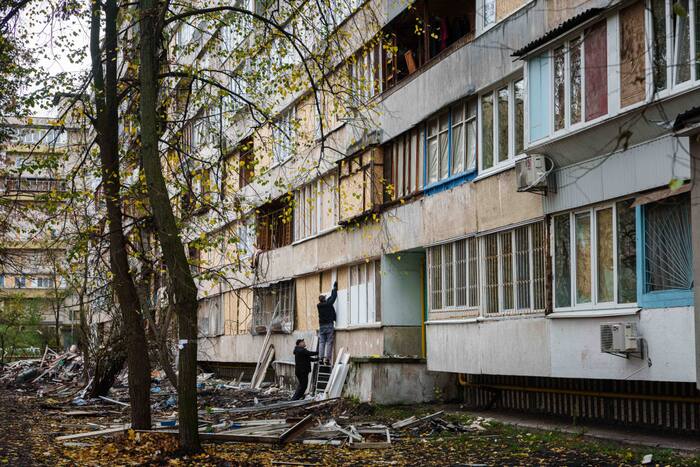
She discarded her 2-year-old son’s plush toys after glass fragments became embedded in them. Outside the ground-floor apartment, twisted window frames had been stacked on heaps of debris waiting to be cleared. On the muddy ground, glass glinted among the fallen autumn leaves.
“Even now we still find glass,” Horban said. “We can vacuum three times, wash the floor and clean everything, but microscopic pieces still turn up somewhere — in the bed or among the toys.”
With winter arriving, Ukraine is confronting a serious shortage of replacement windows as Russian missile and drone strikes continue damaging homes and leaving residents vulnerable to freezing temperatures. Kyiv temperatures dropped to minus 20 degrees Celsius (minus 4 degrees Fahrenheit) last winter.
Government aid may take months to arrive, while experienced installers are scarce and replacement prices have surged. The burden is especially heavy in lower-income neighborhoods near industrial areas.
Horban lives in a Soviet-era “groundscraper,” a vast horizontal apartment complex in the Ukrainian capital. A missile strike in October hit one vertical section of the building, blowing out hundreds of windows along its facade.
A costly race against the cold
Most broken windows have been covered temporarily with fiberboard or tarpaulins. In some of the boards, small Plexiglas panels provide a limited source of daylight.
Replacing the windows in Horban’s apartment would cost roughly $1,700 — more than three times Ukraine’s average monthly salary. Government compensation may take three or four months.
Many families cannot wait that long. Apartments without proper windows are left exposed to cold, moisture and mold, problems that worsen when power cuts interrupt heating and ventilation.
Damage to housing represents one of the war’s biggest financial burdens. By the end of last year, an estimated 3 million housing units had been destroyed or severely damaged, adding $90 billion to Ukraine’s reconstruction bill, according to the World Bank.
Installers are in short supply
Ukraine’s window manufacturers have the capacity to produce replacement units. The critical constraint is the lack of qualified workers to install them.
Mykhailo Orlenko, executive director of the Association of Ukrainian Manufacturers of Transparent Structures, said companies had been unable to secure exemptions from military service for their employees, including many window installers.
“The market lost a large number of these specialists,” he said.
Factories can produce windows in about 10 working days, but installation often takes far longer because customers must wait for an available crew. Surging demand has driven installation costs to at least twice their level of a year ago.
Oleksandr, a 42-year-old installer with 25 years in the trade, said blackouts make the work even more difficult. His crew uses battery-powered equipment and often carries heavy materials up stairwells when elevators stop working.
During one recent assignment, the team replaced balcony doors and windows in a fourth-floor apartment, hauling every item upstairs by hand.
“That meant 18 trips up and down the stairs with heavy loads. A working elevator would have made it easier, but we didn’t wait for the electricity to return — we started working immediately,” he said.
Oleksandr asked that only his first name be used because of security concerns following Russian attacks on private businesses.
Training a new generation for reconstruction
The industry is responding to the labor shortage by expanding training programs. In March, a vocational college in Kyiv opened a European Union-funded facility where 26 10th-grade students began a three-year course in window, door and facade installation.
Wearing new overalls, the teenagers practice on mock window openings made from brick, cinder block, wood and synthetic materials. Their lessons are regularly interrupted by missile and drone alerts.
The program followed lobbying by professional associations, which urged the government to officially recognize window installation as a profession. That designation allows the sector to pursue grants and establish formal training courses.
Graduates may earn starting salaries of about $900, comparable to those of law graduates, because Ukraine is facing a severe loss of skilled workers, Orlenko said.
Instructor Volodymyr Tserbii hopes the apprentices will play a role in rebuilding Ukraine while gaining access to a profession that will be essential to the country’s recovery.
Government planners estimate that repairing Ukraine’s damaged homes, schools, roads, power plants and other infrastructure will take at least a decade.
Surviving another winter
For Horban, the wait for replacement windows is only one of many problems facing her family.
The apartment has no gas, so the family cooks on a portable cylinder. They heat their son’s room only when electricity is available, while a leaking kitchen roof has caused further damage.
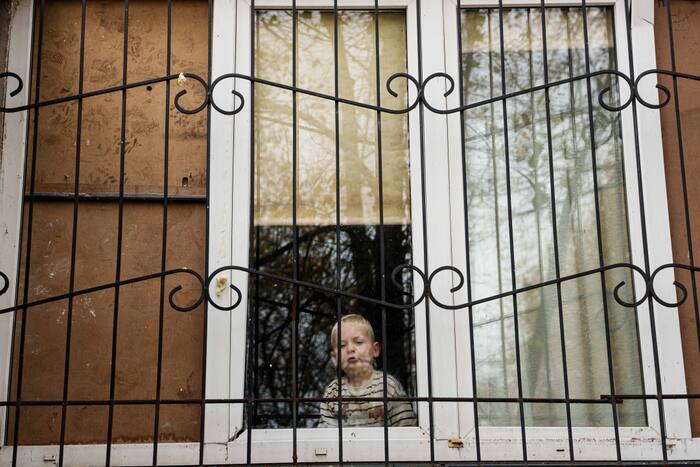
The explosion also frightened her toddler, Viacheslav. The language of war has entered his vocabulary.
Standing at a windowpane that survived the blast, he presses his nose against the glass, waves at people outside and asks his mother if more bombing is coming. He uses the words “bam bam” for the sound of explosions.
“Bam bam?” he asks.
“No bam bam,” she replies.
“This is not life, this is surviving,” Horban said. “This is dragging out an existence, not living.”
___
Vasilisa Stepanenko, Evgeniy Maloletka and Susie Blann in Kyiv contributed.
___
Follow the AP’s coverage of the war in Ukraine at


