
Thirty years ago, Trip Hawkins appeared to have reached the summit. As the founder of Electronic Arts, he had turned an ambitious vision for a mainstream video game publishing powerhouse into reality with blockbuster franchises including Madden NFL, FIFA, and The Sims. A federal appeals court later noted that “by 1996 his net worth had risen to $100 million.”
By the mid-1990s, Hawkins seemed financially secure for life. He owned a private jet, a collection of luxury cars, and two expansive mansions staffed by large household teams. His children attended elite private schools.
Behind that image of success, however, his financial empire was steadily weakening. Extravagant spending, inadequate financial advice, and a failed tax-avoidance strategy would eventually lead to bankruptcy, years of legal battles with the IRS, and the potential loss of his fortune. Court filings later showed that Hawkins’ private jet cost $11.8 million, required $1 million a year to operate, and generated $100,000 in monthly hangar fees. He purchased a $2.6 million vacation home in La Jolla, maintained a $3.5 million residence in Atherton, and spent more than $8,900 each year on San Francisco Giants season tickets. At one point, the Hawkins household was spending $78,000 more every month than it earned.
To finance that lifestyle, Hawkins sold more than $66 million worth of EA stock between 1996 and 1998 alone. Rather than pay the taxes due on those sales, he turned to a series of complex accounting strategies that ultimately proved far less clever than expected.
Nearly three decades later, EA has reached a new peak. Yesterday, reports revealed that a consortium led by Saudi Arabia’s sovereign wealth fund plans to acquire Electronic Arts in what would become the largest leveraged buyout in history, pending regulatory approval. Somewhere in the world, Trip Hawkins may well be reflecting on what might have happened if he had simply held on to his shares.
The Rise of a Gaming Visionary
Before Trip Hawkins built billion-dollar video game franchises, he studied game theory at Harvard. He attended the university during the same era as Bill Gates and Steve Ballmer. Alongside playing varsity football, Hawkins designed his own field of study in Strategy and Applied Game Theory. He later earned an MBA from Stanford. That combination of academic discipline and a lifelong fascination with games shaped his business philosophy.
In 1978, Hawkins joined Apple as one of the company’s first 50 employees. He initially worked as Director of Strategy and Marketing under Mike Markkula before eventually reporting directly to Steve Jobs.
While at Apple, Hawkins reached a remarkably prescient conclusion. The company’s developers were creative, unconventional thinkers, yet much of their talent was being directed toward relatively routine operating-system software and business applications such as spreadsheets. Hawkins believed that these creative minds should instead be using their skills to produce something far more imaginative—such as a game.
In May 1982, Hawkins left Apple and invested $200,000 of his own money to launch a video game development company. By December that year, he had raised his first round of venture capital and recruited Steve Wozniak to serve on the board.
One of Hawkins’ founding principles was that software developers should be treated like artists, much as filmmakers and rock stars were. That philosophy inspired the name “Electronic Arts.” EA’s early marketing materials even featured portraits of developers styled like album covers—a bold choice in an industry that rarely gave its creators public recognition.

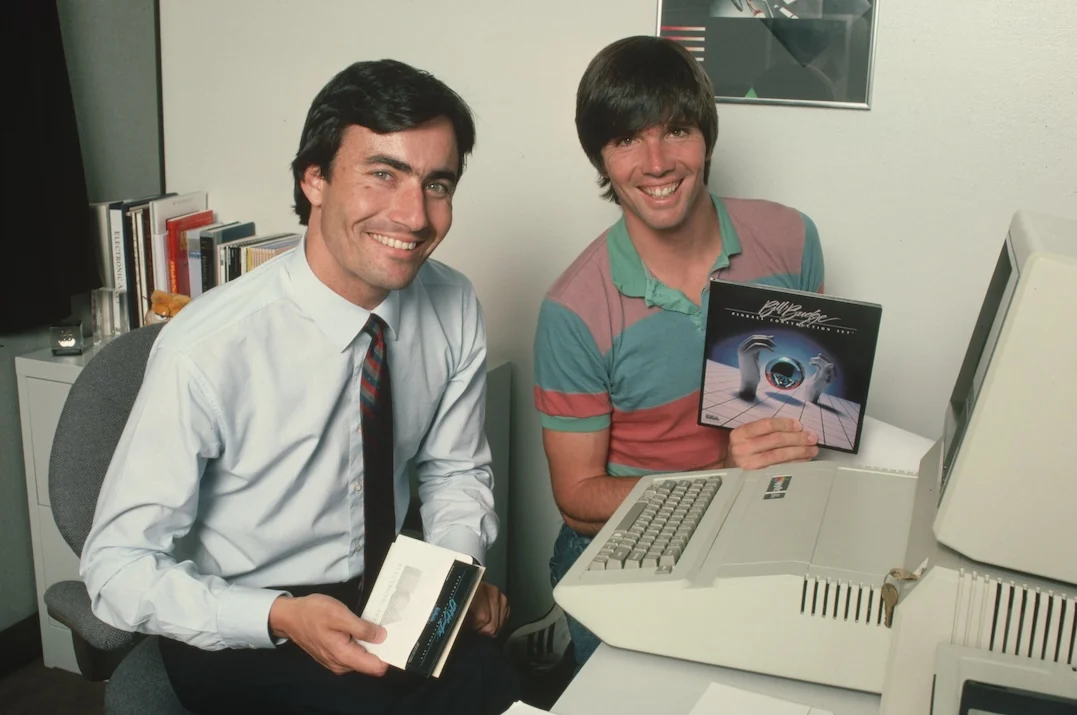
Trip Hawkins (left) and a young business associate at Electronic Arts in 1984 (Photo by © Roger Ressmeyer/CORBIS/VCG via Getty Images)
Hit Games
One of the company’s first games turned out to be a smash hit. It was also the first time a celebrity licensed their name and likeness to appear in a game. Actually, two celebrities. The game was called “1 on 1 with Dr. J & Larry Bird.” Dr. J and Larry Bird were each paid $25,000 and received 2.5% of royalties.
Peak Net Worth
EA continued to rise thanks to PC games like Pinball Construction Set, Archon, and M.U.L.E., but the true breakout moment came in 1988 with the release of John Madden Football. EA soon inked licensing deals with professional sports leagues and athletes, leading to the creation of blockbuster franchises like Madden NFL, FIFA, and NHL.
To fund its growth, EA went public on January 9, 1989, listing on the NASDAQ under the ticker symbol “ERTS.” The IPO raised significant capital and helped EA scale rapidly, expanding development, acquiring studios, and cementing its dominance in the gaming world. On the day of the IPO, Trip owned 20% of ERTS.
By the end of 1996, the year he divorced his first wife, Trip’s stake in EA had dropped to 10%. At that point, the company’s market cap was $1 billion. That meant – on paper – his net worth was $100 million.
From Industry Icon to IRS Target
Between 1996 and 1998, Trip Hawkins sold about $66 million worth of EA stock. Those proceeds funded both an opulent lifestyle—cars, houses, private school tuition, a private jet—and a bold new gamble: Hawkins invested $12 million of his own money into a new venture, The 3DO Company. Backed by Panasonic and Time Warner, 3DO aimed to revolutionize home gaming with a cutting-edge console. But the device was overpriced and underpowered compared to Sony’s PlayStation. Despite early hype, 3DO flopped—and with it, a significant chunk of Hawkins’ fortune vanished.
By then, the damage was already done. The EA stock sales that funded Hawkins’ lifestyle and investments triggered approximately $67 million in taxable capital gains. Rather than pay the taxes owed, Hawkins followed the advice of accounting giant KPMG, which pitched him on aggressive tax shelters involving Swiss banks and Cayman Islands entities.
These shelters—known as FLIP (Foreign Leveraged Investment Program) and OPIS (Offshore Portfolio Investment Strategy)—were designed to manufacture paper losses to offset real gains. Under FLIP, Hawkins invested $1.5 million in UBS shares and an option to buy into a Cayman Islands company called Harbourtowne, which entered a $30 million contract to buy more UBS shares. UBS repurchased the shares before delivery, but KPMG told Hawkins he could still add that $30 million to his tax basis—effectively inventing a massive loss. OPIS worked the same way using a separate offshore vehicle. In total, Hawkins claimed more than $60 million in losses between 1996 and 2000 despite only risking about $3.5 million of real money.
In theory, it was all perfectly legal. In practice, Uncle Sam didn’t agree. In 2002, the IRS formally disallowed the shelters for tax years 1997–2000, leaving Hawkins on the hook for about $36 million in back taxes and penalties—$21 million assessed by the IRS and $15.3 million by California’s Franchise Tax Board. Hawkins managed to pay or forfeit tens of millions in cash and property toward his tax debt—selling homes and turning over seized funds—but even after those payments, the IRS still filed a proof of claim for $19 million and the FTB for $10.4 million more.
In a 2003 family court motion to reduce child support, Hawkins acknowledged owing $25 million to the IRS, stated he was insolvent, and indicated through his attorney that he intended to discharge the tax debt in bankruptcy. This declaration would later be cited as evidence of willful intent to avoid repayment.
A few years earlier, Hawkins purchased a private jet for $11.8 million. That jet required $1 million per year in operating costs and $100,000 per month in hangar fees. Court records show he used the plane for trips to Hawaii, England, Russia, Italy, Aspen, San Diego, and Long Beach. He sold this jet in 2003 for $5 million.
In 2002, he bought a newly built $2.6 million vacation home in La Jolla, maintained a $3.5 million home in Atherton, and spent nearly $9,000 per year on San Francisco Giants season tickets and parking.
Despite these lavish expenses, Hawkins denied that his lifestyle was excessive. In a 2015 interview, he claimed his only major indulgence was the jet:
“I bought a private jet because I thought it would make me more efficient in my work. That was really stupid.”
He also insisted his real mistake was trusting his accountants, who told him the tax shelters were legitimate. In his defense, Hawkins wasn’t alone. In 2005, the IRS hit KPMG with a $456 million fine—the largest criminal tax case ever filed at the time—for what it called a “multi-billion dollar criminal tax fraud conspiracy.” Through FLIP, OPIS, and similar schemes, KPMG generated $11 billion in fictitious tax losses, costing the U.S. Treasury an estimated $2.5 billion. While some KPMG accountants were later prosecuted, clients like Hawkins avoided charges thanks to formal opinion letters declaring the shelters legal at the time.
Bankruptcy and Legal Battles
In 2006, Hawkins filed for Chapter 11 bankruptcy. Within months, he sold his Atherton home for $6.5 million and his La Jolla condo for $3.5 million, applying the proceeds to the IRS. But that wasn’t enough to avoid scrutiny. Both the IRS and California’s Franchise Tax Board argued that Hawkins had willfully tried to evade his tax debts, making them non-dischargeable under bankruptcy law.
In 2011, U.S. District Judge Jeffrey S. White upheld an earlier bankruptcy court ruling that rejected Hawkins’ attempt to discharge his debts. In a sharply worded 16-page opinion, the judge concluded that Hawkins knew he was insolvent after the IRS disallowed his tax shelters, but “continued to spend money extravagantly with knowledge of his tax liabilities.” Among the cited examples was the purchase of a $70,000 Cadillac Escalade—the fourth vehicle in a two-driver household. Judge White wrote that “Hawkins planned to defeat his taxes via bankruptcy and continue living the lifestyle to which he had grown accustomed.”
But in 2014, the Ninth Circuit Court of Appeals reversed that ruling. In a 2–1 decision, the court ruled that lavish spending alone is not enough to prove intent to evade taxes. It held that tax debts can only be denied discharge if the debtor acted with specific intent to avoid paying. The case was remanded to bankruptcy court for re-examination under this stricter standard.
Judge Johnnie Rawlinson, in dissent, warned that the ruling risked enabling “the shenanigans of the rich.” She pointed to Hawkins’ own court statements indicating he planned to use bankruptcy to avoid tax payments, and highlighted his extraordinary personal expenses, including $94,000 per month in 2005 and the $1,200 monthly payment on the Escalade.
He still maintains that he is a victim in all this, not a tax dodger. As he explained in a 2015 interview:
“Tax code seems to me to be about as complicated as brain surgery, and I don’t pretend to tell either tax experts or surgeons how to do their thing, and I would bet you would feel the same. You ask them to do all the forms, and you trust what they do. If they say they know a way to legally save money on a good investment or deduction, you do what they say. We all make mistakes trusting people, it is just that the higher you are, the further you are going to fall.“
“Yes, before I clearly understood and accepted that I had tax problems and obligations, I did spend too much money because I presumed, like most people, that my money was my money and that I was an American living in the USA.“
Critics were unsympathetic. As one legal commentator noted, even a basic understanding of tax law should have made it clear that claiming $60 million in losses on a $3.5 million investment wouldn’t hold up to scrutiny.
The 2016 Final Decision
On remand, the bankruptcy court reconsidered the case under the stricter “specific intent” standard. In 2016, Judge Thomas Carlson concluded that Hawkins had not acted with specific intent to evade taxes. He ruled that Hawkins genuinely believed the losses from his FLIP and OPIS tax shelters were legitimate, and that while his spending was excessive, it was not a deliberate attempt to defraud the IRS. Later that same year, the court entered a final judgment: all of Hawkins’ pre-bankruptcy federal and state tax liabilities were discharged. After more than a decade of legal battles, Hawkins had effectively wiped out more than $25 million in debts.
Life After EA
Even after his fortune dwindled and legal troubles mounted, Trip Hawkins never stopped innovating. While his post-EA ventures didn’t reach the same dizzying heights as Electronic Arts, they reflect a continued passion for technology, education, and gaming.
In the 2010s, Hawkins remained active in the tech and gaming space through a number of board and advisory roles. In 2012, he joined the board of Israeli tech firm Extreme Reality, which developed 3D motion control software using only a standard 2D camera. A year later, he became a senior advisor to Nativex, a mobile ad platform for games. In 2014, he joined the advisory board of Skillz, a mobile eSports company that helps developers integrate competitive gaming into their apps.
From 2016 to 2019, Hawkins served as a professor of entrepreneurship and leadership at UC Santa Barbara, where he shared insights from his rollercoaster career with the next generation of founders. He currently resides in Santa Barbara, continuing to straddle the worlds of gaming, education, and mentorship.
What Could Have Been…
Hawkins ultimately escaped his tax debts through bankruptcy, but the real cost was opportunity. Had he simply held onto his EA stock instead of cashing out in the late 1990s, his stake would have been worth billions.
As a reminder, on the day EA went public in 1989, Trip owned 20% of the company. By the mid-1990s, he owned 10%.
On Monday, it was revealed that a consortium of investors—led primarily by Saudi Arabia’s sovereign wealth fund—had agreed to take EA private in a $55 billion leveraged buyout, the largest in history. At that valuation, if Trip still held his original stake, he would be walking away with an $11 billion payday. If he “just” still held his mid-1990s 10% stake, today he would be receiving $5.5 billion.


