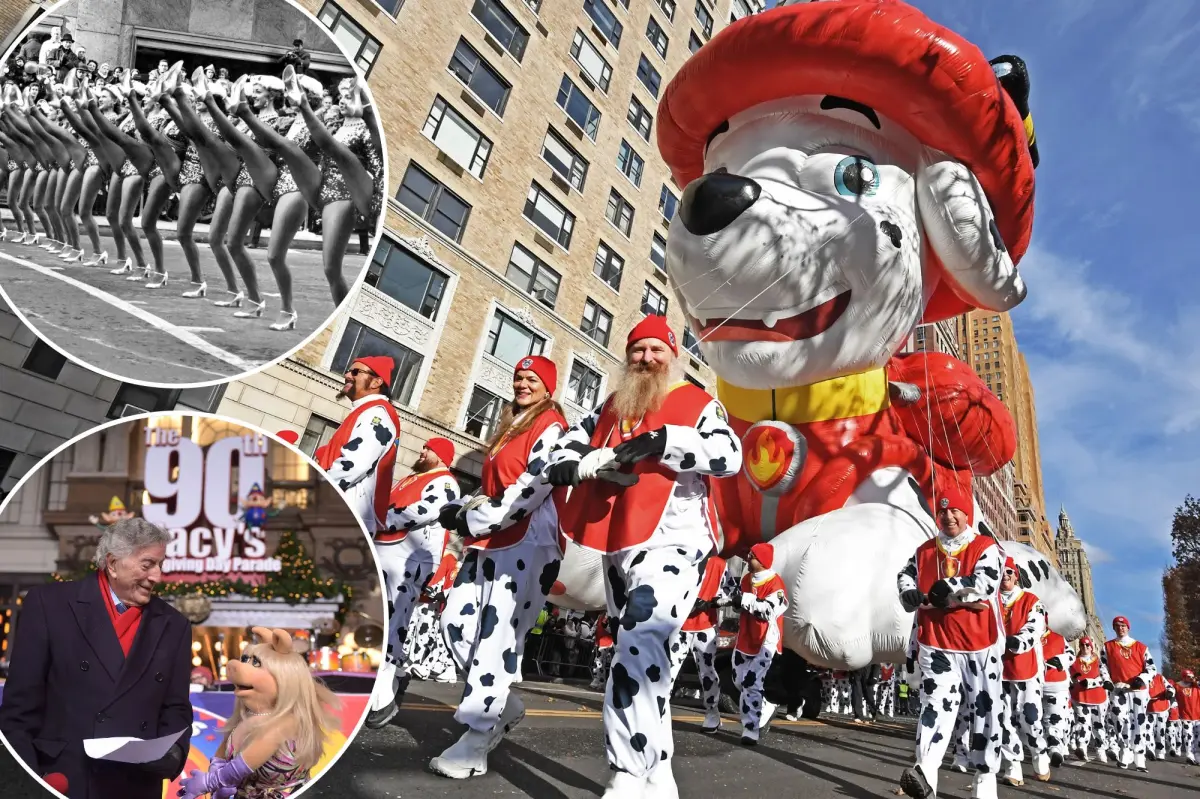
For more than a century, the Macy’s Thanksgiving Day Parade has turned Manhattan’s streets into the centerpiece of America’s Thanksgiving celebration.
The event made its debut in 1924 under the name Macy’s Christmas Parade, following the dramatic expansion of the retailer’s flagship Herald Square store to one million square feet.
Store executives scheduled the procession for Thanksgiving morning as a way to launch the holiday shopping season and attract Christmas shoppers. A century later, the event has evolved into a Thanksgiving Day spectacle, drawing millions of spectators in New York and television viewers across the country.
Through the years, the parade has delivered some of New York City’s most memorable scenes — from live Central Park Zoo animals and celebrity appearances to record-setting balloons and spectacular midair mishaps.
To mark the parade’s centennial, The Post revisits the historic firsts, beloved traditions and unforgettable moments that have defined Macy’s Thanksgiving Day Parade history.
A Central Park Zoo and Circus Kickoff
For its inaugural procession in 1924, Macy’s employees took to the streets alongside live animals from the Central Park Zoo, including lions, monkeys and camels. The first parade featured four floats, four bands, hundreds of marching employees, professional entertainers and, naturally, Santa Claus.
Macy’s store manager James A. Goold proposed the event to celebrate the retailer’s expansion. Many Macy’s employees were European immigrants who brought with them a love of colorful street festivals rooted in traditions from their homelands.
The route concluded with Santa climbing onto the Macy’s marquee, establishing the enduring tradition of Kris Kringle bringing the parade to a close each year.
Character Balloons Take Flight
In 1927, the parade introduced its most enduring attraction: a giant, 21-foot Felix the Cat balloon. The silent-film star replaced the live zoo animals and quickly won over crowds, beginning the character-balloon tradition that remains central to the Thanksgiving Day spectacle.
Illustrator and puppeteer Tony Sarg created the design with technical assistance from the Goodyear Tire and Rubber Company. The project marked the start of his work on numerous parade floats and balloons, and he remained a leading force in their design through 1941.
The original Mickey Mouse balloon arrived in 1934, standing 40 feet tall and designed by Walt Disney himself. Mickey soon became a parade favorite and one of its most recognizable recurring characters. By the early 1930s, vehicles traveling behind the balloons had also begun playing audio, adding voices and sound to the spectacle.
The Parade Enters the War Era
As character balloons grew larger and sound echoed through Manhattan, the threat of a world war began to shape the parade’s story.
During the 1941 procession, singer Dinah Shore performed the patriotic song “A Merry American Christmas” before the parade went on hiatus for World War II. That year also featured an unusual mishap: a giant Santa Claus balloon lost helium and collapsed along the route, forcing handlers to drag it from the street.
After a three-year wartime break, the parade returned in 1945 with a triumphant celebration that reflected the country’s festive and patriotic postwar spirit.
IN CASE YOU MISSED IT: John Corbett, Bo Derek Adopt Gene Hackman’s Dog After His Death
One memorable attraction from the postwar years was the Harold the Clown balloon, which appeared in four different looks over four consecutive years: a traditional clown, a baseball player, a police officer and a firefighter.
Harold the Baseball Player became a pop-culture sensation and appeared in the classic 1947 holiday film “Miracle on 34th Street.”
A National Broadcast Takes the Parade Nationwide
That same landmark year, the parade reached an audience far beyond Manhattan when CBS aired its first national television broadcast in 1947, bringing the streets of New York into homes across the country.
The 1950s ushered in a booming postwar era for the parade — one that even a nationwide helium shortage could not permanently ground.
A serious helium shortage threatened to halt the balloon tradition in 1955, prompting organizers to limit the lineup to just four giant balloons. The shortage soon eased, however, and by 1957 character balloons had returned in force, highlighted by the New York City debut of Popeye.
Rockettes, Stars and Parade Favorites
In 1958, the Radio City Rockettes left Radio City Music Hall for the first time to perform on the city streets. Their high-kicking debut immediately captivated New Yorkers and launched a Thanksgiving tradition that continues today.
Television and entertainment figures began hosting NBC’s Macy’s Thanksgiving Day Parade broadcast during the 1950s. In the early 1960s, Betty White and Bonanza star Lorne Greene emerged as the event’s most familiar hosts, sharing the role for 12 years.
Snoopy first took to the skies as the Flying Ace in 1968, beginning his reign as the parade’s signature superstar. With more than 40 appearances and numerous makeovers, the Peanuts’ beagle has appeared in more Macy’s Thanksgiving Day Parades than any other character.
Alongside Snoopy, Tom Turkey remains the undisputed king of Herald Square. Introduced in 1973, the parade’s beloved animatronic mascot has led the procession for more than five decades, securing his place among its most enduring traditions.
Few pop-culture debuts generated more excitement than the 1977 arrival of the “Sesame Street” cast. Big Bird, Bert, Ernie and Cookie Monster joined the parade on a specially designed float, delighting millions of viewers.
In 1986, as the city celebrated six decades of balloon magic, Humpty Dumpty completed a mishap-free journey and became the 100th unique giant balloon to soar above Manhattan.
Balloon Mishaps and New York Tragedy
The parade’s history has also reflected the city’s darkest moments. In 1997, powerful wind gusts drove The Cat in the Hat into a light pole at Central Park West and 72nd Street, injuring four people. Kathleen Caronna suffered a fractured skull and remained in a coma for 24 days, prompting significant new safety measures.
Four years later, the parade featured a poignant tribute following the Sept. 11 attacks. During the 2001 procession, children of New York City’s fallen heroes marched beside NYPD and FDNY first responders while carrying American flags inspired by the Twin Towers.
Even a global pandemic could not end the city’s Thanksgiving tradition. In 2020, the parade was reduced to a broadcast-only procession covering a single block, with 130 volunteers and five vehicles.


