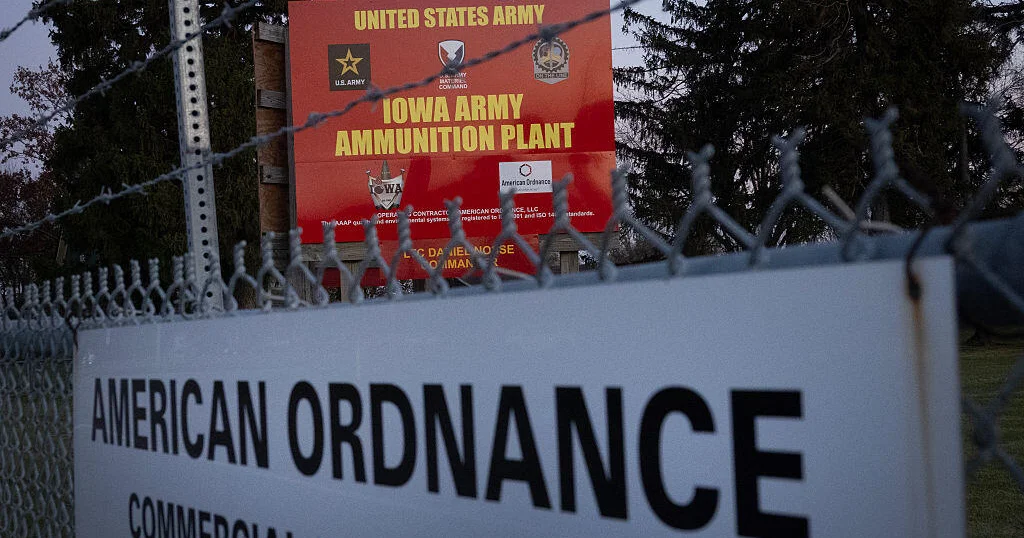
The U.S. Army says it intends to proceed with the detonation of several tons of unstable explosives at an Iowa munitions facility by Tuesday, according to a new court filing. The announcement comes despite a federal court order that indefinitely halted the plan. The Army argues the order does not prevent the operation because allowing the explosives to remain in place could create an even greater public safety threat if they detonate unexpectedly.
In documents filed late Saturday, the Department of the Army said it plans to invoke an emergency munitions and explosives provision tied to the Environmental Protection Agency’s permit. Officials contend that a controlled blast is necessary to protect nearby communities from the potentially more dangerous consequences of an accidental explosion.
On Friday, a federal court blocked the Army’s proposal to destroy the explosives, which contain lead azide, at the Iowa Army Ammunition Plant in Middletown. The decision followed strong opposition from residents and environmental advocates concerned that toxic lead particles could spread in a dust cloud across portions of Iowa and Illinois.
The Army had initially planned two controlled blasts for Friday, then postponed the operation until Monday before the court intervened.
The 8th U.S. Circuit Court of Appeals issued the emergency pause after environmental organizations filed a lawsuit challenging the planned demolition.
The military said Friday that it was coordinating with the Department of Health and Human Services and the EPA to carry out the controlled blast with the strongest safety precautions possible.
“Officials have been meticulously planning for this event since March, and all agencies involved are prepared to take the most extreme mitigation measures available to ensure there is no risk to the public and any disruptions are minimized,” the Army said.
Scott Olson / Getty Images 
In Saturday’s filing, the government said the detonation must take place by Tuesday because forecasts call for temperatures below 30 degrees in the coming days. According to the Army, the lead azide has deteriorated, and falling temperatures could cause crystals within the waste material to fracture.
CONTINUE READING: Search Update on Teen Soldier Missing From California Base
“A controlled detonation allows the Army to implement measures to minimize the risk to the public, including the risk from the ejection of partial unexploded ordnances that can explode later from the Facility,” the filing states. “The Army intends to act consistent with the terms of the Emergency Permit and its mitigation measures even if not in effect. That includes mitigation measures to minimize the risk of the dispersal of lead dust. In short, a controlled detonation is by far safer than an uncontrolled explosion.”
Following the Army’s filing, the Iowa Environmental Council and Sierra Club submitted a motion Sunday asking to expand their emergency request to stop the detonation.
The groups’ filing contains statements from three experts and local government officials who dispute the Army’s assessment of the dangers associated with postponing the blast. They also raised questions about public notification and the possible health and environmental consequences of the operation.
In a joint statement Sunday, the Iowa Environmental Council, Sierra Club and Earthjustice challenged the Army’s assertion that all alternatives had been properly considered, arguing that “this emergency is of the Army’s own making.”
“The Army seemed more concerned over the weekend with finding a way to sidestep the judicial process than on meeting the public’s demands for greater transparency, notice to affected communities, and far stronger protection of people, property, and the environment from serious harm,” said Earthjustice attorney Thien Chau.
Josh Turek, Iowa’s incoming Democratic senator, said Sunday that he was “concerned about the potential health risks resulting from the U.S. Army’s planned detonation in Middletown and the lack of clear communication and transparency from the U.S. Army.” He added that he was “pushing for answers, including specifics of when the detonation is taking place.”
“I also believe we need a full investigation into why this stockpile of lead azide, which has been at IAAAP for decades, was allowed to degrade into this critical state, why safer methods of disposal were not pursued, what other potentially dangerous materials are being stored at the IAAAP and their condition, and what procedures are needed to ensure this never happens again,” he said. “The public also deserves answers as to why the U.S. Army’s communication — both with the public and with Iowa officials — was delayed and inadequate from the beginning.”
In March, the Army reported that 68 drums of lead azide at the facility had begun to undergo “recrystallization.” The material was stored in bunkers at the Iowa Army Ammunition Plant, a munitions facility established in 1941 that manufactures medium- and large-caliber ammunition.


