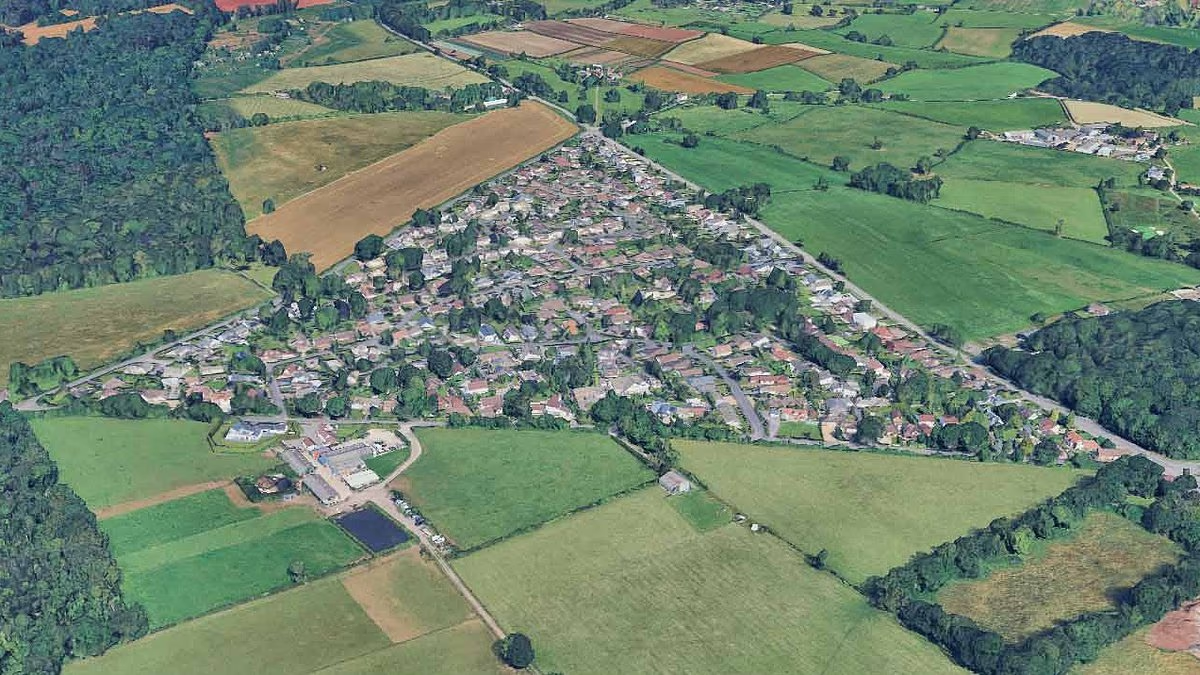

Residents of a distinctive triangular village are opposing plans for 200 new homes, warning that the development would destroy its iconic shape.
Hill Residential wants to build the properties on the edge of Failand, Somerset, near Bristol.
The ‘Failand Triangle’ takes its name from the settlement’s unusual road layout and plot boundaries. Residents say extending development beyond those boundaries would erase what makes the village distinctive.
The three-sided settlement was created on a former tree plantation after the Second World War and has retained its shape ever since. The surrounding fields are designated as green belt land.
Hill Residential submitted its planning application in December 2025, arguing that the land is ‘grey belt’ and that the scheme would provide much-needed housing.
The proposed homes would extend Failand beyond its established footprint, which currently comprises around 350 properties between Clevedon Road, Weston Road and Flax Bourton Road.
More than 250 residents have urged North Somerset Council to reject the plans. The application is due to be considered at a six-day public inquiry in April 2027.
Maria Payne, a councillor for Wraxall and Failand Parish Council, said: ‘The triangle is what defines the settlement of the village of Failand.

An aerial view of Failand’s iconic ‘Failand Triangle’ in Somerset, with open fields surrounding the settlement

Development has not spread beyond the triangle because the village is surrounded by green belt land
‘The boundary of the triangle is being completely broken. The local plan is very clear that it should not be breached.’
Ms Payne, who is part of the Hands Off Failand Green Belt group, said campaigners were raising funds to help fight the proposal.
‘All the roads in and out are very fast and very steep,’ she added.
‘The only way in and out is by car. From a sustainability perspective, there is nowhere within walking distance, and nobody is going to invest in building a supermarket.’
Another resident said: ‘Failand is a unique and special village.
‘It is a perfect triangle, and this development would destroy a uniqueness rarely seen anywhere else. It must be protected.
‘The village has a leafy character all of its own, something visitors often comment on.’
Sandra Roberts, 61, said: ‘I was brought up here, and it has always been known as the triangle.
‘When I attended the village school, we used to go running around it and count how many laps we could complete. That is how it has always been. There is a lot of wildlife, and you can see deer there.
‘It simply does not feel like the right fit for this area. The traffic has increased so much, and Flax Bourton has become a rat run.’

A sign placed on a tree in the village reads: ‘Hands off Failand green belt’

Maria Payne, a councillor for Wraxall and Failand Parish Council, said the triangle ‘defines the settlement of the village of Failand’

Resident Charlie Barker, 23, said the plans would ‘destroy the whole village’

The proposed homes would extend the village beyond its distinctive triangular shape
Simon, a retired local resident in his 50s, said he feared the village would lose its identity.
‘The appearance and visual character would disappear,’ he said.
‘This is not about opposing homes; it is about building them in the right place for people who want to live here.
MORE ON THIS: Historic RAF Scampton Dambusters Base Left to Fall Into Ruin
‘This is completely unsuitable and unsustainable over-development in the green belt and in the wrong location.’
Charlie Barker, 23, said: ‘It would destroy the whole village. We do not want it, and there is not enough infrastructure to support it.
‘I have seen similar developments built in places nearby. What are you going to do—put a small driveway beside the road and then build a large housing estate in the field? It will be ugly.
‘I also do not believe we need to build new homes here. We do not need an entire housing estate; brownfield sites could be developed instead.
‘The whole character of the area would be destroyed by building a modern housing estate in the middle of it.’
A 76-year-old resident said: ‘It is going to disrupt our lives for 10 years. It will be incredibly noisy with bulldozers, and what we value here is the peace and quiet.
‘It is a green belt field. They are trying to claim it is not because they want to make money.
‘Why should we give in? It is not grey belt or brown belt.
‘It will change the entire area.’
Another resident, Mrs Baker, 60, said: ‘It has always been known as the Failand triangle.
‘We often look out of our living-room window and see wild rabbits in the fields. Their natural habitat will be destroyed, and the whole area will change completely.

A general view of Failand, where developers want to build new homes

The proposed development would extend the area beyond its distinctive triangular shape
‘We have lived here for more than 30 years, and one of the reasons we chose to stay is the peace and quiet of the area.’
After submitting the application, Hill Residential appealed to the Government’s Planning Inspectorate, claiming North Somerset Council had delayed reaching a decision.
In its appeal, the developer said: ‘The appellant has been required to repeatedly chase the council for responses, without which the application would have progressed at a far slower pace.’
North Somerset Council said the parties had verbally agreed to extend the application deadline until the end of July.
The council said: ‘However, despite several requests, the appellant refused to confirm the agreed extension of time in writing.’
At the planning inquiry, Hill Residential is expected to argue that the land qualifies as ‘grey belt’ and that the development would provide urgently needed housing.
Its statement of case says: ‘It will deliver substantial benefits, and the need for the scheme is compelling.’
Although North Somerset Council accepts that the greenfield site is technically classified as ‘grey belt’, its lawyers will argue that the location is not sustainable and that the proposal should still be rejected.
The council’s statement of case says: ‘The proposal, due to its position in open countryside and poor connections to essential services, facilities and infrastructure, would be in an unsustainable location and constitute inappropriate development in the green belt.’
A council spokesperson said: ‘The council opposes this development because it represents inappropriate development in the green belt and would be in an unsustainable location, with poor access to schools, shops and other services.
‘The developer has appealed to the Planning Inspectorate, and the scheme will be considered at a public inquiry in April 2027.’
Our News Outlet has contacted Hill Residential for further comment.
Email katherine.lawton@dailymail.co.uk