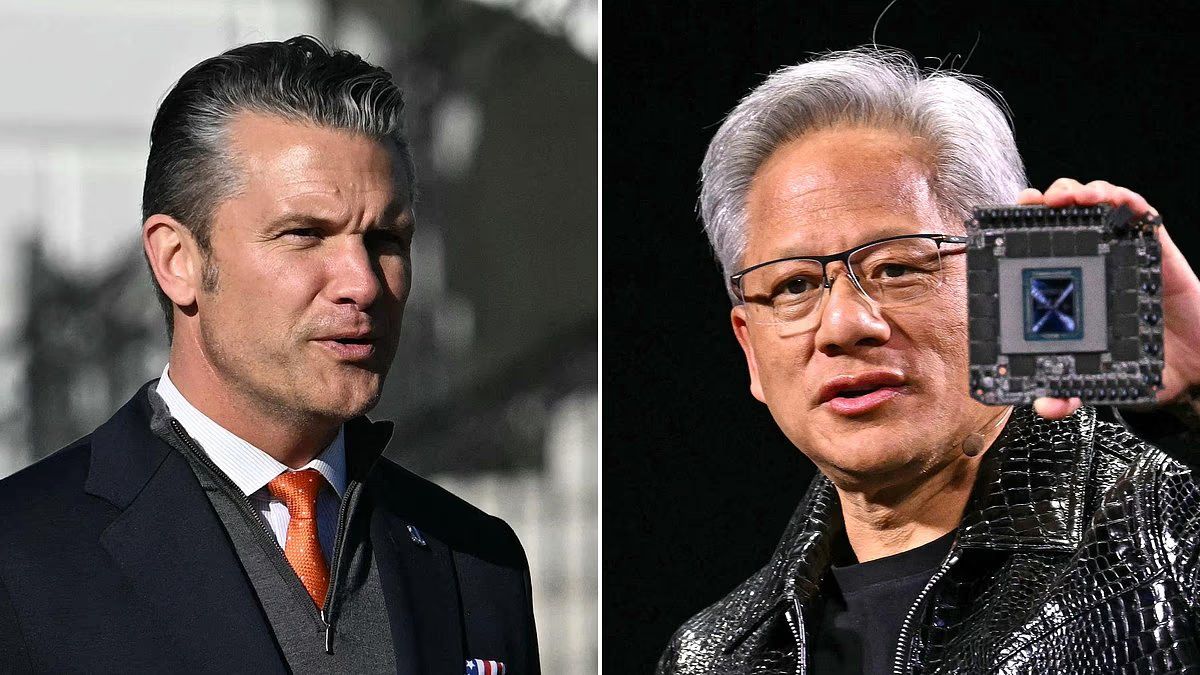

Defense Secretary Pete Hegseth reportedly considered invoking a broad wartime law from the Korean War era to pressure Nvidia into restoring billionaire Jensen Huang as the artificial intelligence chipmaker’s chief executive.
As the Trump administration worked to bring Huang back after his scandal-related exit, senior Pentagon officials discussed whether the federal government could use its vast economic authority against the world’s leading AI chip company.
According to three people familiar with the discussions who spoke to The Washington Post, the proposal centered on the Defense Production Act of 1950. The law was created to direct American industry during wars and other national emergencies.
Hegseth and Deputy Defense Secretary Steve Feinberg reportedly examined whether the statute could give officials financial leverage over Nvidia’s board, based on the argument that Huang’s leadership was essential to U.S. national security.
The Pentagon has strongly denied that any such conversations occurred.
While the law does not expressly give the government authority to select the leader of a private company, officials allegedly considered whether it could be used to exert substantial pressure on Nvidia’s profitable business operations.
“Essentially, they could use the DPA to force Nvidia to direct more of its manufacturing toward military projects,” a Trump administration official told the Post.
That strategy could have complicated Nvidia’s commercial plans and reduced its profits by requiring the company to put government orders ahead of those from private customers.

Pete Hegseth reportedly considered using a Korean War-era statute to pressure Nvidia into bringing back its ousted CEO, an account the Pentagon has denied

Jensen Huang resumed his role as Nvidia CEO on Monday after Trump administration officials reportedly emphasized the importance of his leadership to U.S. national security and technological dominance
The reported discussions were part of what one source described to the newspaper as a “full-court press” by senior administration figures over the weekend to secure Huang’s return.
President Donald Trump and Vice President JD Vance reportedly came to believe that reinstating the billionaire was necessary to calm markets after his departure sent shock waves through Wall Street.
Trump personally asked Vance to help negotiate Huang’s comeback as the controversy surrounding Nvidia intensified.
By Monday morning, Huang had returned to the company’s top job.
It is not known whether the Defense Production Act idea was ever shared with Nvidia’s directors or brought directly to Trump or Vance.
A person familiar with the board’s deliberations told the Post that directors understood officials viewed Huang as important to national security, but did not regard the intervention as a threat.
The White House directed questions about the alleged discussions to the Pentagon, which issued an emphatic rejection.
“The conversations described between DOW senior leaders never happened and no such proposal was made by the Secretary, Deputy Secretary, or Under Secretary,” an unnamed Pentagon official told the Post.

“I spoke to them,” Trump said on CNBC on Monday, describing how he helped persuade Nvidia’s board to restore Huang to the CEO position

Before returning as CEO of the $3.7 trillion AI technology giant, Huang reportedly told Nvidia’s board he had “additional affairs beyond the two that had been widely reported” (pictured with Alice Huang)
Nvidia spokesman Patrick Rutherford declined to comment on the report.
The Defense Production Act has traditionally been used to guarantee access to critical goods and materials during national emergencies.
During his first administration, Trump relied on the law to push General Motors into producing ventilators as hospitals faced overwhelming demand during the coronavirus pandemic.
Applying the statute to influence the leadership of one of America’s most powerful companies, however, would mark an extraordinary expansion of federal authority.
CHECK THIS OUT: FedEx Cargo Jet Overshoots Runway at Miami International Airport, Stops Near Busy Road
Legal specialists questioned whether the law could properly be used for that purpose.
Pete Harrell, an attorney and visiting scholar at Georgetown University, said the reported proposal appeared consistent with what he described as the administration’s wider method of dealing with major corporations.
“It’s not really interested in setting out … regulations,” Harrell told The Post. “It’s interested in getting five companies in a room and kind of telling them what to do.”
Bill Greenwalt, a Defense Production Act specialist at the American Enterprise Institute, likewise questioned whether government contracts could legally be used to force Nvidia into compliance.

Nvidia’s reinstated CEO Jensen Huang receives an ovation from employees after returning to the company’s headquarters in Santa Clara, California

Huang said he was undergoing therapy and acknowledged that violating parts of Nvidia’s code of conduct was unacceptable
He said export restrictions on Nvidia’s products would likely have given the administration a more practical source of leverage.
The alleged intervention comes as Hegseth has made artificial intelligence a central element of his plans for the U.S. military, particularly as competition with China grows.
In a memo issued earlier this year, the defense secretary called for the United States to build an “AI-first warfighting force.”
He also warned that “AI-enabled warfare and AI-enabled capability development will redefine the character of military affairs over the next decade.”
Hegseth has increasingly turned to Silicon Valley for expertise, assigning former Uber executive Emil Michael and billionaire financier Feinberg roles in updating America’s military capabilities.
Two people familiar with the matter told the Post that Michael also took part in discussions about the Defense Production Act.

Trump shared a Truth Social meme showing Huang holding a red bra, a provocative reimagining of the iconic image taken after Trump was wounded by a would-be assassin in 2024

Huang is pictured with his wife, Lori. The couple married in 1985 and have two children

Nvidia’s board announced Huang’s return on Monday after questioning him for hours during a lengthy Sunday session

Trump said pardoning Nvidia CEO Jensen Huang was “an option,” but expressed hope that Huang would answer questions directly when he testifies before Congress next week
Join the discussion
Should the government ever use emergency powers to influence who leads major tech companies?
Talk of using emergency powers to help restore Huang’s career had already begun circulating among prominent technology investors before Nvidia announced his return.
Cryptocurrency investor Balaji Srinivasan raised the idea on social media last week, writing: “Defense Production Act, but for the restoration of Jensen Huang.”
Technology investor Shervin Pishevar also said Tuesday that Nvidia’s future reaches well beyond the interests of its shareholders.
“Now that Jensen Huang is back, we should recognize that NVIDIA and America’s leadership in artificial intelligence are not simply matters of corporate governance or shareholder value,” Pishevar wrote on X.
“They are matters of national security, economic competitiveness, and geopolitical power.”