
US intelligence officials believe Kang Wei, who was often introduced as the husband of Nvidia chief Jensen Huang’s alleged Chinese lover, was viewed by Beijing as a far more valuable espionage asset.
The FBI, CIA and Office of the Director of National Intelligence briefed selected congressional staff about intelligence concerning Alice Huang and her alleged links to China’s Ministry of State Security, according to The New York Times.
However, the briefing reportedly placed greater emphasis on Kang Wei, the man commonly described as her husband.
Officials are said to have told staff that Wei had been an asset of China’s Ministry of State Security at some point, and that his contacts with the agency were more extensive than those of Alice Huang.
Wei also established a major investment network in China. Proposed data-centre projects connected to that network were valued at more than $9 billion between 2021 and 2024.
He founded Shanghai Hexi in 2010 after working as a fund manager. The company invested in technology businesses, including video game firms, before expanding into cloud computing and artificial intelligence infrastructure.
Wei’s investment network was linked to Century Longteng, which entered into a 2022 partnership with Huawei to develop cloud data centres, computing systems and energy infrastructure.
China’s securities regulator also fined him in 2018 for failing to disclose holdings in a pharmaceutical company during a takeover battle.

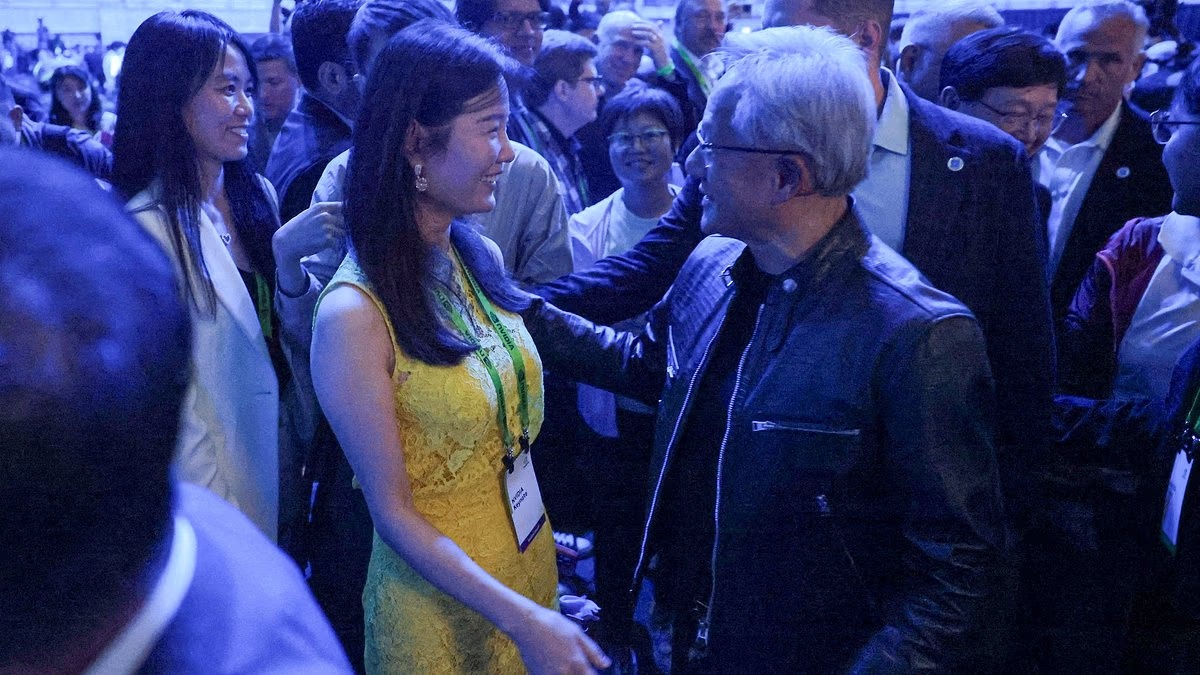
Businessman Kang Wei, left of Alice Huang, was reportedly identified by US intelligence officials as a much more significant Chinese spy asset than Jensen Huang’s alleged lover. His investment network has been linked to multibillion-dollar data-centre projects and a partnership with Huawei

On Tuesday, officials from the FBI, CIA and Office of the Director of National Intelligence briefed staff from the House and Senate intelligence committees on intelligence concerning Alice Huang

House Democratic Leader Hakeem Jeffries called Huang’s reinstatement ‘indefensible, irresponsible and incomprehensible’ and demanded tighter restrictions on advanced AI chips sold to China
The officials reportedly said they had found no evidence that Beijing instructed Alice Huang to begin a relationship with Jensen Huang as part of an intelligence operation. They did not, however, dispute that she passed information to the Chinese agency after the relationship began.
US intelligence agencies had monitored Alice Huang’s contacts with China’s spy service for more than a year. According to earlier reporting by The New York Times, those contacts extended from spring 2025 through the autumn of this year.
That period coincided with her secret relationship with Jensen Huang, who was then leading the world’s largest maker of advanced artificial intelligence chips.
Agencies also gathered evidence indicating that Kang Wei, her business partner who was frequently presented as her husband, had worked with the same Chinese intelligence service.
The full scope and timing of their respective contacts with Beijing had not previously been disclosed.
The disclosures have raised questions about the scale of Chinese intelligence activity around Nvidia and whether sensitive information could have been exposed through the alleged relationship.
Alice Huang was a senior executive at Megaspeed International, a Singapore-based company under investigation over suspected attempts to divert advanced Nvidia AI chips to China in breach of US export controls.
US officials continue to examine whether the alleged relationship was connected to the chip-diversion operation as investigators trace the possible transfer of restricted technology to Chinese interests.
The congressional briefing was limited, and staff members were not shown some of the most sensitive intelligence gathered about Alice Huang.
Lawmakers have requested further details, including a classified memo reportedly overseen by Secretary of State Marco Rubio.
The developments come as Jensen Huang faces mounting scrutiny over his relationship with the Trump administration and Nvidia’s business dealings in China.
President Donald Trump has publicly defended the Nvidia chief, saying the government has found no reason to believe that his return to the company presents a national-security threat.
Huang’s reinstatement has nevertheless triggered bipartisan criticism on Capitol Hill, where lawmakers are demanding answers about potential national-security risks and Trump’s personal role in the decision.
Republican Senator Tom Cotton said the Nvidia controversy was ‘just the tip of the iceberg’ and argued that Congress still had significant questions to pursue. Senator John Cornyn also challenged the assertion that Huang’s return posed no security risk, asking: ‘Based on what?’
Democrats have promised investigations as well. Senate Minority Leader Chuck Schumer said he would examine any potential wrongdoing by the administration or Nvidia executives.
House Democratic Leader Hakeem Jeffries described Huang’s reinstatement as ‘indefensible, irresponsible and incomprehensible’ and called for tougher limits on the sale of advanced AI chips to China.


