
Britain would be expected to adopt the euro and contribute more to the European Union budget than it did before if it sought to rejoin under Andy Burnham, officials in Brussels have warned.
The warning comes as the Prime Minister prepares to put his Brexit reset agreement into UK law, with officials stressing that Britain could not simply return to the bloc as though its departure had never happened.
Sources told the i Paper that full membership would require the UK to abandon the pound and give up Margaret Thatcher’s renowned budget rebate, which reduced Britain’s financial contribution to the EU.
The UK could eventually seek an exemption from using the single currency, the sources said, but it would first have to demonstrate a willingness to join the euro.
A closer relationship with the EU than the arrangement secured by Mr Burnham last week would also mean accepting the return of freedom of movement, according to the sources. That prospect is already causing concern among opponents of the agreement.
The comments come as one of Mr Burnham’s senior ministers prepares to argue that the new agreement represents a starting point, rather than the limit of the Government’s ambitions.
Scottish Secretary Douglas Alexander is expected to tell the UK-Italy Pontignano Conference in Rome that Brexit ‘failed even on its own terms’.

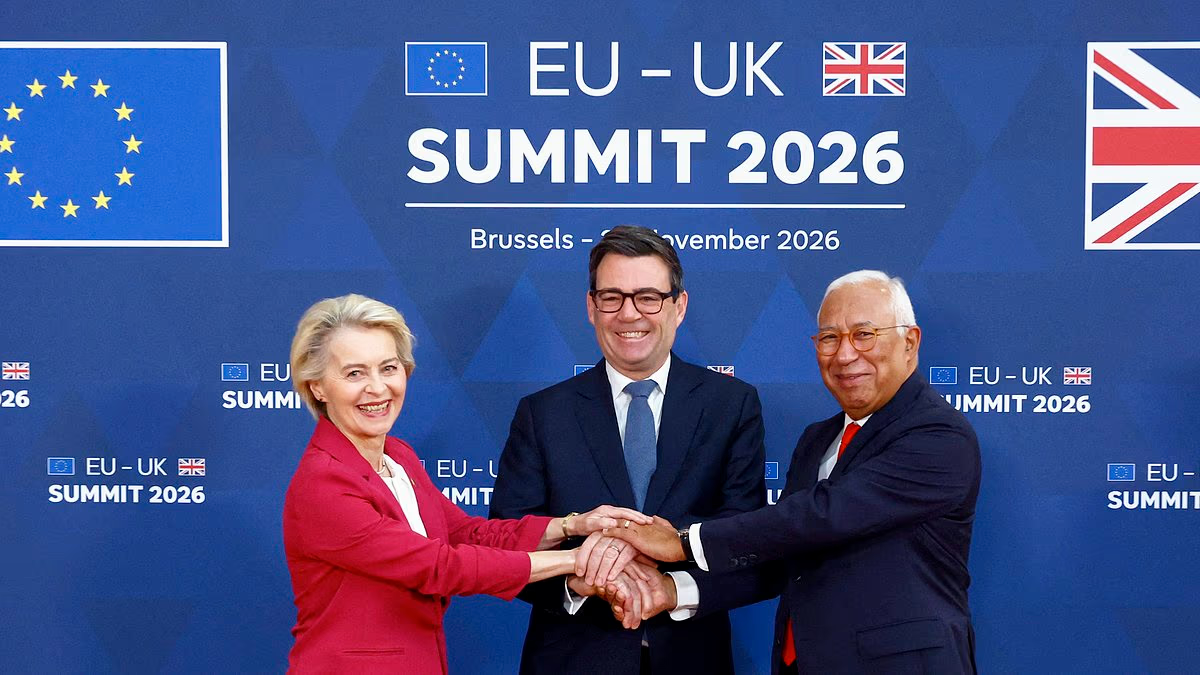
Prime Minister Andy Burnham shakes hands with European Commission president Ursula von der Leyen and Antonio Costa from the European Council at the UK-EU summit last week

Scottish Secretary Douglas Alexander is due to tell the UK-Italy Pontignano Conference in Rome that Brexit ‘failed even on its own terms’
He is expected to say that Britain must decide whether to accept its reduced position or pursue a new course that gives people greater influence, more control and renewed optimism about the future.
He will describe the agreement reached in Brussels last week as a ‘floor’ and a demonstration of what is possible, rather than a ceiling on what the Government hopes to achieve.
Mr Alexander is also expected to insist that ministers are not seeking to reopen the political divisions of the past decade.
Instead, he will present the Government’s approach as a practical and patriotic response to what Britain needs in an increasingly volatile and dangerous world.
He is expected to argue that the country cannot deliver the changes it needs over the next 10 years without reshaping its relationship with Europe.
His message will be that when the current arrangement is failing, the answer is to move ahead rather than remain where Britain is—and that a broken status quo must be repaired, not ignored.
Meanwhile, officials were forced to revise down estimates of the agreement’s cost after a minister suggested that it could run into hundreds of millions of pounds.
Environment minister Emma Hardy told Times Radio that the payment represented ‘a contribution fee towards the cost of administering the border’.
UK officials later clarified that the bill would instead be in ‘the low tens of millions’, only a small portion of the figure initially indicated.
They said the financial outlay would be ‘massively outweighed’ by the economic gains expected to flow to businesses from the changes.
The agreements published on Thursday include the formula used to calculate the UK’s yearly payments to the EU under the arrangement.
An ‘operational contribution’, calculated broadly along the lines of member states’ contributions to the EU budget, will be linked to the gross domestic product of the UK and the bloc. A separate ‘participation fee’ will equal 4 per cent of that contribution.
That additional fee will help cover the running costs of the shared biosecurity area, including systems such as information technology infrastructure.
Mr Burnham secured the agreement with the EU last week in an effort to reduce trade barriers, eliminate most post-Brexit checks on food and drink and establish a youth experience scheme.
MPs are due to vote on the deal next month, following the tabling of draft legislation to put the agreement into effect at Westminster on Thursday.
In a pointed indication of Britain’s changed position, Downing Street admitted on Thursday night that adopting EU farming rules would mean the Government no longer had the authority to prohibit the sale of food products produced within the bloc.
The admission came as estimates suggested that Mr Burnham’s reset could be worth less than half the £17billion claimed, with the food and farming section of the three-part agreement potentially delivering only £200million.
Labour campaigned at the 2024 election on a promise to prohibit foie gras imports, calling the force-feeding of ducks and geese to enlarge their livers ‘absolutely disgusting’.
However, diplomatic sources said the proposed ban had been abandoned after ‘implacable’ resistance from Paris, which refused to accept restrictions on the controversial French product.
Animal welfare organisations reacted angrily on Thursday evening, branding the move ‘shameful’ and accusing ministers of allowing ‘pressure from across the Channel to dictate policy here at home’.
The dispute underlines the extent to which the UK will no longer be free to determine its own food and farming regulations.