
Billy London believed he was on the verge of leaving West Hollywood—and the gay adult-film world—behind. Instead, investigators found his head and feet in a dumpster, a gruesome killing so similar to the crimes of Jeffrey Dahmer that detectives briefly questioned whether the “Milwaukee Cannibal” had traveled to Los Angeles.
More than 30 years later, Investigation Discovery’s new true-crime documentary, “My Brother’s Killer,” revisits the case and examines how the answer ultimately came from much closer to home.
The murder remained unsolved for decades. In 2023, however, the LAPD said it had obtained a confession from a convicted killer—a biological male, former White supremacist and fellow adult-film performer who, according to the Los Angeles Times, now identifies as an Orthodox Jewish woman.

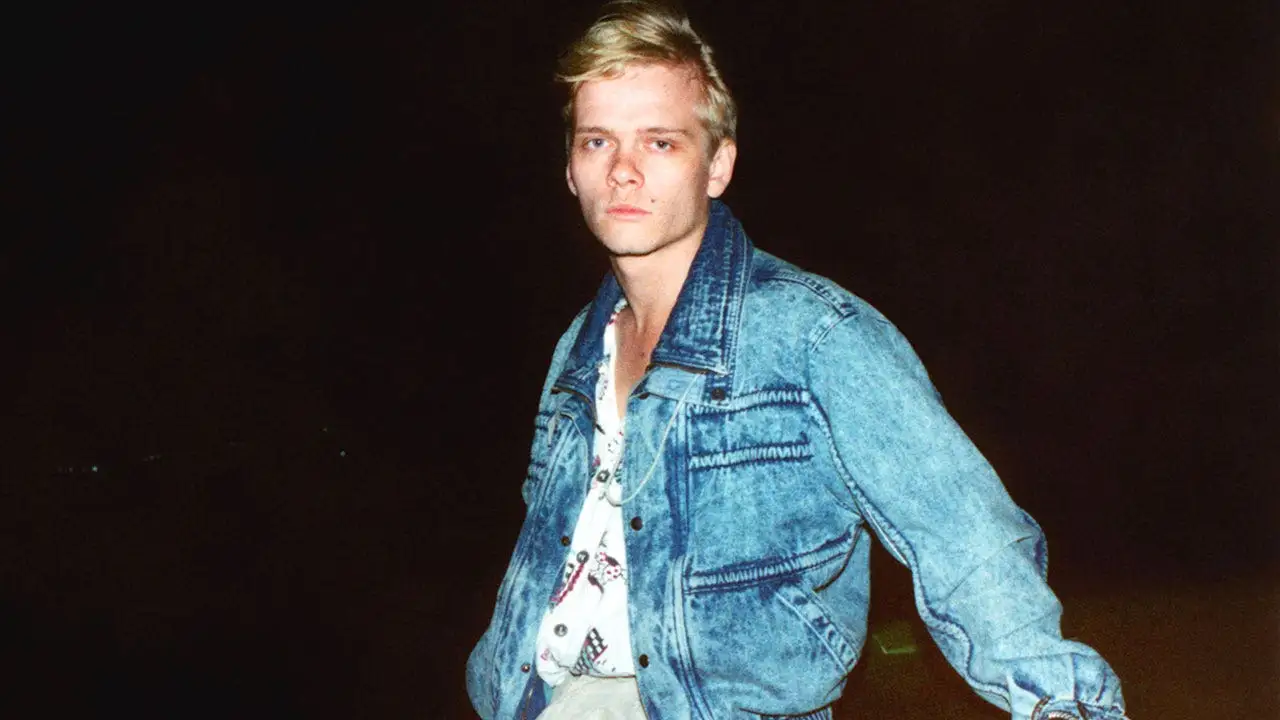
Billy London, whose birth name was William Newton, was found dead in Los Angeles on Oct. 29, 1990. He was 25. His story is featured in Investigation Discovery’s true-crime documentary “My Brother’s Killer,” premiering on television Dec. 3, 2026, at 9 p.m. and streaming on HBO Max. (Investigation Discovery)
“This is a really important next chapter in what I believe the film can do once it is released,” director Rachel Mason told News Outlet. “There are absolutely other crimes and other victims out there who may not have been identified. Some of those crimes may not have come to light at all.”
Before the documentary’s Dec. 3 broadcast, Mason created a website inviting people to submit information. The site says Darrell Lynn Madden, now known as DarraLynn Madden, “is suspected of being involved with the deaths of several men in California, Arizona, Texas and Oklahoma between the years 1985 and 2007.”

Rachel Mason and Marc Rabins review a newspaper carrying Billy London’s obituary. (Investigation Discovery)
“If you have information, please share it,” Mason said. “Everything submitted through this website will be preserved as an anonymous potential lead for follow-up because there are clearly other cases.”

“My Brother’s Killer” director Rachel Mason passes the dumpster-lined alley where Billy London’s remains were discovered. (FutureClown Productions)
London, born William “Bill” Newton, was from Wisconsin. He ran away at 16 and moved to Los Angeles in the mid-1980s, hoping to find acceptance as a gay man. He took adult-film jobs largely to support himself, but the artist and poet eventually grew tired of the city and began preparing to move to Las Vegas, where he planned to live with his younger sister.
“When we look back at Billy’s final days, they are now tragically obscured by the horror of what happened,” Mason said. “But he had plans. If he had lived, he would have moved to Las Vegas and reunited with his sister. His relationship with Marc was also changing. People knew drugs were part of his life, and he was trying to reduce his substance use. He was trying to get clean.”

In the weeks before his October 1990 death, Billy London was preparing to leave Los Angeles and move in with his sister in Las Vegas. (Investigation Discovery)
Witness accounts contained in the LAPD case file, along with a tip discussed on “The Dinner Party Show” podcast, placed Newton at Rage Nightclub on Santa Monica Boulevard shortly before he disappeared, the Los Angeles Times reported. The next morning, Oct. 29, 1990, the 25-year-old’s remains were found in a dumpster less than two miles away. Only his head and feet were recovered.

Billy London was last seen alive leaving Rage Nightclub on Santa Monica Boulevard in West Hollywood in October 1990. (Investigation Discovery)
Months later, detectives considered whether London had been killed by Dahmer, who was arrested in Milwaukee, Wisconsin, on July 22, 1991. The notorious serial killer and cannibal targeted young gay men, killing 17 men and boys between 1978 and 1991 and dismembering many of his victims.

Jeffrey Lionel Dahmer, known as the “Milwaukee Cannibal,” received a sentence of 15 life terms on Feb. 15, 1992. (Sygma via Getty Images)
“At first, it was a plausible possibility because there remains a gap of several days in Dahmer’s known whereabouts,” Mason said. “No one knows exactly where he was during the final days of October that year—the same period when Billy disappeared and was killed. Dahmer’s mother also lived in Fresno.”

Jeffrey L. Dahmer appears in the courtroom of Judge Jeffrey A. Wagner in Milwaukee, Wisconsin, on Aug. 6, 1991. He was later given 15 consecutive life sentences totaling 957 years. Fellow inmate Christopher Scarver killed Dahmer on Nov. 28, 1994, at Columbia Correctional Institution in Portage, Wisconsin. (AFP via Getty Images)
“That gave detectives a possible avenue to pursue,” she said. “They investigated whether Dahmer could have made his way to Los Angeles at that time.”
The Los Angeles Times also reported a podcast tip claiming London left Rage with a man who resembled Dahmer. Dahmer denied killing Newton before his death in prison in 1994, and investigators never found evidence tying him to Los Angeles.

Billy London worked as a gay adult-film actor and producer in Los Angeles. (Investigation Discovery)
Detectives also examined London’s on-and-off partner, Marc Rabins, as a person of interest. Rabins, who appears in the documentary, has consistently denied having anything to do with the killing.

Marc Rabins, Billy London’s romantic partner when he died, was investigated as a person of interest and lived under suspicion for more than 30 years. (Investigation Discovery)
“That suspicion followed Marc for years,” Mason said. “He was not responsible for this horrific murder, and Billy was someone he loved. He mourned him for decades and still does. It is a profound tragedy when an innocent person is associated with such an awful crime.”

Detective John Lamberti reviews Billy London’s murder file in the LAPD homicide library. (Investigation Discovery)
According to the Los Angeles Times, Detective John Lamberti said the breakthrough began with information from Clark Williams. The empty nester had seen a post about London’s murder in a Facebook group called “The History of Gay Wisconsin” and was struck by the parallels between his own life and London’s.

John Lamberti, an LAPD cold-case homicide detective, reopened Billy London’s 1990 murder file and helped obtain the confession that brought the investigation to a conclusion. (Investigation Discovery)
Williams became determined to learn more. He studied the credits of West Hollywood adult films made around the time of London’s death, searching for anyone who might still be alive and able to share memories. One title, “The Devil and Danny Webster,” featured a newcomer named Billy Houston.

Podcaster Christopher Rice, shown with co-host Eric Shaw Quinn, helped revive public and police attention surrounding Billy London’s unsolved 1990 murder. (Investigation Discovery)
While researching Houston, Williams found an Oklahoma article about Darrell Lynn Madden. Madden had pleaded guilty in 2008 to kidnapping and murdering Steven Domer, as well as killing his accomplice, Bradley Qualls.
CHECK THIS OUT: Mayor Mamdani Was Detained at Least Twice by NYPD Unit He Disbanded
The report also disclosed that Madden had once appeared in gay adult films under the name Billy Houston.

Darrell Lynn Madden appears in an LAPD booking photograph from approximately 1992. (Investigation Discovery)
Williams was stunned. He located criminal records placing Madden in Los Angeles around the time London was killed. He also found the book “American Honor Killings,” in which Madden reportedly described a Los Angeles killing to author David McConnell. Realizing the discovery was beyond what he could handle alone, Williams contacted Lamberti.

Billy London is pictured in Malibu at an unknown date. (Investigation Discovery)
Mason said the case was ultimately advanced by a network of people—including Williams—who refused to stop discussing London’s murder and searching for answers.

Clark Williams was the civilian researcher who uncovered the crucial lead identifying Billy London’s suspected killer. (Investigation Discovery)
“A major part of this was people refusing to let the case disappear,” Mason said. “It would have been easy to assume it would never be solved and move on. Instead, people kept hope alive. Many of those who joined the effort were part of the LGBT community. They knew Billy’s story and wanted justice. In the end, the case was advanced by people who could easily have found themselves vulnerable to a crime like this.”

Dumpsters remain in the alley where Billy London’s remains were discovered. (Investigation Discovery)
Investigators determined that the adult-film company where Madden worked operated from a building directly behind the alley where London’s remains were found. When detectives interviewed Madden, he gave a recorded confession.
Mason later interviewed Madden for the documentary as well.

Rachel Mason interviews Darrell Lynn Madden, now known as DarraLynn Madden, for “My Brother’s Killer.” (Investigation Discovery)
“DarraLynn presents a lot of challenges for anyone trying to assemble the pieces of one of the most horrific crimes imaginable,” Mason said. “You expect to meet someone impossible to speak with. But the reality is the opposite.”
“DarraLynn is highly intelligent,” Mason added. “Even the homicide detectives told me afterward that she was someone they could sit down and have a beer with. She is personable, and that creates a difficult question: How can someone who is so easy to talk to be connected to such horrifying acts?”

Marc Rabins displays one of his photographs of Billy London. (Investigation Discovery)
In a prison interview with Mason, Madden said a group of “skinhead” acquaintances noticed London walking alone in an area where they went to “hunt and perform acts of violence.” Madden placed an arm around London and warned him in a calm voice: “This is what we’re gonna do—or else.”

DarraLynn Madden, also known as Darrell Madden, confessed to killing Billy London in 1990. (Investigation Discovery)
Madden said the group put London in a car, mocked and beat him “like a prize piñata,” then drove to an associate’s apartment to “show off what we got.”

Detective John Lamberti, shown here, and the LAPD regard Billy London’s 1990 murder as solved. (Investigation Discovery)
“I think it was always my idea to strangle,” Madden said in the documentary. “I have used my hand before, and it takes too much energy.”

Investigators said Darrell Lynn Madden, also known as DarraLynn Madden, provided details about Billy London’s killing that only the perpetrator would likely know. (Oklahoma Department of Corrections)
After London died, Madden said, the group dismembered his body—“which was not an easy task”—to make it easier to dispose of. He said he suggested placing London’s head in a dumpster near a location familiar to him.
Madden also recalled strangling London with a cord and said he was high at the time, a detail consistent with the autopsy, which found methamphetamine in London’s system. Lamberti said Madden revealed precise information about the crime that investigators believed only the killer could have known.

Rachel Mason launched MyBrothersKiller.com to collect information that could help identify additional male victims suspected of being killed by Darrell Lynn Madden, also known as DarraLynn Madden, in California, Arizona, Texas and Oklahoma from 1985 through 2007. (Investigation Discovery)
“DarraLynn repeatedly expresses remorse,” Mason said. “It is a constant presence in the interview, and that is something striking to witness in the film.”

Darrell Lynn Madden, also known as DarraLynn Madden, remains incarcerated at an Oklahoma Department of Corrections maximum-security prison. (Investigation Discovery)
The documentary says the Los Angeles County District Attorney’s Office did not file charges because of insufficient evidence and Madden’s existing life imprisonment. News Outlet contacted the district attorney’s office for comment. Madden is serving multiple consecutive life sentences at a maximum-security prison in Oklahoma.

“My Brother’s Killer” portrays Billy London as a poet and artist searching for his place in the world. (Investigation Discovery)
With London’s death finally explained, Mason said she hopes new tips will help investigators revisit other unsolved killings.

Rachel Mason walks through the H-Unit at Oklahoma State Penitentiary. (Investigation Discovery)
“I hope people feel encouraged to consider what they might be able to do,” she said. “Even when a case appears unsolved or impossible to solve, you may possess information no one else has. There can be heroes among us.”