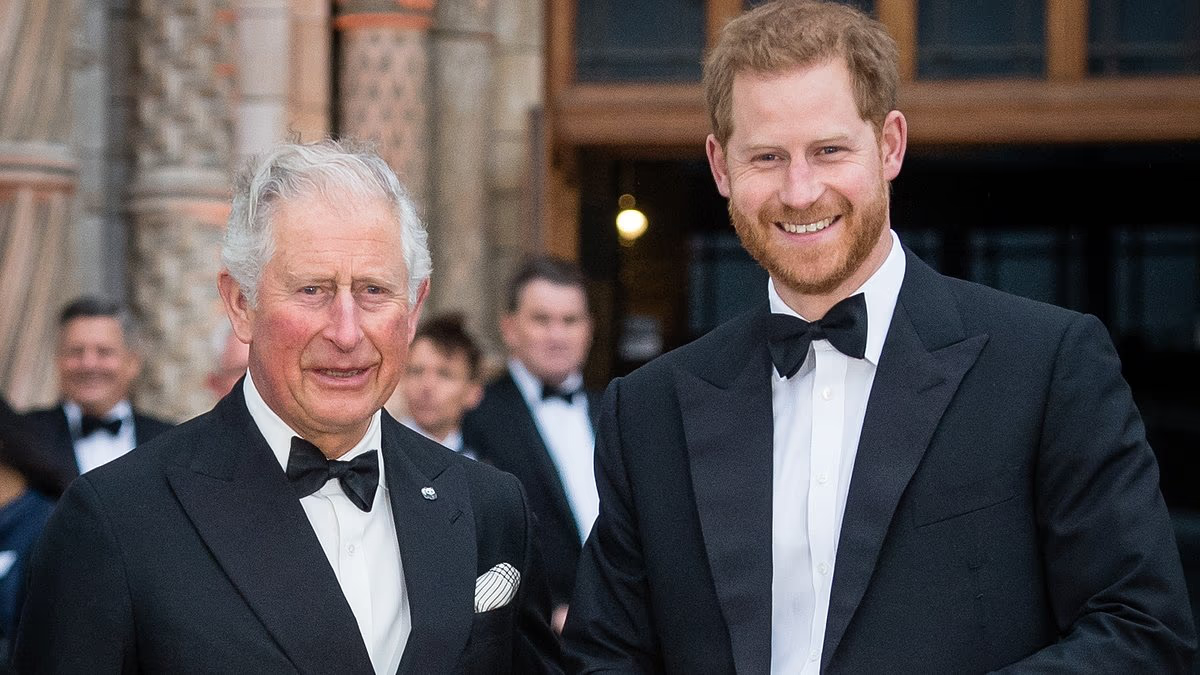

Prince Harry’s journey to Balmoral to see the King appeared to be the move of a man searching for a way back in. His return to Britain generated plenty of headlines, but it did little to restore his standing within the Royal Family.
Six weeks after his meeting with King Charles in mid-October, it now seems clear that the visit to the Scottish estate failed to deliver the reconciliation Harry had been hoping for.
As far as is known, there has been no invitation for Harry to attend the Royal Family’s traditional Christmas lunch at Buckingham Palace or to spend Christmas Day at Sandringham.
Instead, in the weeks ahead, Harry is expected to return to California with Meghan and their children, leaving any hopes of a royal Christmas gathering apparently dashed.
The encounter was also notably different from their meeting earlier in the summer, when Archie, seven, and Lilibet, five, were introduced to their grandfather again at Highgrove. This time, neither Harry nor Charles had a wife beside him to soften what must have been a cautious and tightly controlled conversation, particularly given the prince’s history of making family disputes public.
While Harry and his father met at Balmoral, Queen Camilla was around 400 miles away attending Royal Ascot. Meghan, meanwhile, was apparently not invited.
The details of the conversation may never be known, since the meeting was intended to remain private. Yet the message that has emerged appears unmistakable.
It was not, seemingly, the message Harry wanted. The two men may be able to remain on “good terms”, but any broader restoration of the relationship appears to have stopped there.

The King with Prince Harry in 2019, the year before he and Meghan moved to California
Since Harry and Meghan returned to Britain, the couple have generated a steady stream of publicity.
Their visit to Nottingham was billed as an effort to revive the warmth they once enjoyed from the British public, particularly after their first walkabout as a couple in 2017.
But nine years can bring a dramatic change. Rather than drawing crowds of hundreds, the couple were greeted by dozens of well-wishers, with journalists appearing to outnumber them.
There was also the awkward appearance on This Morning earlier this month, where Harry drank a shot of whisky while helping prepare a Christmas cake. He later took his children to Winter Wonderland in London’s Hyde Park and delivered a speech to the European Parliament on online safety for children.
Some observers interpreted the burst of activity as an attempt to pressure the Royal Family into welcoming the couple back. If the Balmoral meeting is any indication, however, that strategy has achieved little.
The House of Windsor is already under considerable strain. Catherine’s cancer treatment, the King’s own health difficulties and the continuing prospect of damaging revelations involving Prince Andrew and his links to the late financier and convicted sex offender Jeffrey Epstein have all placed the monarchy under intense pressure.
MUST READ: Aaron Rodgers, Steelers Face $22 Million Salary Issue to Resolve
The family has continued to carry out its duties, but Harry appears to remain focused on communicating how important he believes he is to the future of the institution.
He might also consider the experience of another royal who rejected his duties: Edward VIII. Eleven years after abdicating, the Duke of Windsor attempted to engineer a return to public life.
Edward told then-prime minister Clement Attlee that he still had an important contribution to make. He even searched for a suitable country home within reach of London, hoping that he and the Duchess of Windsor could begin rebuilding their place in British society.
His brother, King George VI, did not agree. Supported by the Queen Mother, who deeply disliked the duke, he made clear that there was no role in Britain for a royal who had abandoned his responsibilities and plunged the monarchy into turmoil. The Windsors soon departed and never returned.

Harry would do well to recall the fate of his fellow royal refusenik, Edward VIII (here with his wife, the Duchess of Windsor). Eleven years after he abdicated, the duke attempted a similar comeback, but his brother King George VI was having none of it
Some may argue that King Charles should have taken a similarly uncompromising position years ago and warned Harry to keep his distance. Instead, despite the hurt caused by repeated public disputes, Charles has continued trying to act as a father to his son.
That patience may not last indefinitely. Harry knows there is a limited window in which a return, however unlikely, remains possible while his father is still King.
A change of monarch, however, may bring a very different response. Once William becomes King, Harry may find there is little appetite for another attempt at reconciliation.
History offers another curious comparison in Harold Davidson, the disgraced Rector of Stiffkey. Removed from the church in 1932 over allegations of dishonourable conduct, Davidson reinvented himself as a theatrical performer and became a fixture in the newspapers.
His appetite for attention led to increasingly sensational stunts. At one point, he staged a hunger strike inside a barrel on Blackpool seafront; later, at Skegness, he attempted to recreate the Biblical story of Daniel in the lions’ den.
The stunt ended in tragedy when he was mauled after stepping on one of the animals’ tails.
Harry may be eager to remain in the headlines, but it is difficult to imagine him taking matters quite that far. Even so, after the festive season, the most sensible outcome for everyone may be for him to remain in Montecito.
The opportunity may have passed, Harry — and, ultimately, responsibility for that rests with you.
Christopher Wilson is the author of The Windsor Knot: Charles, Camilla And The Legacy Of Diana