
Share this @internewscast.com
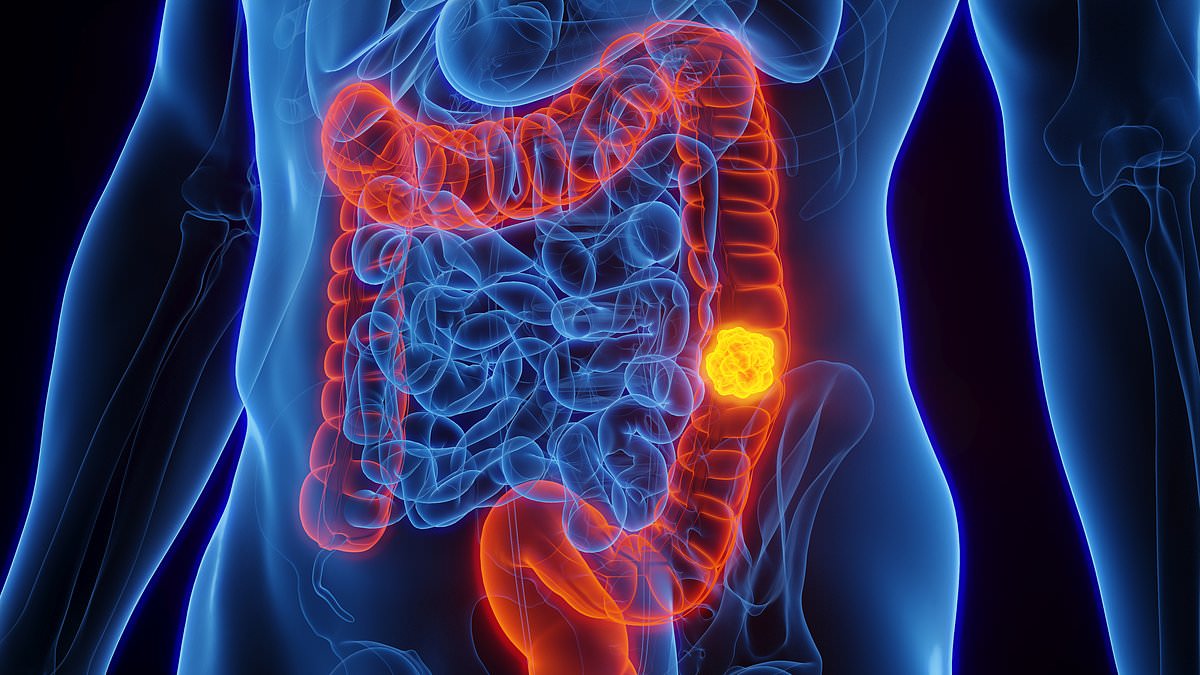
Excitement is building around a potential breakthrough in bowel cancer treatment, as a revolutionary clinical trial has kept participants free from cancer recurrence for almost three years using an innovative approach.
In the study, scientists discovered that administering immune-boosting medications to patients with a particular form of bowel cancer prior to surgery prevented the return of the disease.
The research, conducted by teams from University College London (UCL) and University College London Hospitals NHS Foundation Trust (UCLH), has been described as ‘extremely promising’ by experts.
Bowel cancer ranks as the fourth most prevalent cancer type in the UK, accounting for approximately 46,600 new cases and 17,700 deaths annually.
Alarmingly, this aggressive illness is increasingly affecting younger individuals. Since the early 1990s, there has been a 50% rise in bowel cancer cases among those aged 25 to 49.
Earlier this year, actor James Van Der Beek, known for his role in Dawson’s Creek, succumbed to bowel cancer at the age of 48, following a two-year battle with the disease.
The new study focused on 32 patients with stage two or three bowel cancer whose tumours had a genetic profile known as MMR-deficient/MSI-high – accounting for around 10 to 15 per cent of stage two and three bowel cancer cases.
Patients were given up to nine weeks of the immunotherapy drug pembrolizumab before surgery, instead of the normal method of surgery followed by three to six months of chemotherapy.

Hopes of a bowel cancer cure have been raised after a groundbreaking clinical trial kept patients cancer-free for nearly three years following a new method of treatment
Early results showed the treatment led to tumour shrinkage, with 59 per cent of patients having no detectable signs of cancer after their operation.
And after 33 months of follow-up, none of the patients saw their cancer return.
This included those whose cancer had completely disappeared and those who still had tiny amounts remaining after surgery, which did not grow or spread.
It is a major breakthrough as roughly a quarter of patients receiving standard surgery and post-operative chemotherapy would normally be expected to relapse within three years.
Researchers believe this proves that pre-surgery immunotherapy may be an effective treatment method for bowel cancer.
Dr Kai-Keen Shiu, chief investigator of the trial from UCL Cancer Institute and a consultant medical oncologist at UCLH, said: ‘Seeing that no patients have experienced a cancer recurrence after almost three years of follow-up is extremely encouraging and strengthens our confidence that pembrolizumab is a safe and highly effective treatment to improve outcomes in patients with high-risk bowel cancers.
‘What is particularly exciting is that we now may be able to predict who will respond to the treatment using personalised blood tests and immune profiling.
‘These tools could help us tailor our approach, identifying patients who are doing well and may need less therapy before and after surgery versus patients at higher risk of disease progression or relapse who need additional treatment.’
Patients involved in the trial, and who are now cancer-free, have told how the treatment has been life-changing for them.
Christopher Burston, 73, from Portland, Dorset, was diagnosed with bowel cancer in February 2023 after taking part in routine screening.
He had been completing the bowel screening kits sent by post for several years when one returned a positive.
Mr Burston said: ‘One came back with indications of blood in my stool. I went through further tests, and it was at the colonoscopy that they identified a cancer in my bowel.’
Weeks after diagnosis his oncologist suggested he might be suitable for the clinical trial and, despite the need to travel to London, he decided to take part.
Mr Burston received three doses of immunotherapy over nine weeks followed by surgery in May 2023. He experienced minimal side effects and made a strong recovery after spending one week in hospital.
He said: ‘The outcome of the surgery was essentially that the cancer had melted away, these were the doctor’s words. The immunotherapy had had an almost immediate effect.
‘I saw the images when I had the first colonoscopy and could see it was really quite a substantial lump. So as I say, it wasn’t a minor thing, I was diagnosed with stage three cancer.’

Christopher Burston, from Portland, Dorset, took part in the trial and is now cancer-free
More than three years later, he is cancer-free and said he feels ‘very lucky’ to be able to return to normal life.
Alongside survival results, scientists analysed blood samples to understand why the treatment was so effective and to identify which patients were most likely to benefit.
They developed personalised blood tests capable of revealing whether treatment had worked and whether any cancer remained in the bloodstream.
Professor Marnix Jansen, a clinician scientist and consultant histopathologist who is leading the translational research on the trial from UCL Cancer Institute and UCLH, said: ‘These results not only confirm the durability of responses we saw almost three years ago, but also provide crucial biological insights into why immunotherapy is so effective in this setting.’
Yanrong Jiang, first author of the latest abstract and clinical PhD student at the UCL Cancer Institute, added: ‘As a research team, we were thrilled to be able to follow patients very closely using the personalised blood tests. When tumour DNA disappeared from the blood, patients were much more likely to have no cancer remaining, and this matched the long-term results we’re now seeing.
‘In addition, we also saw that immune profiling from tumour tissue, before patients start their first cycle of treatment, can help to predict response. We hope these tests may be used to guide treatment decisions in a more practical and timely way.’