

Share this @internewscast.com
Italy’s parliament has enacted a groundbreaking law that formally recognizes femicide within the nation’s criminal code, imposing a life sentence for such crimes.
The decision was made in a vote on Tuesday (Wednesday AEDT) to coincide with the United Nations’ International Day for the Elimination of Violence Against Women.
The legislation, receiving bipartisan backing, passed in the Lower Chamber with 237 affirmative votes, supported by both the center-right majority and the center-left opposition.

This new law, advocated by Prime Minister Giorgia Meloni’s conservative administration, is a response to the alarming trend of violence and killings targeting women in Italy.
It also introduces tougher penalties for gender-related offenses, including stalking and revenge porn.
High-profile incidents, such as the 2023 murder of university student Giulia Cecchettin, have fueled significant public outrage and discussions regarding the roots of violence against women within Italy’s traditionally patriarchal society.
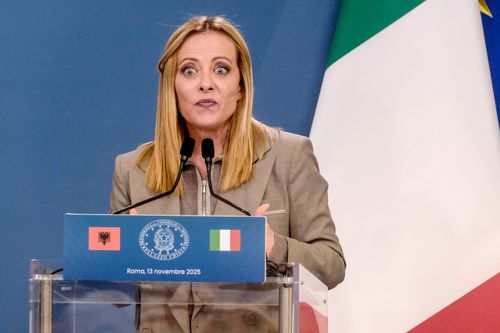
“We have doubled funding for anti-violence centres and shelters, promoted an emergency hotline and implemented innovative education and awareness-raising activities,” Meloni said on Tuesday.
“These are concrete steps forward, but we won’t stop here. We must continue to do much more, every day.”
While the centre-left opposition supported the law in parliament, it stressed that the government approach only tackles the criminal aspect of the problem while leaving economic and cultural divides unaddressed.
Italy’s statistics agency Istat recorded 106 femicides last year, 62 of them committed by partners or former partners.
The debate over introducing sexual and emotional education in schools as a way to prevent gender-based violence has become heated in Italy. A law proposed by the government would ban sexual and emotional education for primary students and require explicit parental consent for any lessons in high school.
The ruling coalition has defended the measure as a way to protect children from ideological activism, while opposition parties and activists have described the bill as “medieval.”
“Italy is one of only seven countries in Europe where sex and relationship education is not yet compulsory in schools, and we are calling for it to be compulsory in all school cycles,” said the head of Italy’s Democratic Party, Elly Schlein.
“Repression is not enough without prevention, which can only start in schools.”