
Share this @internewscast.com

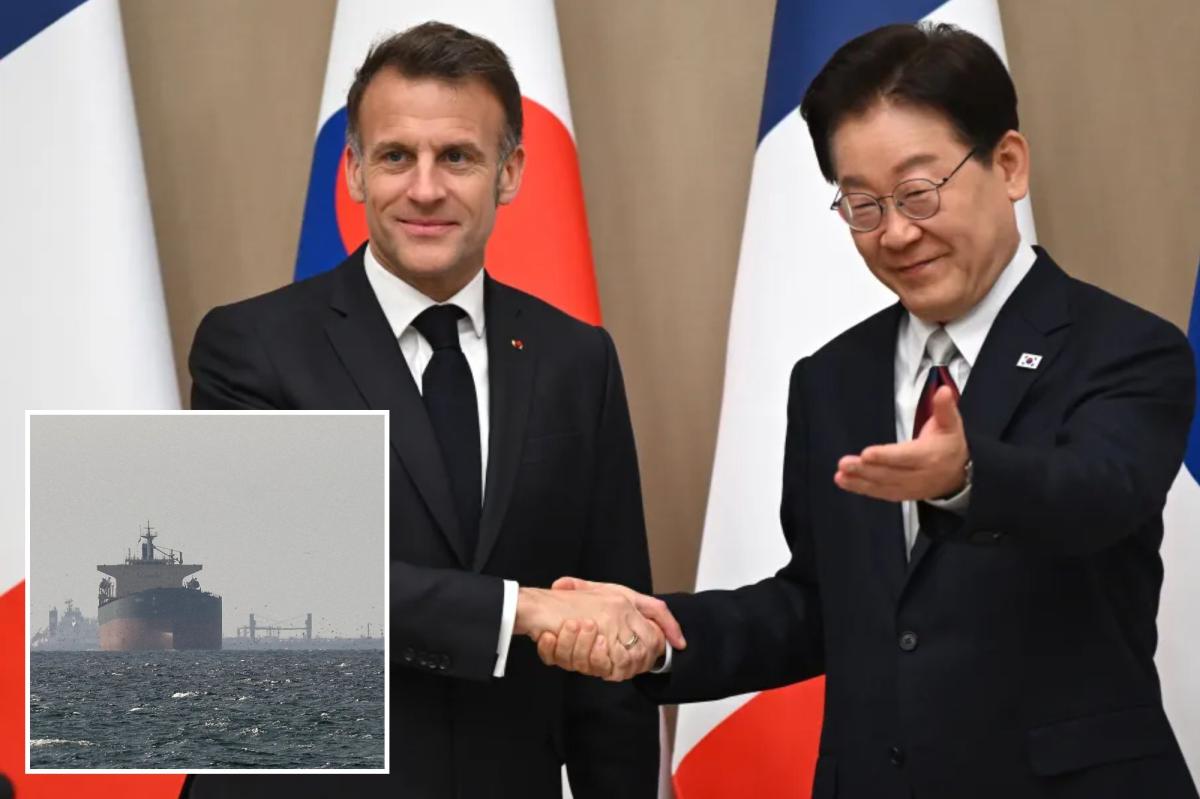
On Friday, French President Emmanuel Macron and South Korean President Lee Jae Myung pledged to collaborate on reopening the Strait of Hormuz to mitigate global economic uncertainties stemming from the Middle Eastern conflict.
Their meeting in Seoul coincided with US President Donald Trump criticizing allies for not backing the U.S. and Israel in their conflict with Iran.
This visit marked Macron’s first trip to South Korea since assuming office in 2017, as part of his broader tour of Asia, which has already included a stop in Japan.
During the meeting, Macron emphasized to Lee the potential of their countries to contribute to stabilizing the Middle East, with a particular focus on addressing Iran’s control over the Strait of Hormuz, a critical juncture in global energy supply.
In a joint televised statement following the meeting, Macron highlighted the importance of Franco-South Korean cooperation in reopening the strait and reducing tensions in the Middle East. Lee echoed this sentiment, affirming their commitment to ensuring safe passage through the Strait of Hormuz.
However, the leaders did not provide details or answer questions regarding their specific strategies for reopening the crucial waterway, which is a vital passage for about 20% of the world’s oil supply.
“We need to clearly define, at the international level, the conditions for a process to ease the crisis and conflict in the Middle East,” Macron said. “We need to ensure that the Strait of Hormuz is reopened.”
Lee said he and Macron agreed to expand cooperation in technology, energy and other areas. South Korean and French officials also signed agreements to cooperate on nuclear fuel supply chains, jointly invest in an offshore wind project in southern South Korea and to collaborate on critical minerals.
South Korea has moved to increase output at its nuclear reactors to mitigate the energy crunch and Lee has also called for a faster transition to renewable energy, saying the war has exposed the country’s heavy reliance on fossil fuel imports.
Macron’s Asia trip comes as Trump has ramped up his frustration with allies.
In a speech Wednesday, Trump said Americans “don’t need” the strait but the countries who do “must grab it and cherish it.”
In an earlier Easter event at the White House, Trump called for his allies in Asia and China to get involved in reopening the waterway.
“Let South Korea, you know, we only have 45,000 soldiers in harm’s way over there, right next to a nuclear force — let South Korea do it,” Trump said. “Let Japan do it. They get 90% of their oil from the strait. Let China do it.”
The United States stations about 28,000 troops in South Korea, not the 45,000 stated by Trump.
The US troops’ deployment in South Korea is meant to deter potential aggressions from North Korea.
Macron has said reopening the Strait of Hormuz through a military operation is unrealistic.
South Korean officials have said they are in contact with Washington on the issue and that Seoul isn’t considering paying Iran transit fees to secure fuel shipments through the strait.