
Unlock the White House Watch newsletter for free
Donald Trump announced plans to raise tariffs on steel and aluminium imports, escalating them from 25 percent to 50 percent as part of a renewed phase in his international trade conflict.
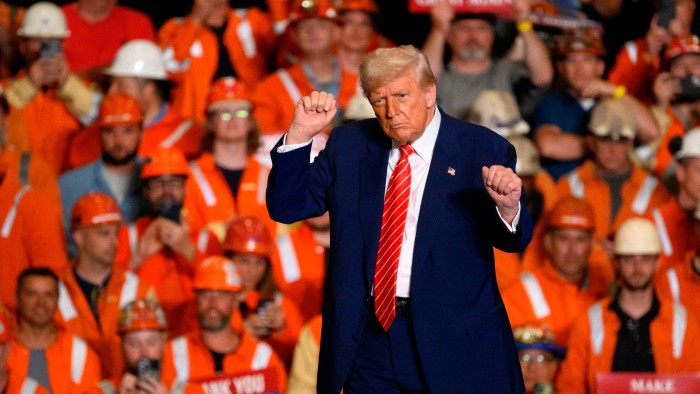
The US president declared the higher tariffs while promoting a $15 billion collaboration between Nippon Steel and US Steel during an event in Pennsylvania, where he also pledged to construct a tariff “fence” to protect local metal manufacturing.
“We’re increasing the tariffs on steel entering the United States of America from 25 percent to 50 percent, which will provide even greater security for the steel industry,” he informed the audience in West Mifflin.
“Nobody is going to get around that . . . At 25 per cent, they can sort of get over that fence. At 50 per cent they can no longer get over the fence.”
The new levies will take effect from June 4, the president wrote in a Truth Social post following the rally.
Trump has sought to revitalise America’s industrial heartlands by aggressively targeting what he sees as dumping by foreign importers. In March, he slapped 25 per cent levies on steel and aluminium imports in one of the first broadsides of his global trade war.
Pennsylvania was one of crucial swing states Trump won in last year’s presidential election after he and Joe Biden courted blue-collar voters with competing promises to protect manufacturing jobs.
“Whatever the legal barriers or economic fallout, Trump is clearly determined to continue using tariffs as a policy tool to protect American smokestack manufacturing from the ravages of foreign competition,” said Eswar Prasad, an economist at Cornell University.
Friday’s announcement increases trade tensions once again two days after a US trade court ruled many of the president’s tariffs illegal, though this did not include sectoral levies, such as those on steel and aluminium. The White House has vowed to fight the decision.
Trump’s volatile approach to tariffs — repeatedly announcing new levies before later dialling them back — has caused confusion among companies and led to huge swings in markets in recent months.
The Trump administration reached a deal with China two weeks ago to lower tariffs between the two countries, which had reached as much as 145 per cent. But tensions appeared to be rising again on Friday when Trump accused Beijing of reneging on the arrangement.
The steel tariff escalation comes after Trump last week broadly endorsed Nippon Steel’s bid to enter a “partnership” with US Steel, reversing his campaign trail opposition.
The president on Friday hailed what he called a “blockbuster agreement” with a “great partner” that he said would “ensure this storied American company stays an American company”.
Trump said Nippon Steel had made a “monumental commitment” to invest $14bn in the company, including more than $2bn to increase steel production in Pennsylvania’s Mon Valley and $7bn to modernise mills and build facilities in Indiana, Minnesota, Alabama and Arkansas.


