
Share this @internewscast.com
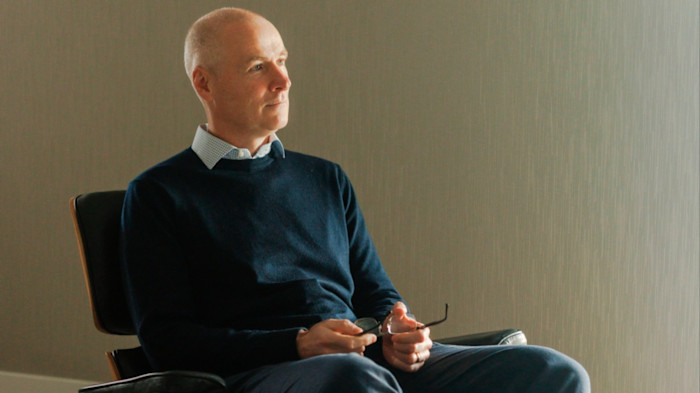
Tim Campbell reflects on a pivotal encounter from over 20 years ago that profoundly influenced his approach to leadership in business.
As the CEO of Edinburgh-headquartered Baillie Gifford, a prominent fund management firm, Campbell reminisces about a lunch meeting in the early 2000s with the finance head of an Argentine bank on the brink of collapse. A vivid memory that lingers with Campbell is the visible strain and impact the crisis had on the executive.
“The inability to return depositors’ money was a defining moment,” Campbell notes. “It heightened my awareness that extreme scenarios do occur. Most financial crises stem from the failure of models, underscoring the importance of the human aspect in investment management.”
Campbell highlights a significant challenge for active fund managers: the unstoppable growth of passive investments, which mirror market movements instead of relying on individual stock selection.
Since its inception in 1908, Baillie Gifford has dedicated itself to long-term investment strategies, emphasizing growth stocks that are anticipated to outperform the broader market. As one of the UK’s largest fund managers, this focus has been central to their operations.
However, the firm faces mounting challenges. The assets under its management have decreased from a high of £336 billion in 2021 to around £210 billion last year. This decline is attributed to the waning popularity of growth stocks, which has adversely affected investment values, coupled with a growing investor shift towards passive strategies.
Campbell is now leading a restructuring aimed at pushing into new areas — notably “active” exchange traded funds. These allow fund managers to try to beat the market but in a product that is cheaper to run and easier for investors to trade than mutual funds. “In the US, people are moving away from mutual funds to ETFs,” he says. “We need to respond to that.”
He is also refocusing Baillie Gifford on growth areas such as private markets and wealth management.
Jason Hollands of wealth manager Evelyn Partners says that as Baillie Gifford “is unashamedly focused on active fund management”, it has “struggled during a period where market leadership has been narrowly concentrated and passives have been capturing a large slice of flows”.
He adds: “Recent years have been tougher for many of Baillie Gifford’s funds in terms of relative performance.”
Campbell was voted into the top job in April last year by the firm’s 59 partners. He replaced Andrew Telfer, who had been with the business for more than three decades. Like Telfer, and many of Baillie Gifford’s partners, Campbell has been at the firm for decades — he joined in 1999.
Baillie Gifford has faced challenges beyond the switch to passive investing. In 2024 a pressure group urged authors to boycott literary events it sponsored because of the asset manager’s investments in companies with links to Israel and the fossil fuel industry. Campbell, who was not CEO at the time, says it pulled funding as the protests were “a huge management distraction”.
Its £15bn Scottish Mortgage fund, which is known for backing fast-growing technology stocks including Elon Musk’s Tesla and SpaceX, came under scrutiny for its holding of private assets when board member Amar Bhidé, who has since left, sounded the alarm over the trust’s ability to monitor such illiquid investments, among other issues.
A few of the firm’s investment trusts have also been subject to a campaign by activist hedge fund Saba Capital, which has criticised their performance.
Baillie Gifford made nearly 50 job cuts last year to help keep costs in check and as part of its broader refocusing.
“There are some things when you look at our organisation now versus five years ago . . . we need less of and there are some things we need more of,” says Campbell. “Sadly we did make some redundancies and those were roles that were no longer required in the world that we live in and we’re going to continue to evolve with whatever our clients need.” The company is trying to place people in different roles.
Campbell acknowledges leadership style is crucial during this type of restructuring. “I’ve tried to be very human,” he says, noting that “everyone has a life outside of work . . . [and I] try and get to know people”. He adds that “particularly when you go through periods of change, it’s incredibly important that you communicate that clearly”.
He came up with the idea of a five-minute video to summarise the management committee’s meetings for colleagues. “[People] want to know why they’re coming to work and what does an organisation stand for, what do you believe in and what are you doing?”
After studying history and political science at university, Campbell had a brief spell as a music teacher in the Middle East, before returning to Edinburgh in search of a job. Two of his friends worked in asset management and recommended joining the industry.
“I picked Baillie Gifford, so joined them in 1999 a few months before the tech bubble burst, which was quite formative.” He is now one of three managing partners overseeing the running of the firm, but with overall leadership responsibilities.
After decades of wooing pension fund clients to run money on their behalf, from the UK and US to Australia and Hong Kong, the asset manager is seeking to court a wider mix of customers, including more wealth managers, family offices and global financial institutions.
Pension funds piling into cheaper passive funds have made it harder to win mandates for running “active” strategies — Baillie Gifford’s bread and butter.
As part of this shift, the fund group opened an office in Singapore in 2024 to tap into the country’s “big private wealth client base” and opportunities across Asia. It has 11 offices, including Hong Kong, Shanghai, Zurich, Frankfurt, Amsterdam, New York, Toronto, Dublin, Edinburgh and London.
“I look at our industry now and over 50 per cent of the assets are owned by passive,” says Campbell. “It’s strange to think [active management has] become a minority endeavour. I think that presents huge opportunities for us.
“But I’m acutely conscious that it means if we’re going to have a thriving business in 10, 15, 20 years’ time, we need to be exceptional” and “continue to invest heavily” in investment research.
Campbell insists “having a significant presence in private companies is now so important”, particularly as some fast-growing businesses are choosing to stay private for longer. It has about $10bn invested in private markets, including holdings in TikTok owner ByteDance and payments company Stripe.
But Campbell acknowledges the risks in backing private companies, whose values are more opaque than listed stocks and are often harder to sell. “It’s super important that people have a rigorous process around how [they] value private companies,” he says.
As Campbell prepares to oversee Baillie Gifford through its strategic shift, he is focusing on his leadership style based on what he has learnt over the years.
“There are one or two examples of how not to lead that were very formative,” he recalls. “I think one of the things I’ve tried very hard [to achieve], maybe in response to those, [is] consistency: show up every day; be approachable, accessible, honest, transparent about what [you’re] doing.”
He acknowledges the financial industry “is not universally loved”, but says “if we do our job well, it improves people’s quality of life, it’s useful to society, the economy and business at large; and I want people to feel proud about what they do . . . [and] realise what a privilege it is to look after people’s money.”
A day in the life
With our youngest twin daughters at university, my wife and I are adjusting to the blissful lack of morning mayhem. She’s a GP, so we’re both up early for work. I try to fit in a run three times a week before heading to the office in central Edinburgh.
There’s no typical day. It’s usually a mix of speaking with clients, driving progress on strategic priorities and checking in with partners, staff and overseas offices to make sure everyone has what they need.
When I’m in Edinburgh, I have lunch at the communal table in our staff canteen. About a quarter of my time is spent on the road meeting clients and prospects, which gives me the chance to connect with different colleagues. I devote any spare time to reading — our own investment research or exploring how industries and client needs are evolving.
Dinner is followed by a walk with my wife to debrief the day. If I have any energy left, I’ll sit at the piano and revisit my first career as a music teacher, wrestling with Rachmaninov’s “Prelude in C-sharp minor”. For now, Rachmaninov is winning.