
Share this @internewscast.com
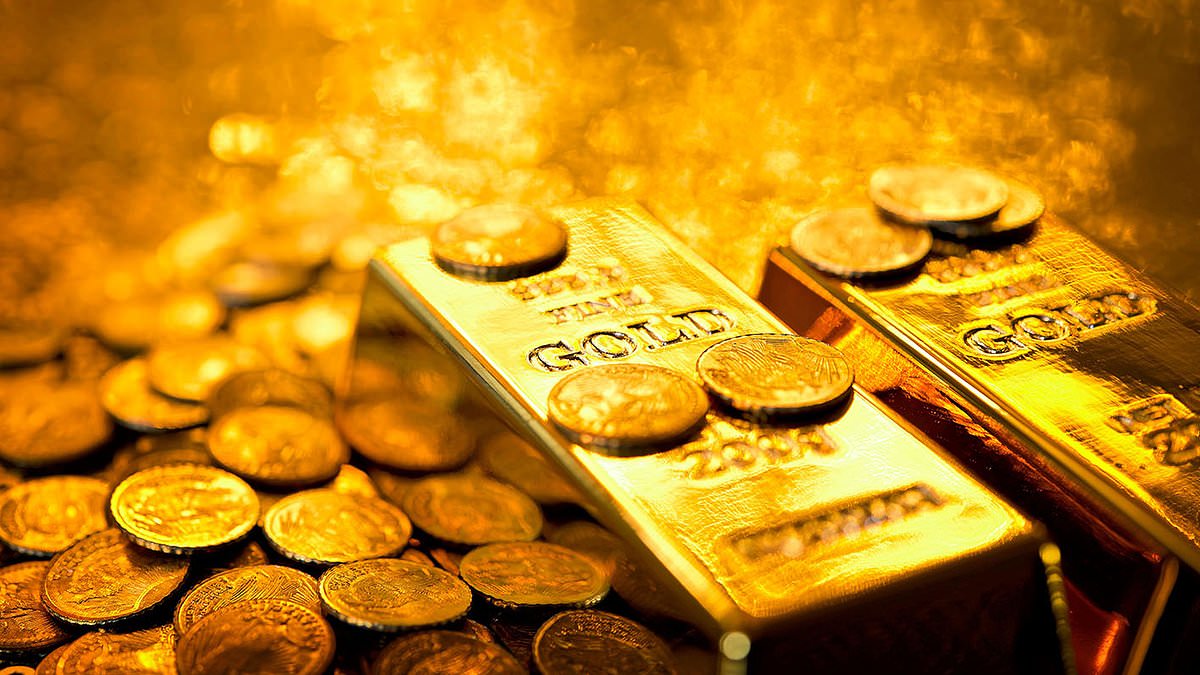
This year, precious metals like gold, silver, and platinum have outshone even the most dazzling Christmas decorations.
Looking ahead, experts predict that this strong performance might extend beyond 2026.
As the U.S. dollar gradually loses its dominance as the world’s leading reserve currency, investors are likely to continue seeking refuge in these metals.
The slower transition to electric vehicles is also boosting the appeal of platinum, making it an increasingly attractive investment.
According to Ole Hansen, Saxo Bank’s head of commodity strategy, there is a “persistent structural bid for security.” He advises those doubtful of gold, silver, and platinum’s value to reconsider their stance.
For those planning their New Year’s resolutions early, consider adding these sparkling assets to your investment portfolio for some extra shine.

Midas touch: Gold, silver and platinum have been a shimmering success this year
DAZZLING RESULTS
Since the start of the year, the gold price has risen by 60 per cent to $4,321, bouncing back from a reverse in October. Silver has taken what traders call a ‘parabolic leap’, soaring by 121 per cent to $63, boosted by a supply crunch.
As a result, shares in the FTSE 100 member Fresnillo, which mines both silver and gold, are 379 per cent higher than at the start of the year.
Platinum has advanced by 104 per cent to $1,913, also thanks to a shortage. The metal is a key ingredient of the catalytic converters in petrol and hybrid cars – which are set to be around for longer than predicted.

WILL GOLD SHINE ON?
A peace deal between Russia and Ukraine could dampen demand for gold.
But since tensions will continue in Europe and the Middle East, this metal may still be viewed as an ‘under-owned asset’, whose price could advance to $4,900 in 2026 – or so the US bank Goldman Sachs forecasts.
Bullion’s ascent has been driven by the popularity of gold exchange traded funds (ETFs) into which investors worldwide have stashed £396billion.
But most buying is by the central banks of emerging and major nations, which have built up £3.7 trillion in gold reserves.
They prefer bullion to the dollar and US Treasuries (government bonds) which, not so long ago, were the favoured hedge at times of heightened geopolitical risk.
America has 4,583 metric tonnes of gold in its Fort Knox facility. But Poland, Kazakhstan and China have been busy buying this year.
And as ‘de-dollarisation’ gathers pace, Madagascar, Serbia and South Korea are joining the party.
Central banks’ love affair with gold was sparked by the freezing of Russian assets following the invasion of Ukraine.
But the passion for the yellow metal may now have turned into what analysts have termed ‘a multi-year trend’.

‘Forgotten asset’: Silver is being described as ‘the new gold’
THE NEW STARS
Silver, which used to be called ‘the forgotten asset’, is being described as ‘the new gold’.
There is talk that its price could reach $100 next year, partly as a result of a stockpile amassed in the US in case it becomes subject to tariffs. Not to be outdone, platinum is being called the ‘undervalued asset’, reflecting the view that it has for too long been overshadowed by gold.
Gold is used in coins and jewellery. Silver, however, is also an essential component of many types of electronics products such as smartphones.
In addition, it is an element in the semiconductors powering the artificial intelligence (AI) industrial revolution.
Manufacturers of solar panels also need silver – although, like other industries, they may search for cheaper alternatives if it becomes too costly.
At the same time, nations are developing a liking for silver, with the Saudi central bank taking stakes in the iShares Physical Silver and Global X Silver Miners funds.
The downturn in sales of electric vehicles seems set to spur demand for pollution-limiting catalytic converters, which each contain three-to-seven grams of platinum. The metal is also used in engine spark plugs.
Since jewellery makers are turning to platinum as a cheaper alternative to gold, this metal’s price could motor ahead.
This belief lies behind the 104 per cent rise to ZAR 1,913 in the shares of Valterra, the South African platinum group which joined the London market this year.

Change of mind: Platinum is used in catalytic converters and engine spark plugs
BUBBLE FEARS
The main disadvantage of investing in precious metals used to be the lack of an income. But now there are concerns that the gold price, in particular, may be in a bubble and poised for a painful correction.
Similar apprehension surrounds shares in the US tech titans such as Microsoft and Nvidia.
The Swiss-based Bank for International Settlements has issued an alert over the outlook for gold, arguing that its ascent is due to speculative buying by private investors motivated by FOMO (fear of missing out). This assessment, which dismisses the billions spent by central banks, is a bit condescending.
Most investors backing precious metals want to diversify because they are apprehensive about tech stocks. The influential US hedge fund manager Ray Dalio has been telling clients to commit as much as 15 per cent of their portfolios to gold. But most UK wealth managers recommend between 4 per cent and 5 per cent.
YOUR INVESTMENT OPTIONS
You can buy gold bars and coins through the Royal Mint or a dealer such as Sharps Pixley.
The delights of ownership are, however, offset by the costs of delivery, insurance and secure storage. It is simpler to opt for a low-cost exchange traded commodity fund backed by physical gold, silver or platinum, such as Invesco Physical Gold, Invesco Physical Silver, WisdomTree Core Physical Silver and Invesco Physical Platinum.
Gold mining company shares are a riskier way to back this metal. They fare better than gold when the price is moving upwards, but they fall faster when it goes into reverse because of their costs of production. This is exemplified by Newmont, the world’s largest gold mining corporation, whose shares have increased by 165pc this year to $102. Analysts rate Newmont a ‘buy’ on the basis that the new boss Natascha Viljoen will be able to deliver superior returns.
Barrick, which mines gold and copper, is another ‘buy’, although shares are down 4 per cent to $45. But Fresnillo is rated a ‘hold’, presumably because it may not repeat this year’s share price feats.
The challenge of researching these shares means that a fund is an easier route. Jason Hollands, of Bestinvest, likes Jupiter Gold & Silver, which he has chosen for his own portfolio.
Other best buys include Ninety-One Global Gold, which has delivered a return of 15 per cent this year. In February, when this column first highlighted the benefits of gold, I put money into iShares Physical Gold and I will add silver and platinum funds to this.
But I would enjoy the payback more if I could stop calculating how much better off we would be if Gordon Brown, who was the Chancellor at the time, had not sold 395 tonnes of our gold between 1999 and 2002. This raised £2.14billion at the time. Today it would be worth about £41billion.
DIY INVESTING PLATFORMS
AJ Bell

AJ Bell
Easy investing and ready-made portfolios
Hargreaves Lansdown

Hargreaves Lansdown
Free fund dealing and investment ideas
interactive investor

interactive investor
Flat-fee investing from £4.99 per month
Freetrade

Freetrade
Investing Isa now free on basic plan
Trading 212

Trading 212
Free share dealing and no account fee
Affiliate links: If you take out a product This is Money may earn a commission. These deals are chosen by our editorial team, as we think they are worth highlighting. This does not affect our editorial independence.
Compare the best investing account for you