
Share this @internewscast.com
After watching “Breakfast at Tiffany’s,” I always dreamed of owning a piece of jewelry from that legendary store.
By 2010, I had finally saved enough money and spent around £1,200 on my purchase.
With gold prices soaring lately, I wonder if I made a wise investment or if I simply paid for the prestigious name. Holly, Barnsley.

A This is Money reader wants to know if she paid too much for a Tiffany necklace
Dan Hatfield, valuation expert for This is Money, responds: Tiffany & Co. is far more than just a jewelry retailer.
It stands as one of America’s iconic cultural exports, a 19th-century New York success story that has become synonymous with romance and sophistication worldwide.
Established in 1837 by Charles Lewis Tiffany, the company earned its reputation through a commitment to quality and excellence.
At a time when silver purity was inconsistent and loosely regulated, Tiffany introduced the .925 sterling silver standard in the US, effectively forcing the market to sharpen up.
It positioned itself not merely as a retailer, but as an arbiter of quality. This is vitally important.
Not only were Tiffany’s producing fabulous items they also had authority and integrity at the forefront of their offerings. This would stand them in good stead for decades to come.
Then, in 1886, came the defining stroke of genius: the Tiffany Setting. By lifting the diamond high in a six prong mount, light was allowed to flood through the stone, transforming that all important sparkle.
The modern engagement ring, as we recognise it today, owes a remarkable debt to that design.
Tiffany still refers to it, quite unapologetically, as the birth of the engagement ring ‘as we know it’.
By the late 19th century, Tiffany was supplying royalty, redesigning the Great Seal of the US and acquiring pieces from the French Crown Jewels.
This is a pedigree very few companies hailing from the other side of the pond can claim.
To be so embraced by the upper echelons of society and to be American just wasn’t known of then. And then came cinema.
In 1961, along came Audrey Hepburn in Breakfast at Tiffany’s, coffee and croissant in hand, gazing into those Fifth Avenue windows.
The scene lasted only minutes. The impact lasted in our minds forever.

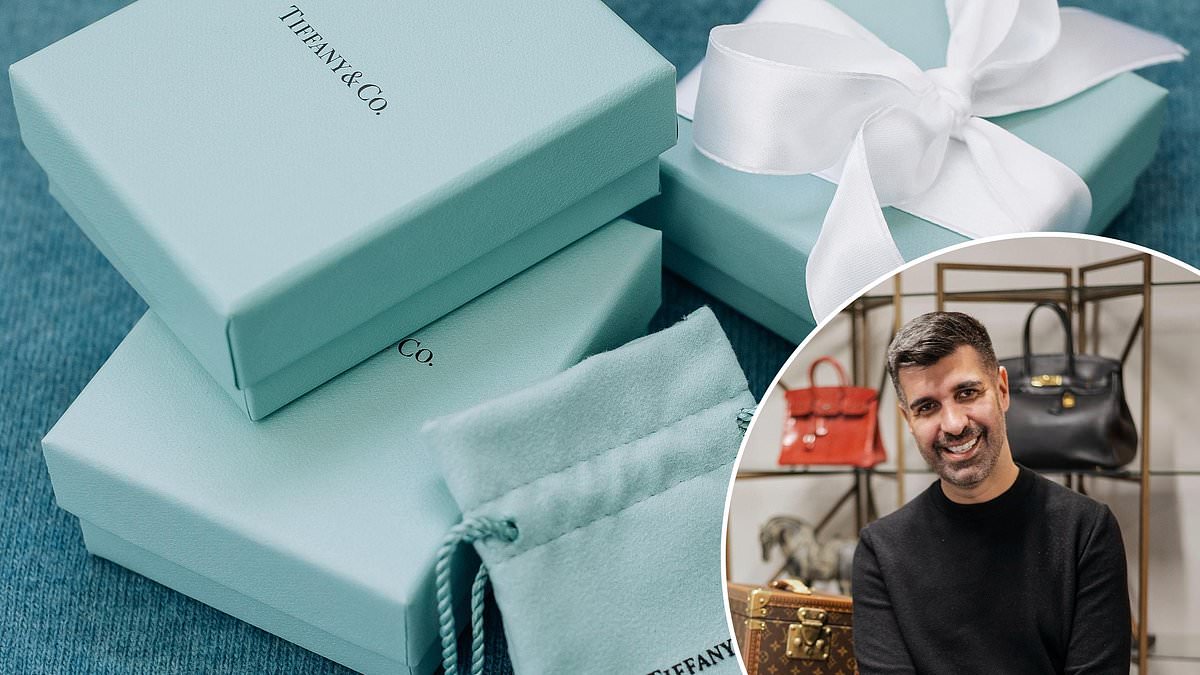
Tiffany & Co. isn’t just a shop that happens to sell jewellery, says Dan Hatfield
The film didn’t invent Tiffany’s prestige, it crystallised it. Overnight, the blue box became more than packaging.
It became a promise that glamour wasn’t reserved solely for heiresses and Hollywood, it might – just might – be within reach for us all.
From that moment on, Tiffany wasn’t simply selling jewellery. It was selling aspiration wrapped in satin ribbon.
So by the time you walked into a Tiffany boutique in 2010, you weren’t purchasing grams of gold. You were buying into nearly two centuries of myth making, design authority and cultural cachet.
You bought in to that dream, that fairytale. And why wouldn’t you? The glamour, the romance, the beauty, the gold! It’s all just too tempting for us magpies.
Of course you wanted to buy something that would retain its value or increase over time but I’m sure the thrill of the purchase was also tantalising for you as well.
From your photo, this looks like an Elsa Peretti Open Heart pendant in 18ct yellow gold, one of Tiffany’s most recognisable designs.
That matters, because Elsa Peretti wasn’t a minor designer, she was seismic. Tiffany itself says her arrival in 1974 ‘signaled a revolution’ in jewellery design, and the partnership has endured for decades.
Peretti’s genius was creating pieces that felt modern and sensual, without being fussy.
The Open Heart is a perfect example, asymmetrical, sculptural, simple enough to wear daily, but distinctive enough that people recognise it instantly.
This piece is made of 18ct gold. That’s equates 75 per cent pure gold. As you have pointed out gold is extremely valuable right now. We are seeing record highs.
In 2010 we saw gold average put at about £790 an ounce.
At the time of writing my column this figure stood at £3,877.
That’s a jump of almost 390 per cent – now if you think that’s impressive in just one year alone the price has increased by almost 75 per cent. It’s eye watering.
In all of my many years as a pawnbroker and valuer I have never known such increases. On a daily basis I look at the spot price and it takes my breath away.
Your item will weigh around 15.6 grams.
This means that, based on 2010 gold prices you paid almost quadruple the intrinsic value of gold.
You weren’t just buying the metal though, you were buying the design, craftsmanship, the prestige, that blue box. It all costs money.
If you had wanted to buy a piece purely for investment purposes then this would not have been a wise purchase.
You could have bought 15.6 grams of 18ct gold for a much lower price in 2010, in fact around £300.
That’s not to say it was a bad purchase but these designs sit in a rather tricky area.
They aren’t so rare that they will command premium prices but they feel too special to be worth just the price of the gold when we look at second hand values.
The value of the weight of the metal today is around £1,450.
That means that if you were just to sell it for what the piece you would have made around £250.
Any gain may be seen as positive but to put it in to context, many people are seeing the quadruple returns on their money from purchases from this time.
It is easy to deduce then that you pay a rather large premium for the ability to purchase an item from Tiffany and co.
I also have to add, therefore some value on due to the prestige of the maker. I would add another £300 to £500 so hopefully you could achieve around £2,000 on a good day.
So whilst this lovely bit of jewellery may not send you floating down moon river, it’s still a rather spectacular return on your high end luxury purchase.
I’m pretty certain it would afford you a rather lovely breakfast at Tiffany’s, that’s for sure
Send in your Modern Treasures

Dan Hatfield: Our columnist is ready to value your Modern Treasure
Dan Hatfield is This Morning’s money-making expert and resident pawnbroker. He is an international specialist in antiques, jewellery, diamonds and collectibles.
Dan’s first non-fiction book, Money Maker: Unlock Your Money Making Potential is available now.
This is Money’s Modern Treasures column is after your items and collections for valuations.
Please send in as much information as possible, including photographs, to: editor@thisismoney.co.uk with the email subject line: Modern Treasures
We’re after post-War items only please and we may contact you for further information.
Dan will do his best to reply to your message in his bi-weekly column, but he won’t be able to answer everyone or correspond privately with readers.
Nothing in his replies constitutes regulated financial advice. Published questions are sometimes edited for brevity or other reasons.
As with anything, if you are looking to sell items and collections, it is wise to get a second and third opinion – not just rely on Dan’s suggestions.