
Share this @internewscast.com
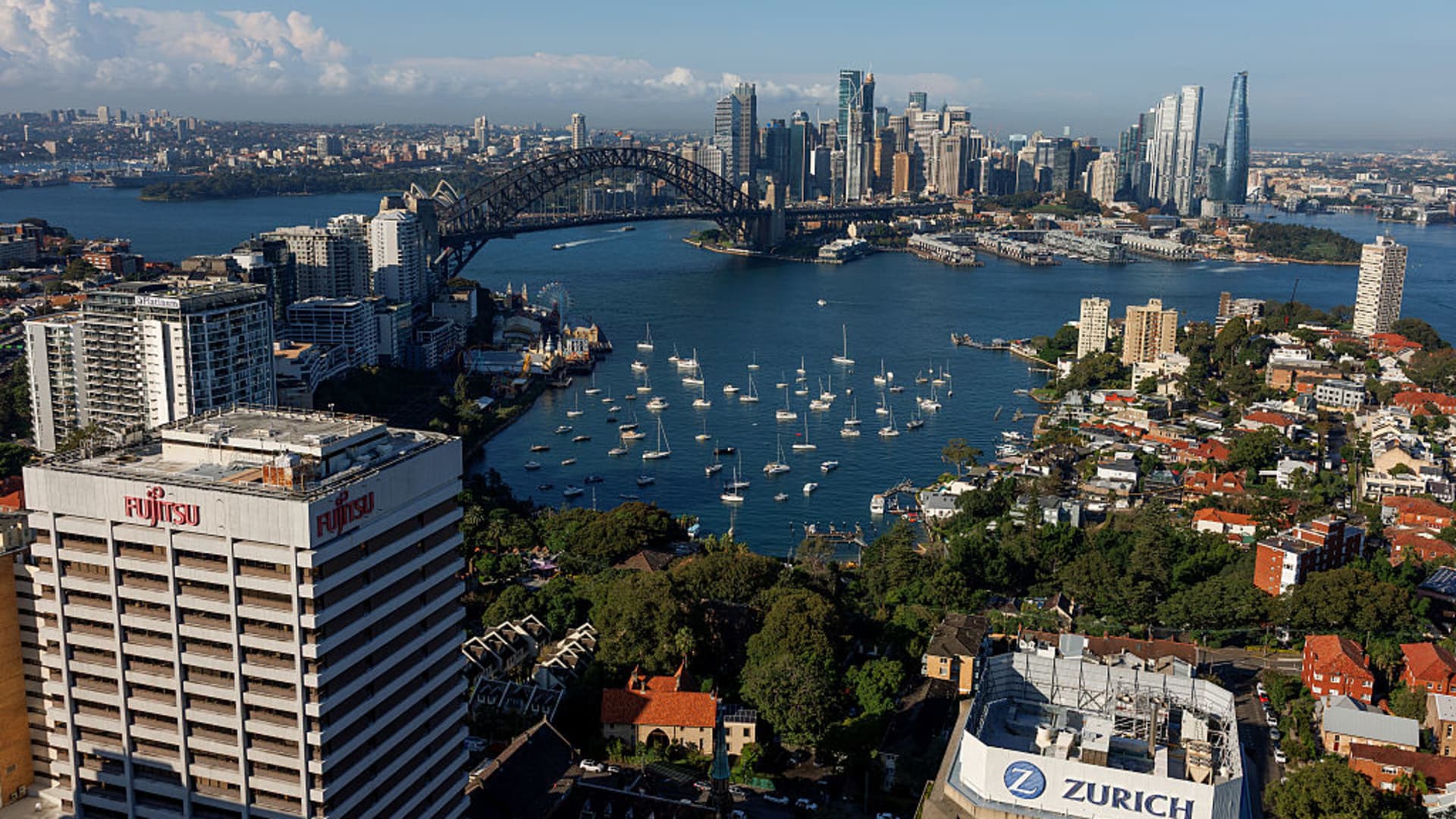
Sydney Harbour and the skyline of the central business district (CBD) in Sydney, Australia, on Tuesday, April 29, 2025.
Bloomberg | Bloomberg | Getty Images
Australia’s economy expanded more than expected in the second quarter of the year, marking the fastest pace of growth since September 2023.
The country’s GDP grew 1.8% year over year, higher than the 1.6% expected by economists polled by Reuters, and higher than the 1.3% seen in the previous quarter.
On a quarter-over-quarter basis, Australia’s GDP grew 0.6%, compared to 0.5% forecast in the Reuters poll.
Data from the Australian Bureau of Statistics said that the growth was driven by domestic spending, including household and government consumption.
However, public demand was flat as public investment fell 0.2 percentage points, negating the 0.2 percentage point rise in government expenditure. Net trade contributed modestly to growth, led by exports of mining commodities.
The GDP reading comes after the Reserve Bank of Australia cut rates by 25 basis points to 3.6% during its most recent monetary policy in August, and also sounded a more optimistic note in its monetary policy statement.
The central bank said that while uncertainty in the world economy remains elevated, there is a little more clarity on the scope and scale of U.S. tariffs and policy responses in other countries, which means that more extreme outcomes are likely to be avoided.
Australia was hit with the baseline 10% tariff by U.S. President Donald Trump, which the country’s trade minister reportedly hailed as a “vindication” for the government’s negotiations.
“Domestically, private demand appears to have been recovering gradually, real household incomes have picked up and some measures of financial conditions have eased,” the RBA added.
However, the bank also reduced its economic growth forecast for the year to 1.7% from 2.1%, saying that a weaker-than-expected rise in public demand in early 2025 was unlikely to be offset through the rest of the year.
The lower GDP growth forecast is owed more to a lower outlook for productivity growth, instead of trade disruptions, the central bank said.
Inflation in Australia came in at 2.1% in the second quarter, its lowest since March 2021 and near the lower end of the RBA’s inflation target of 2%-3%.
Analysts from Bank of America noted in an Aug. 28 note that consumer and business confidence is picking up as easier financial conditions support private demand.
According to a Westpac-Melbourne Institute survey released on Aug. 19, Australia’s consumer sentiment jumped 5.7% to 98.5 in August, its highest level in over 3 years, BofA noted. A reading higher than 100 shows positive consumer confidence, with more optimists than pessimists, while a reading below indicates pessimism.
“This long run of consumer pessimism may finally be coming to an end,” Westpac’s Head of Australian Macro-Forecasting, Matthew Hassan, said.