
Share this @internewscast.com
Diversification stands as a cornerstone of effective long-term investment strategies. Essentially, it’s wise to avoid concentrating all your investments in one area, such as stocks, bonds, precious metals, specific sectors, or individual assets. Instead, distribute your investments across a variety of options.
This principle also holds true for generating investment income. It’s beneficial to derive income from multiple avenues—primarily bonds and stocks. Furthermore, when it comes to dividends, it’s prudent to source them from a diverse range of companies and stock exchanges.
The UK stock market, currently experiencing significant growth, continues to be a rich source of dividends for investors seeking income. There are no indicators suggesting this trend will reverse in the near future.
According to equity analysts, dividends from the UK’s top 100 publicly traded companies are projected to reach £86 billion this year, marking a 6.5 percent rise from the previous year’s figures.
Looking ahead, forecasts suggest these dividends will increase further to £92.6 billion next year.
With inflation at 3.2 percent and interest rates at 3.75 percent gradually decreasing, the prospect of receiving rising dividend payments from the UK equities market remains highly attractive.
Yet, while UK income stocks (even better, funds) should form the foundation stone of any long-term investment portfolio (you can reinvest any dividends you don’t need to draw on), don’t forget diversification.
There are plenty of stock markets around the world made up of companies that also deliver an attractive stream of income, year in, year out. They deserve your attention, whether they are listed in the US (yes, there are plenty of American companies that have been growing their dividends for donkey’s years), Europe, or out east in increasingly income-friendly markets such as Japan and South Korea.
Recently, investment manager Capital Group published its latest data on global dividends, growth in which it reported, is running in excess of 6 per cent a year, with the US, Asia and Europe leading the way.

David Coombs, head of muti-asset investments at Rathbones Asset Management, is a big fan of Coca-Cola (3 per cent dividend yield) which is approaching its 64th consecutive year of dividend increases
HOW TO GET A SLICE OF GLOBAL INCOME
The best route for most investors to access this goldmine of global equity income is via an investment fund or investment trust. There are funds in abundance that go trawling for this income, whether globally or in regions such as the US, Europe and Asia.
Last week, I mentioned ten income-seeking investment trusts that provide investors with a winning mix of growing income, low annual charges and value for money. Half of these reap most of their income from overseas: Aberdeen Asian Income, Brunner, Fidelity China Special Situations, Scottish Mortgage and The Global Smaller Companies Trust.
Other well regarded income-orientated trusts that invest overseas can be found in the list of ‘dividend heroes’ published by the Association of Investment Companies. These are funds that have grown their annual income for at least ten years – you can see the list at: theaic.co.uk/income-finder/dividend-heroes.
Investing platforms such as AJ Bell, Hargreaves Lansdown and Interactive Investor also provide top fund lists that include equity income funds. In addition, scrutineer Fund Calibre includes many equity income funds among its ‘elite’ rated choices. See fundcalibre.com/elite-funds.
An alternative or complementary approach for the daring is to buy shares in overseas companies that are focused on paying dividends to shareholders.
FOR THE DARING INCOME INVESTOR
All the big platforms now allow investors to buy international shares and hold them in a self-invested personal pension (SIPP), an Isa or investment account.
For example, AJ Bell provides access to 23 stock markets beyond the UK, including the US, Germany and Switzerland while Interactive Investor offers 17.
Hargreaves Lansdown allows investors to invest in more than 6,000 overseas shares.
‘Shares in US companies are the most popular overseas ones with our do-it-yourself investors,’ says Dan Coatsworth, head of markets at AJ Bell.
Interactive says that in recent months US tech stocks such as Meta, Nvidia and Tesla have featured among the most bought equities (including UK shares) on its platform.
Although Meta and Nvidia pay dividends, they are minuscule and are not the reason why investors are buying shares in these artificial intelligence-focused businesses. They are primarily looking for strong share price gains.
While income opportunities from buying selected overseas shares abound, investors need to be aware that they come with extra costs and complications.
Coatsworth explains: ‘Completing a W-8BEN form allows you to deal in US shares and pay a 15 per cent withholding tax – it is 30 per cent without the form – on any divi income before it is paid to you. So, you need to factor that charge into the income equation when looking at headline dividend yields.’ The exception to this tax rule is if shares are bought within a SIPP.
In Canada, the equivalent form is NR301, and the withholding tax is again 15 per cent – here reduced from 25 per cent.
The form is not required for SIPP investors, who automatically benefit from the lower 15 per cent rate. Investing platforms will point you towards the forms you need to fill in.
Trading in shares listed on other markets – for example, France and Spain – may also attract taxes.
Investors also pay foreign exchange charges on trading overseas equities (in addition to the dealing fees).
For example, AJ Bell levies a 0.75 per cent fee on trades up to £10,000, a 0.5 per cent fee on the next £10,000, and 0.25 per cent above £20,000.
A similar fee will be levied when converting dividends into sterling.

Nvidia CEO Jensen Huang speaks at a conference in Washington, D.C.
WHAT TO BUY IN THE U.S.
On Friday, I asked a panel of leading fund managers and financial experts to identify the overseas shares they believe should appeal to income-seeking investors. Their 13 picks (lucky, not unlucky, for investors) fall into three geographic camps: the US, Europe and Asia.
While some provide compelling annual dividend yields (4 per cent plus), others offer a lower income but a record of dividend growth going back decades.
In the US, experts picked companies such as pharmaceutical giant Pfizer (famous for its blockbuster Covid-19 vaccination), telecoms business Verizon, and household goods group Kimberly-Clark (owners of brands such as Andrex and Huggies). Their respective yields are 6.8, 6.8 and 5.2 per cent.
‘Market sentiment in Pfizer cooled as a result of falling Covid-19 product sales and its non-participation in the fast-growing weight-loss market,’ says Jason Hollands of investment platform Bestinvest. ‘But it has potentially significant new products in the pipeline, especially in the oncology space.
‘Its recent purchase of biotech company Metsera also gives it a business developing the next generation of anti-obesity drugs.’
Matt Britzman, senior equity analyst at Hargreaves Lansdown, describes Verizon ‘as an undervalued US telecoms giant’ with a new boss ‘pushing for a bold transformation based on sharper marketing, cost cuts and a renewed focus on growth areas such as 5G and fixed wireless’.
According to Nikki Martin, manager of investment fund Sarasin Global Dividend, Kimberly-Clark is a classic ‘defensive stock’ – out of favour in a market infatuated with artificial intelligence. It also has 54 years of annual dividend growth under its belt.
In a similar vein, David Coombs, head of muti-asset investments at Rathbones Asset Management, is a big fan of Coca-Cola (3 per cent dividend yield) which is approaching its 64th consecutive year of dividend increases. He describes it as the ‘gold standard’ for sustainable global income.
He also likes Colgate-Palmolive, an ‘essential defensive quality play’ which has grown its annual dividend for 63 years. Its shares currently offer a dividend yield of 2.7 per cent.
Martin Connaghan, manager of investment trust Murray International, likes health care giant Johnson & Johnson and medical technology company Medtronic, with respective dividend yields of 2.5 and 2.8 per cent – and 63 and 49 years of annual dividend growth.
Two final US choices come from Fran Radano, manager of the North American Income Trust: Walt Disney and cruise giant Royal Caribbean Group.
Although they currently offer modest dividend yields (1.1 and 1.2 per cent, respectively), Radano is more enthused by the fact that both companies have recently raised their dividend payments by 50 and 33 per cent.
Walt Disney, he believes, will increasingly benefit from its ‘direct to consumer’ streaming business, while Royal Caribbean should see strong earnings growth on the back of ‘a best-in-class product with private destinations and new ships’.
… AND WHAT TO BUY IN EUROPE
In Europe, German telecoms giant Deutsche Telekom is an income favourite of both Rathbones’ Coombs and Richard Hunter, head of markets at Interactive Investor.
Its shares currently provide an income equivalent to 3.3 per cent a year – and Coombs describes it as a ‘hidden quality gem in the European telecoms space’.
A dividend of €1 a share will be announced in March, and Coombs says that with the company generating so much cash, the ‘dividend is not just safe, but well placed to keep on growing’. Hunter says that its shares, currently trading at €28, are ‘undervalued’.
Hunter also likes French drinks giant Pernod Ricard, owner of famous brands such as Absolut vodka, Malibu rum and Jameson whiskey. Its shares have fallen by nearly a third over the past year, a result of tariffs making access to the lucrative Chinese market more difficult.
But Hunter says the correction in the share price has been overdone, ‘leaving some considerable scope for upside’. The shares offer a dividend yield of 6.5 per cent.
Bestinvest’s Hollands likes French energy oil and gas firm TotalEnergies, calling its shares ‘cheap’ and the 6 per cent dividend yield ‘inflation beating’. The cheapness of the shares, he adds, will provide ‘some protection’ against lower oil prices in the wake of Donald Trump’s audacious removal of Venezuela’s President Maduro.
FINALLY…

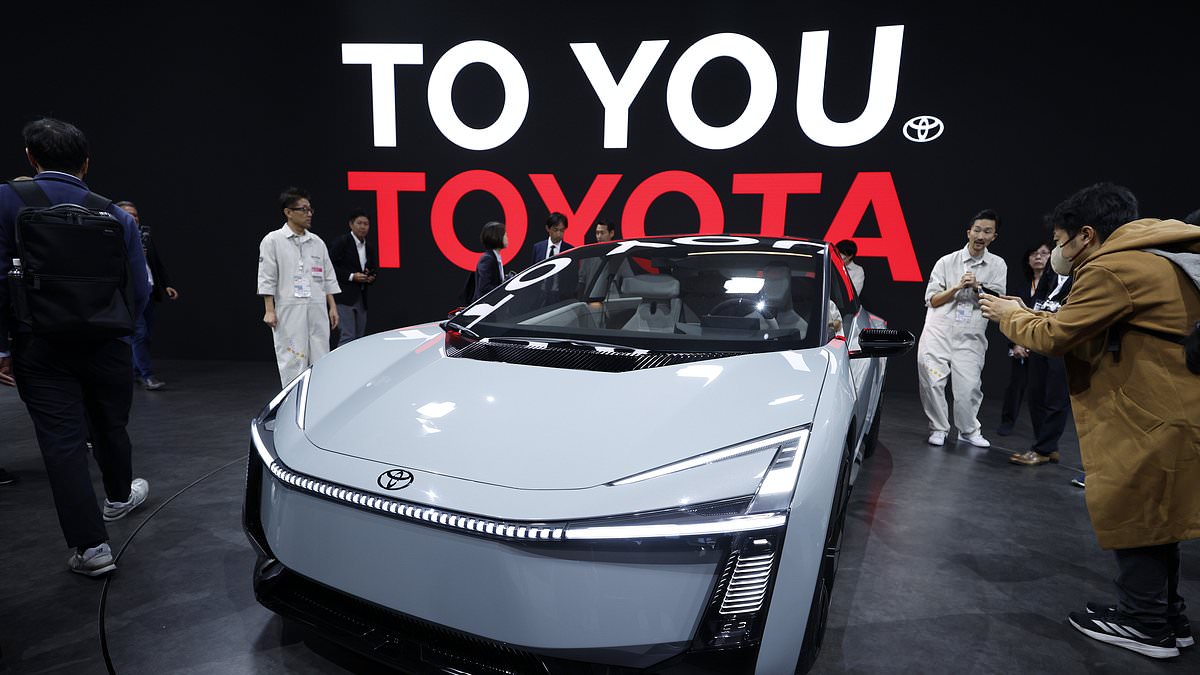
Lale Akoner says: ‘With an ongoing investment in next-generation batteries, Toyota offers investors an appealing mix of income, resilience and value among global blue-chip stocks’
With Japan now a haven of dividend income, eToro’s Lale Akoner, likes Toyota Motors, which offers a dividend yield of 2.9 per cent.
Akoner, the trading platform’s global market analyst, says: ‘Its shares trade well below many auto sector rivals, reflecting investor caution over its slower transition to full electric vehicles.
‘Yet Toyota’s hybrid-led strategy continues to deliver strong cash flows, helping support an attractive dividend.’
She adds: ‘With an ongoing investment in next-generation batteries, Toyota offers investors an appealing mix of income, resilience and value among global blue-chip stocks.’
MAY THIS TRUST’S 100TH BIRTHDAY RESULT IN MANY HAPPY RETURNS
Deadlines permitted, I hope to rock up at the London Stock Exchange on Thursday to clock the 100th birthday of investment trust Finsbury Growth & Income (FG&I).
This £974 million fund, which invests in UK companies with an income bent, started life as Scottish Cities in 1926.
Since the end of 2000, it has been run by Nick Train, one of the country’s most successful investment managers.
Train, often heralded as the UK’s answer to legendary 95-year-old US investor Warren Buffett (just retired), has improved the long-term wealth of hundreds of thousands of investors over the years. Not only at FG&I, but other funds run by his investment company Lindsell Train. Like Buffett, he is a long-term investor.
In the 1980s and 1990s, Train also made money for investors in UK funds he ran for GT Investment Management (a business no more).
Indeed, it was at GT where I first met him, and was struck (and impressed) by his intensity and modesty. I’ve followed his career ever since.
Thursday’s centenary celebration will be co-ordinated by FG&I chairman Pars Purewal, a City stalwart. He will hot-foot it from the trust’s annual general meeting at London’s Guildhall to ‘ring’ the bell at the London Stock Exchange – located in the shadow of St Paul’s Cathedral – which will mark the stock market’s closure for the day. Train will be there as well.
Although I am told the ‘celebration’ will be low-key in light of FG&I’s recent poor investment performance, I do hope that the event will be more joyous than funereal – focusing more on the long-term (which is what investing is all about) than the short-term.
Ahead of the trust’s birthday, I was sent a booklet written about the fund’s first 100 years by investment historian John Newlands. It makes for interesting reading, especially the section devoted to the audacious 1953 ‘takeover’ of the trust by banking firm Rea Brothers.

Richard Hunter, head of markets at Interactive Investor, is a fan of French drinks giant Pernod Ricard, which owns famous brands such as Absolut vodka, Malibu rum and Jameson whiskey
For investment trust nerds like me, it chimes with the ongoing attempt by US hedge fund manager Saba Capital to take control of trust Edinburgh Worldwide. (Note to Edinburgh shareholders: vote to stop Saba ahead of the requisitioned general meeting on Tuesday week.)
Yet it’s Newlands’ examination of Train’s investment record at FG&I which is most fascinating – and that I implore any edgy shareholder to examine.
Over the 25 financial years (each to the end of September) that Train has run the fund, it has outperformed the FTSE
All-Share Index on 17 occasions – underperforming in eight. That’s impressive.
For the 25 years to the end of September 2025 (the last full financial year), the trust’s share price grew by 733 per cent, compared to a 303 per cent return from the FTSE All-Share Index.
Yet, for the time being, Train is stuck in an investment rut, and I am sure that many shareholders are disappointed.
Five of the eight years of the trust underperforming the market have come in the past five financial years. The recent numbers are awful. A total return over the past five years of just 2.8 per cent compares with an average for its UK equity income peer group of 50.9 per cent.
The only consolation is an annual dividend that has grown from 16.6p a share in the year to September 30, 2020 (when it was frozen in response to Covid-19 and lockdowns) to 20.2p in the last year.
The trust is awash with quality UK companies: the likes of fashion firm Burberry, drinks giant Diageo, credit reference agency Experian, software business Sage and Unilever.
However, some of their share prices have gone nowhere.
For example, Diageo’s share price has fallen 47 per cent in the past five years.
Newlands ends his history of FG&I with a comment from Train on the trust’s future. The manager doesn’t hold back, saying he is ‘more enthused’ about the fund’s prospects than at ‘any time this century’.
He describes the fund’s holdings as ‘genuinely world-class companies with substantive growth opportunities in front of them’.
He adds: ‘If our analysis of them is right, the impact on returns in the coming years will be very significant.’
As Newlands told me on Friday, this 100-year-old trust has survived stock market crashes and one world war – and will come good again.
Shareholders should hang on in there and trust Train to turn things around. Investors looking for exposure to a stock market on the march could do far worse than dripping some money into FG&I on a monthly basis.
Meanwhile, those interested in the fund’s history can download a copy at: finsburygt.com